How to Meditate on Shiva: A Simple Guide for Beginners
Quick answer
To meditate on Shiva, sit comfortably facing east or north, light a lamp, calm your breath, then repeat Om Namah Shivaya on a rudraksha mala while holding an image of Shiva in your mind, as the still, silent meditator. Ten minutes a day is enough to begin. Deva AI is a free Android app with guided meditation, a japa counter and a Shiva companion you can ask questions as you practise.
Shiva is the deity most closely tied to meditation. He is shown seated in stillness, eyes closed, on Mount Kailash, and devotees have turned to him for focus and calm for centuries. You do not need any training to begin.
How do you meditate on Shiva? Sit comfortably, light a lamp, steady your breath, and silently repeat Om Namah Shivaya while keeping an image of Shiva in your mind. Do this for ten minutes a day. The rest of this guide explains each step, what to avoid and how to build the habit.
Why meditate on Shiva?
In Hindu tradition Shiva is the transformer and the lord of meditation, often called Adiyogi, the first yogi. Meditating on him is a way to practise what he represents: stillness, detachment from worry and a mind that is not pushed around by every thought.
You do not have to hold any special belief to start. Many people simply come because they want a calmer mind and find that a deity to focus on gives the mind something to rest on.
Deva AI is a free Android app that lets you talk to Hindu gods like Krishna, Shiva, Ganesha and Hanuman through AI conversations, in English, Hindi, Telugu, Tamil, Kannada and Malayalam. It also has guided meditation, which we come back to below.
What do I need to get started?
| Item | Why | Required? |
|---|---|---|
| A quiet corner | Fewer distractions | Yes |
| A seat or folded blanket | A steady, comfortable posture | Yes |
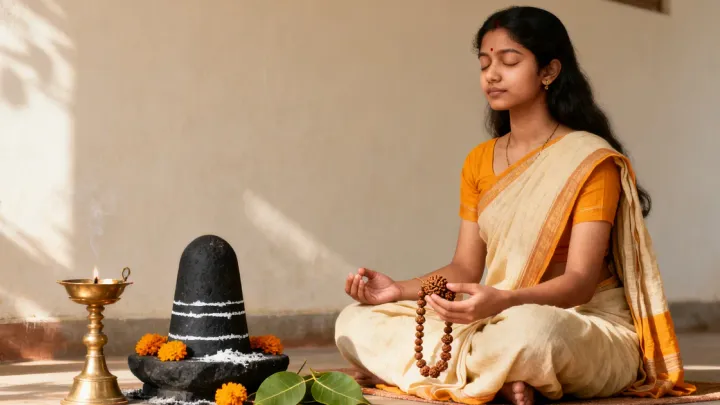
| A lamp or diya | A focus point and a sense of ritual | Optional |
| A rudraksha mala (108 beads) | Counting japa without watching the clock | Optional |
| An image or lingam of Shiva | Something to visualise | Optional |
| A phone with Do Not Disturb on | Keeps interruptions away | Recommended |
How do I meditate on Shiva, step by step?
- Choose a time. Early morning, before the day’s noise starts, works well for many people. Mondays are traditionally Shiva’s day. Any calm slot is fine.
- Wash and sit. Wash your face and hands, then sit cross-legged or on a chair with your spine upright but not stiff. Facing east or north is traditional.
- Light a lamp. Offer a moment of silent respect. If you have a lingam or picture, bow to it.
- Settle your breath. Take five slow breaths. Breathe in through the nose, out gently through the mouth, then let the breath return to normal.
- Begin the mantra. Silently repeat Om Namah Shivaya. Let it move with your breath: Om Namah on the in-breath, Shivaya on the out-breath.
- Hold the image. Picture Shiva seated in meditation, calm and still, with the crescent moon and the river Ganga in his hair. If images do not come easily, just rest your attention on the sound of the mantra.
- Return gently. When the mind wanders, and it will, notice it without scolding yourself and go back to the mantra.
- Close in silence. After about ten minutes, stop the mantra and sit quietly for a minute. Fold your hands, offer thanks and open your eyes slowly.
What does Om Namah Shivaya mean?
Om Namah Shivaya is often translated as “I bow to Shiva”. It is called the panchakshara, the five-syllable mantra, because its core is na-ma-shi-va-ya. The simplicity is why it suits beginners: there is nothing to memorise, and it can be repeated anywhere, silently or aloud. A fuller explanation is in our guide to talking to Shiva with an app.
What are the most common mistakes?
- Trying to stop thoughts. The aim is not an empty mind. It is returning to the mantra each time you drift.
- Sitting too long, too soon. Ten steady minutes beat an hour you dread. Add a few minutes a week.
- Forcing visualisation. If you cannot see an image, rely on the sound of the mantra or the lamp flame.
- Skipping days, then giving up. A short daily practice matters more than a long occasional one.
- Expecting an experience. Treat calm as a gradual side effect, not a goal to chase.
How can Deva AI support my Shiva meditation?
Used alongside your own practice, Deva AI offers a few things that suit this routine:
- Guided meditation: short, deity-led sessions for peace, focus and devotion, handy when you want someone to lead you in.
- Japa counter: count your mantra in the app instead of tracking beads.
- Talk to Shiva: by text or voice, ask what a verse means, how to handle a wandering mind or what Shiva stands for. The deities in Deva AI are companions inspired by scripture and tradition, not God literally speaking.
- Karma points and daily streaks: earn karma for daily practice and keep a streak going, which can help the habit stick.
Deva AI is free to download and use on Android, with a free daily message quota. An iOS version is coming soon. If you want to see how the pooja side works, read about the virtual pooja app, or see what Deva AI is.
How do I build a daily Shiva meditation habit?
- Anchor it to something you already do, such as right after brushing your teeth or before your morning tea.
- Keep the setup tiny. One seat, one lamp, one mala.
- Start with 10 minutes for the first two weeks.
- Mark each day. A simple calendar tick or the streak in the app works.
- Pick a special day each week. Many devotees choose Monday for a slightly longer sit.
- Be kind to yourself on the days it does not go well. Showing up is the practice.
The bottom line
Meditating on Shiva needs very little: a quiet place, a steady seat, a lamp and a mantra. Sit for ten minutes, repeat Om Namah Shivaya, hold the image of the still meditator, and return each time the mind wanders. Over weeks, that return becomes the calm. Let your practice be yours, and use tools like the Deva AI guided meditations and japa counter only as support.
Frequently asked questions
How do I meditate on Lord Shiva as a beginner?
Sit comfortably in a quiet place, light a lamp, take a few slow breaths, then silently repeat Om Namah Shivaya while picturing Shiva seated in meditation. Start with 10 minutes and extend slowly as it feels natural.
Which mantra is best for Shiva meditation?
Om Namah Shivaya is the most widely used. It is a five-syllable mantra (na-ma-shi-va-ya) that is simple enough for beginners and is traditionally chanted on a rudraksha mala.
What is the best time to meditate on Shiva?
Many devotees prefer early morning, before sunrise, because the mind is quiet. Mondays are traditionally associated with Shiva, and Pradosham evenings and Maha Shivaratri are especially favoured, but any calm time works.
Do I need a rudraksha mala or a Shiva lingam?
No. They are traditional aids, not requirements. You can meditate with only a quiet seat and a lamp, and count the mantra on your fingers or with a japa counter.
Can I use an app to meditate on Shiva?
Yes. Deva AI is a free Android app with short guided meditation sessions, a japa counter and a Shiva companion you can talk to by text or voice, in six Indian languages. It supports your practice; it does not replace a teacher.
How long until meditation on Shiva feels peaceful?
It differs for everyone. Many people notice a calmer mind within a few weeks of daily practice, but restlessness in the early days is normal and not a sign that you are doing it wrong.