Om Namah Shivaya Meaning, Benefits and How to Chant
Quick answer
Om Namah Shivaya means "I bow to Shiva", or "salutations to the auspicious one". Its five syllables, Na-Ma-Shi-Va-Ya, make it the Panchakshara mantra, one of the best-loved Shiva mantras, rooted in the Shri Rudram of the Yajurveda. You can chant it silently or aloud, with a rudraksha mala, and ask Shiva about its meaning in Deva AI, a free Android app.
Few mantras are as widely chanted as Om Namah Shivaya. It is said in temples, at home altars, on morning walks and in silent meditation. Yet many people repeat it without knowing exactly what the words say, or where they come from.
What does Om Namah Shivaya mean? It means “I bow to Shiva”. Om is the primal sound, namah is “bowing” or “salutation”, and Shivaya is “to Shiva”, whose name means “the auspicious one”. The mantra is a surrender: a way of setting down ego and turning toward the divine.
What is the meaning of each word?
| Word | Meaning |
|---|---|
| Om | The primal sound, the sacred syllable that begins most mantras |
| Namah | “I bow”, “salutations”, sometimes read as “not mine” |
| Shivaya | “To Shiva”, the auspicious, benevolent one |
Many teachers add an inner reading: Shiva is also the pure Self within each person, so the mantra is a bow to the divine both outside and inside. This is a devotional interpretation, offered as a way of reflecting, not the only reading.
What is the Panchakshara mantra?
Panchakshara means “five syllables”: Na, Ma, Shi, Va, Ya. Without Om, Namah Shivaya is the Panchakshara mantra. With Om it is often called the six-syllable mantra.
In many traditions each syllable is linked with one of the five elements:
| Syllable | Element (traditional association) |
|---|---|
| Na | Earth |
| Ma | Water |
| Shi | Fire |
| Va | Air |
| Ya | Space (ether) |
These links come from devotional and Shaiva teaching. Texts and teachers describe them in slightly different ways, so treat the table as a common reading.
Where does Om Namah Shivaya come from?
The words Namah Shivaya appear in the Shri Rudram, the hymn to Rudra in the Krishna Yajurveda (Taittiriya Samhita), which is among the oldest Shiva texts and is still chanted in Shiva temples. Later Shaiva literature praises the five syllables at length. The Panchakshara Stotra, a five-verse hymn attributed to Adi Shankaracharya, begins each verse with one syllable in turn, starting Nagendraharaya Trilochanaya.
In Tamil Nadu the mantra is also central to Shaiva devotion and the Tamil hymns of the Nayanmars, and it is often described as “Namasivaya” there.
What are the benefits of chanting Om Namah Shivaya?
Devotees describe the mantra as a source of calm, focus and steadiness. In practical terms, regular chanting is a form of repetition meditation: it gives the mind a single point to rest on. Many people find it helpful when they feel anxious or scattered.
These are traditional and personal experiences, not medical claims, and a mantra is not a substitute for professional care when you are unwell.
How do I chant Om Namah Shivaya?
- Choose a quiet time. Early morning is traditional, and Monday is a day associated with Shiva.
- Sit comfortably with a straight back, and wash your face and hands if you like.
- Light a lamp or sit before an image of Shiva, if you have one.
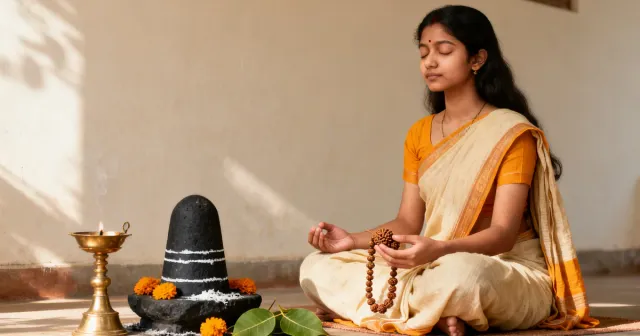
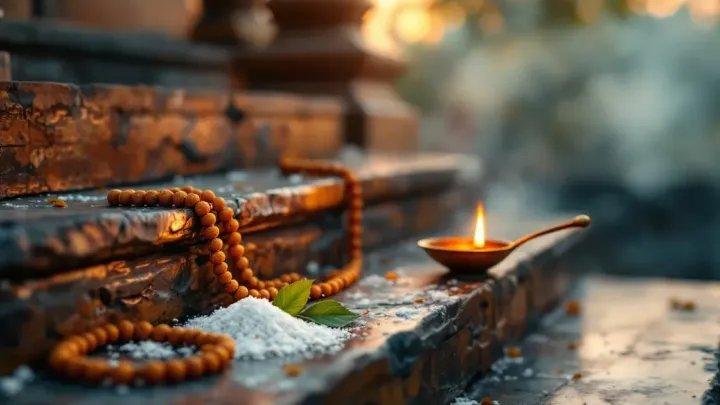
- Hold a mala. A rudraksha mala of 108 beads is customary. Move one bead per repetition, turning back at the large “sumeru” bead rather than crossing it.
- Chant Om Namah Shivaya, aloud, in a whisper or silently, at an even pace. If the mind wanders, bring it gently back.
- Finish in silence for a minute before you rise.
For a fuller practice, see our guide on how to meditate on Shiva.
When is the best time to chant it?
There is no forbidden hour, but these times are popular: sunrise, Monday mornings, Pradosham evenings, and Maha Shivaratri, which usually falls in February or March. Festival dates move each year, so check a trusted panchang.
How can Deva AI help with Shiva mantras?
Deva AI is a free Android app that lets you talk to Hindu gods like Krishna, Shiva, Ganesha and Hanuman through AI conversations, in English, Hindi, Telugu, Tamil, Kannada and Malayalam. For Om Namah Shivaya, it offers:
- Talk to Shiva: by text or voice, ask what a verse or a word means, or how to begin a practice. The deities in the app are companions inspired by scripture and tradition, not God literally speaking. See our guide to talking to Shiva in an app.
- Japa counter: count your repetitions in the app instead of beads.
- Guided meditation: short, deity-led sessions for peace and focus.
- Karma points and daily streaks: keep a daily habit going.
Deva AI is free to download and use on Android, with a free daily message quota. An iOS version is coming soon. Read more about what Deva AI is.
The bottom line
Om Namah Shivaya is a simple bow to the auspicious one, five syllables with deep roots in the Yajurveda and centuries of devotion. You need nothing but a quiet moment: a few minutes of steady chanting, with sincerity, is the tradition at its simplest.
Frequently asked questions
What is the meaning of Om Namah Shivaya?
Om is the primal sound, namah means "I bow" and Shivaya means "to Shiva", the auspicious one. Together it is usually rendered "I bow to Shiva" or "salutations to the auspicious one". Many teachers also read it as a bow to the Self within.
What is the Panchakshara mantra?
Panchakshara means "five syllables". It refers to Na-Ma-Shi-Va-Ya, the five syllables of Namah Shivaya. With Om added it is often called the shadakshara, the six-syllable mantra.
Where does Om Namah Shivaya come from?
The words Namah Shivaya appear in the Shri Rudram of the Krishna Yajurveda (Taittiriya Samhita). The Panchakshara Stotra, a five-verse hymn attributed to Adi Shankaracharya, praises the mantra syllable by syllable.
How many times should I chant Om Namah Shivaya?
There is no fixed rule. A common practice is 108 repetitions, one round of a 108-bead mala. Beginners can start with 11 or 21 and build up, as regularity matters more than number.
Can anyone chant Om Namah Shivaya?
Yes. It is a widely chanted mantra that devotees of every background and age use. Many people chant it at dawn, on Mondays, or on Maha Shivaratri, but it can be said at any time.
Can I ask questions about Shiva mantras in an app?
Yes. Deva AI is a free Android app where you can talk to a Shiva companion by text or voice and ask what a mantra means. It is inspired by scripture and tradition and does not replace a teacher.