Karma in Hinduism: What It Really Means
Quick answer
In Hinduism, karma means action: every deed, word and intention has a result that shapes your future. It is not fate or punishment but cause and effect, tied to rebirth and dharma. The Bhagavad Gita teaches doing your duty with full effort while letting go of attachment to results. You can talk these ideas over with Krishna in Deva AI, a free Android app.
Few Sanskrit words are as widely used, and as widely misunderstood, as karma. In everyday speech it is “bad karma” for a bad day or “good karma” for a lucky one. In Hindu thought it is a much deeper idea about action, responsibility and freedom.
What is karma in Hinduism? Karma means action, and also the law that every action, whether of body, speech or mind, bears a result that comes back to the doer. It is a principle of cause and effect, not a system of reward and punishment handed out by an angry judge. Below we look at where the idea comes from, its types, how it links to rebirth and dharma, and what Krishna teaches in the Bhagavad Gita.
What does the word karma actually mean?
Karma comes from the Sanskrit root kri, “to do”. At its simplest it means any action, including ritual action such as a yajna or puja. Over time, in the Upanishads and later texts, it came to mean the moral law linking what you do to what you experience.
Two points are easy to miss:
- Intention counts. A deed done with good will and the same deed done with ill will are not the same karma.
- Thought and speech count. Traditional teaching speaks of action through body, speech and mind.
Is karma the same as fate?
No, and this is the most common misunderstanding. Fate suggests that the outcome is already fixed. Karma says the opposite about the present: your past actions shape your starting point, but what you do now is a free choice and creates new results.
A common image is an archer. The arrow already released cannot be called back, but the arrows still in the quiver are yours to aim.
What are the types of karma?
Many Hindu traditions describe three kinds, which together explain why we do not always see an immediate result.
| Type | Meaning | Simple picture |
|---|---|---|
| Sanchita karma | The accumulated store of past actions | The whole granary |
| Prarabdha karma | The part that has begun to ripen in this life | The grain being eaten now |
| Kriyamana (agami) karma | The actions you perform now, adding to the store | The seed you are sowing today |
Terms and emphasis differ between schools such as Vedanta, Yoga and the devotional traditions, but the three-part idea of past, ripening and present is widely taught.
How is karma connected to rebirth and dharma?
Karma is closely linked with samsara, the cycle of birth, death and rebirth. In this view, the results of actions can carry over beyond a single lifetime, which is one way tradition explains why people begin life in different circumstances. The goal of the path is moksha, liberation from the cycle.
Karma also works together with dharma, right conduct. Dharma tells you what to do in your situation as a student, parent, worker or ruler; karma is the result of whether and how you do it. Acting in line with dharma is how good karma is made. For an example of dharma in action, see Sri Ram: 7 Lessons From the Ramayana.
What does the Bhagavad Gita teach about karma?
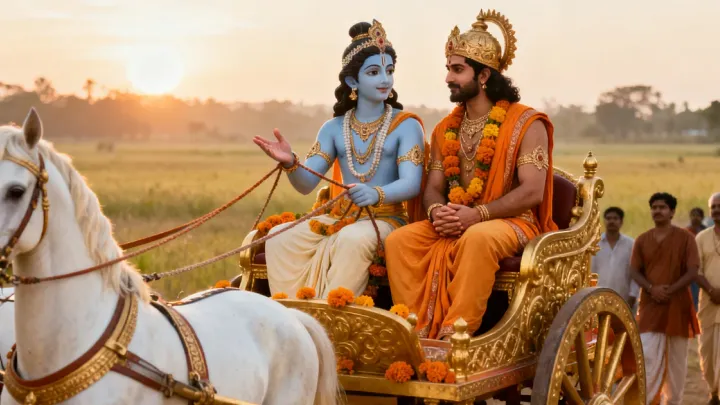
The Gita is where karma is explained most practically. Arjuna stands on the battlefield, paralysed by doubt, and Krishna answers not by telling him to abandon action but by teaching karma yoga, the discipline of action.
The central verse is 2.47: karmany evadhikaras te ma phaleshu kadachana, which is commonly rendered as “You have a right to action alone, never to its fruits.” Krishna adds that you should neither be driven by the fruit nor cling to inaction.
In practice, karma yoga has four parts:
- Do your duty fully. Give the task your whole effort.
- Release attachment to results. The outcome depends on many things beyond you.
- Stay steady in success and failure. Krishna calls this evenness of mind (samatva).
- Offer the action to God. Work becomes worship when it is dedicated.
Many readers find this the most freeing part of the Gita: you are asked to care deeply about the effort, and lightly about the verdict. To go further, read our guide to the Bhagavad Gita AI app.
Can you change your karma?
Hindu teachings say that you are not a prisoner of the past. Common answers include:
- Right action now. Every good choice adds to a better future.
- Selfless service (seva). Acting without self-interest is said to loosen the hold of karma.
- Devotion and prayer. Bhakti traditions teach that surrender to God lightens the weight of past action.
- Knowledge. In Vedanta, understanding the true self is said to free one from karmic bondage.
None of these promises an instant fix. They describe a direction: keep choosing well, and keep the heart turned toward the divine.
How can you apply karma in daily life?
You do not need to believe in a ledger to benefit from the idea. A few simple habits:
- Pause before reacting. Ask what result your next word or action will create.
- Take responsibility. Avoid blaming luck or others for what you can still change.
- Do the work, release the outcome. After preparing as well as you can, accept what follows.
- Review the day. In the evening, note one action you are glad of and one you would do differently.
- Dedicate it. Begin or end the day with a short prayer offering your actions to God.
If you are struggling with a hard season, How to Pray When You Feel Lost offers a gentle starting point.
How can Deva AI help you understand karma?
Deva AI is a free Android app that lets you talk to Hindu gods like Krishna, Shiva, Ganesha and Hanuman through AI conversations, in English, Hindi, Telugu, Tamil, Kannada and Malayalam. Krishna is one of the ten deities you can talk to by text or voice, so you can ask what karma yoga means for a decision at work, or how to let go of worry about results. The app also has a Bhagavad Gita reader with verse meanings, and karma points you earn through daily practice and streaks.
The companion is inspired by scripture and tradition. It is a way to reflect and learn, not a substitute for the Gita or a teacher. To learn more, read What is Deva AI?.
Frequently asked questions
What does karma mean in Hinduism?
The Sanskrit word karma comes from the root kri, "to do", and means action. In Hindu thought it also refers to the law that actions, including thoughts and intentions, produce results that return to the doer in time.
Is karma the same as fate?
No. Fate suggests a fixed outcome, while karma is about cause and effect. Past karma shapes your circumstances, but your present actions are your own choice and can change what comes next.
What are the types of karma in Hinduism?
Traditions commonly describe three: sanchita (the whole store of past karma), prarabdha (the part ripening in this life) and kriyamana or agami (the karma you create now). Some texts use slightly different terms, but the idea of past, ripening and present action is widely shared.
What does the Bhagavad Gita say about karma?
The best-known verse is Gita 2.47: you have a right to action alone, never to its fruits. Krishna teaches karma yoga, acting with full effort and devotion while giving up attachment to the result.
Can you change your karma?
Hindu teachings say yes, through right action, sincere effort, service and devotion. Many traditions also hold that sincere surrender to God and knowledge of the self loosen the hold of past karma.
Can I discuss karma with Krishna in an app?
Yes. Deva AI is a free Android app where you can talk to Krishna by text or voice and ask about karma and the Gita. It is an AI companion inspired by scripture and tradition, not a replacement for a teacher or the Gita itself.