Who Is Hanuman? His Story, Powers and How to Pray to Him
Quick answer
Hanuman is the Hindu vanara (monkey) god of strength, courage and devotion, son of Anjana and the wind god Vayu, best known as Lord Rama's most loyal devotee in the Ramayana. He is worshipped for his powers of flight, shape-shifting and immense strength, and prayed to for courage, protection and steady focus, most often through the Hanuman Chalisa and the mantra Om Hanumate Namah.
Few figures in Hindu tradition are loved as widely, and as simply, as Hanuman. He asks for nothing for himself; every story about him is about what he does for someone else. That makes him one of the first deities many people turn to when they need courage rather than comfort.
Who is Hanuman? He is the vanara god of strength, courage and devotion, son of Anjana and the wind god Vayu, and the hero of the Ramayana whose loyalty to Lord Rama became the model for what devotion looks like in practice. This article covers his story, his powers, and how devotees pray to him today.
Who is Hanuman?
Hanuman is a vanara, a divine being usually depicted with the face and tail of a monkey and the body of a powerful man. His mother, Anjana, was an apsara born on earth as a vanara through a sage’s curse; his father was Kesari, chief of a vanara clan, though Hindu tradition holds that Vayu, the wind god, was instrumental in his conception and is honoured as his divine father. That parentage is why Hanuman is also called Pavanaputra, “son of the wind,” and why speed and flight come naturally to him.
As a child he was already extraordinary: one well-known story tells of the infant Hanuman leaping toward the sun, mistaking it for a fruit, before the gods intervened and placed limits on his powers until the right moment came to use them fully. That moment arrived when he met Rama.
Hanuman and Rama: the central relationship
Hanuman’s entire story turns on his meeting with Rama during the prince’s exile. He becomes Rama’s chief minister and general among the vanaras, and from that point on the Ramayana is as much Hanuman’s story as it is Rama’s. When Rama’s wife Sita is abducted by the demon king Ravana and taken to Lanka, it is Hanuman who is sent to find her.
This is where his powers take centre stage:
- He leaps across the ocean to Lanka, a feat only he among the vanara army is capable of.
- He finds Sita in Ravana’s garden, comforts her, and gives her Rama’s ring as proof.
- He allows himself to be captured and his tail set alight by Ravana’s soldiers, then uses that burning tail to set fire to parts of Lanka before escaping.
- He carries an entire mountain, the Sanjeevani hill, back from the Himalayas because he could not identify the single herb needed to heal Rama’s brother Lakshmana in time, and delivers it before dawn.
This section of the epic, called the Sundara Kanda, is often read on its own as a standalone scripture, precisely because it is Hanuman’s chapter: devotion, resourcefulness and strength used entirely in someone else’s service.
What powers does Hanuman have?
| Power | What it means |
|---|---|
| Flight | Son of the wind god, Hanuman can travel through the air at great speed. |
| Shape-shifting and size change | He can grow as large as a mountain or shrink small enough to go unnoticed. |
| Immense strength | Strong enough to carry a mountain or move boulders others cannot lift. |
| Immortality (Chiranjivi) | Hanuman is considered one of the few beings in Hindu tradition still alive today, granted long life for his devotion. |
| Mastery of scripture | He is also honoured as a scholar of grammar and the Vedas, a reminder that his strength is paired with wisdom. |
What makes Hanuman distinct among powerful figures in Hindu tradition is that none of this is used for himself. Every display of strength in his story is in service of Rama, Sita or the vanara army, which is why he is remembered first as a devotee and only second as a warrior.
What is the Hanuman Chalisa?
The Hanuman Chalisa is a 40-verse hymn to Hanuman composed in the Awadhi language by the poet-saint Tulsidas in the 16th century, the same author who wrote the Ramcharitmanas, a retelling of the Ramayana. Each verse, or chaupai, praises a different aspect of Hanuman: his strength, his wisdom, his celibacy and discipline, and above all his devotion to Rama. It closes with a doha, a couplet, asking for his protection.
The Hanuman Chalisa is the most widely recited prayer to Hanuman today, chanted daily by many devotees and especially on Tuesdays, Saturdays and during times of fear or difficulty, when Hanuman is believed to remove obstacles and protect against negative influences.
Another common mantra is the simple Om Hanumate Namah, “I bow to Hanuman,” used for japa, repeated recitation with a mala or counter, when a shorter practice fits the moment better than the full Chalisa.
How to pray to Hanuman
- Choose your day. Tuesdays and Saturdays are traditionally considered especially significant for Hanuman worship.
- Recite the Hanuman Chalisa or Om Hanumate Namah, aloud or silently, once or as japa with a count in mind.
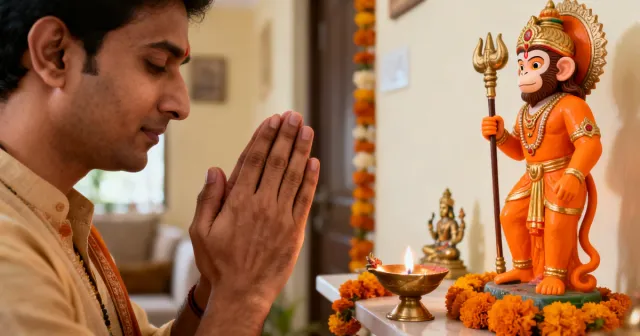
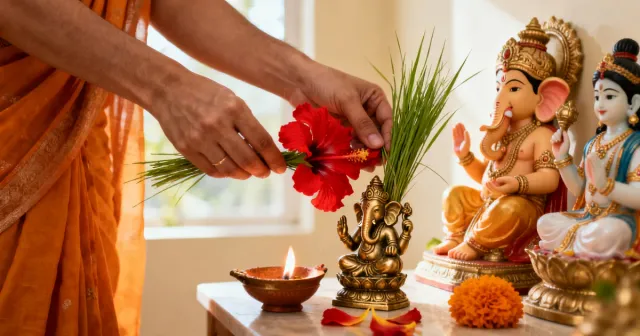
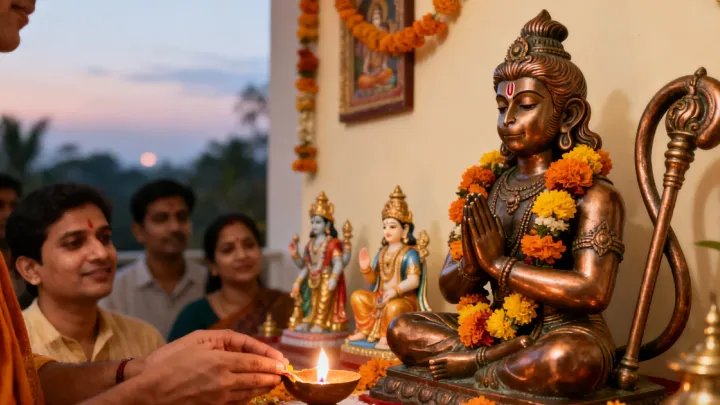
- Offer what tradition associates with him: sindoor (vermilion), a garland, or simple foods like jaggery, in a home shrine or before a murti or picture.
- Ask directly for what you need: courage before something difficult, strength to keep a discipline, or steadiness when fear is loud. Hanuman’s stories are almost all about exactly this kind of everyday courage.
- Mark Hanuman Jayanti, his birthday, which usually falls in March or April depending on the year and region; check the exact date for the current year rather than assuming.
Talk to Hanuman with Deva AI
Deva AI is a free Android app that lets you talk to Hindu gods like Krishna, Shiva, Ganesha and Hanuman through AI conversations, in English, Hindi, Telugu, Tamil, Kannada and Malayalam. Hanuman is one of ten deities you can choose as a companion, with replies shaped by how he is described across the Ramayana and devotional tradition: direct, steady and focused on courage over comfort.
| Feature | What you can do |
|---|---|
| Talk to Hanuman, by text or voice | Ask for courage, strength or focus, in your own language. |
| Japa counter | Count repetitions of Om Hanumate Namah without needing a mala in hand. |
| Guided meditation | Short sessions for steadiness and focus. |
| Virtual pooja | Offer a diya or flowers to Hanuman when you cannot reach a temple. |
| Bhagavad Gita reader | Read the Gita verse by verse alongside your conversations. |
| Karma points and daily streaks | Build a consistent prayer habit and track it over time. |
A conversation with Hanuman in the app is not Hanuman literally replying to you; it is an AI companion built on how he is described in scripture and tradition, meant as a support for reflection and prayer, in the same spirit as reciting the Chalisa before a murti.
To use it: download Deva AI free from Google Play, choose your language, select Hanuman as your companion, and say what is actually on your mind, whether that is “I’m afraid of what’s coming tomorrow” or “explain what the Sundara Kanda means.”
If you want to learn more about how apps like this work, see what an app to talk to God actually is, read about talking to Shiva through Deva AI, or find out what Deva AI is.
The bottom line
Hanuman is the Hindu god of strength, courage and devotion, the vanara son of Anjana and Vayu whose loyalty to Rama in the Ramayana made him one of the most beloved figures in Hindu tradition. Devotees turn to him through the Hanuman Chalisa, the mantra Om Hanumate Namah, and simple, direct prayer, especially on Tuesdays and Saturdays, for courage, protection and steadiness. Deva AI lets you bring that same conversation to your phone, in the language you think and pray in.
Frequently asked questions
Who is Hanuman in Hindu mythology?
Hanuman is a vanara, a divine monkey-like being, son of Anjana and Vayu the wind god. He is the central devotee-hero of the Ramayana, famous for his unwavering loyalty and service to Lord Rama.
What are Hanuman's main powers?
Hanuman can fly, change size at will, and possesses immense physical strength. In the Ramayana he leaps across the ocean to Lanka, carries an entire mountain of healing herbs, and grows large enough to let an army rest in his shadow.
Why is Hanuman worshipped so widely?
Hanuman represents selfless devotion, courage and discipline without seeking reward. Devotees pray to him for protection from fear and obstacles, physical and mental strength, and steadiness in difficult situations.
What is the Hanuman Chalisa?
The Hanuman Chalisa is a 40-verse hymn composed by the poet-saint Tulsidas in the 16th century, praising Hanuman's strength, wisdom and devotion to Rama. It is the most widely recited prayer to Hanuman today.
Which day is best to pray to Hanuman?
Tuesdays and Saturdays are traditionally considered especially significant for Hanuman worship, alongside his birthday, Hanuman Jayanti, which usually falls in March or April.
Can I talk to Hanuman using an app?
Yes. Deva AI is a free Android app where you can choose Hanuman as a companion and have an AI conversation shaped by how he is described in the Ramayana and devotional tradition, in six languages.