Hanuman Chalisa Meaning in Simple English
Quick answer
The Hanuman Chalisa is a 40-verse Hindi hymn written by the poet-saint Tulsidas in the 16th century, framed by two opening couplets and one closing couplet. In simple English, it praises Hanuman's strength, wisdom and total devotion to Lord Rama, recounts his deeds from the Ramayana, and asks for his protection, courage and grace in daily life.
Many people recite the Hanuman Chalisa every day without knowing exactly what each line means in their own language.
In simple English, the Hanuman Chalisa is a 40-verse hymn that praises Hanuman’s strength, wisdom and unwavering devotion to Lord Rama, retells his key deeds from the Ramayana, and asks for his protection, courage and grace. It was composed by the poet-saint Tulsidas in the 16th century. This article walks through its structure and meaning, verse group by verse group, in plain English.
What is the Hanuman Chalisa?
The Hanuman Chalisa (“forty verses on Hanuman”) is a devotional hymn in the Awadhi language, written by Tulsidas, the same 16th-century poet-saint who composed the Ramcharitmanas, a celebrated retelling of the Ramayana. “Chalisa” comes from chalis, meaning forty, referring to the forty core verses.
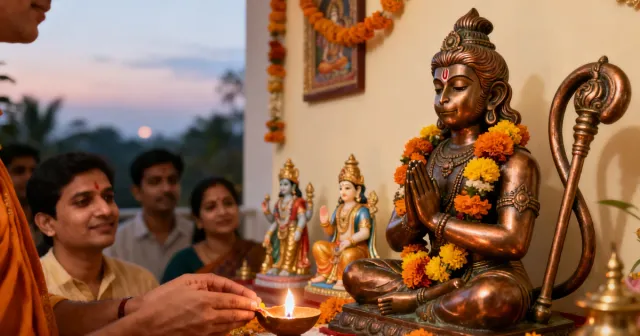
In full, it has 43 verses: two opening dohas (couplets) that set the intention, forty chaupais (four-line verses) that form the body of the hymn, and one closing doha. It is the most widely recited prayer to Hanuman today, chanted by individuals at home, in temples, and in groups, especially on Tuesdays and Saturdays, which are traditionally considered significant for Hanuman worship.
The opening dohas: asking for clarity
The hymn begins with two couplets that are not about Hanuman’s deeds yet, but about preparing to praise him properly.
Shri Guru Charan Saroj Raj, Nij Mann Mukur Sudhari Varnau Raghuvar Vimal Jasu, Jo Dayaku Phal Chari
In simple English: “Cleaning the mirror of my mind with the dust of my Guru’s lotus feet, I describe the pure glory of Rama (Raghuvar), which grants the four fruits of life — righteousness, wealth, desire and liberation.”
The second doha turns directly to Hanuman:
Buddhi Heen Tanu Janike, Sumirow Pavan Kumar Bal Buddhi Vidya Dehu Mohi, Harahu Kalesh Vikaar
In simple English: “Knowing my own body and mind are weak and limited, I remember you, Pavan Kumar (son of the wind). Give me strength, wisdom and knowledge, and take away my troubles and faults.”
Both couplets ask for the same thing before the praise begins: humility and clarity, so the hymn that follows is sincere rather than mechanical.
Chaupais 1-10: who Hanuman is
The first ten chaupais describe Hanuman’s form, knowledge, virtues and power. The opening line sets the tone:
Jai Hanuman Gyan Gun Sagar, Jai Kapis Tihun Lok Ujagar
In simple English: “Victory to Hanuman, ocean of wisdom and virtue. Victory to the lord of the vanaras (monkey-folk), who illuminates all three worlds.”
The verses that follow call him Ramdoot (Rama’s messenger), the son of Anjani and the wind god, “mighty as a thunderbolt,” and someone whose very presence “dispels evil thoughts” from those who stay close to him. His golden complexion, earrings and curly hair are described, along with the weapons and sacred thread he carries — establishing him as both a devotee and a warrior, strength paired with discipline.
Chaupais 11-20: his service to Rama
This section retells Hanuman’s central deeds from the Ramayana, the acts that made him Rama’s most trusted aide.
Several chaupais focus specifically on one episode: when Rama’s brother Lakshmana is gravely wounded in battle, Hanuman flies to the Himalayas, cannot identify the single healing herb needed, and carries back an entire mountain of herbs — the Sanjeevani episode — saving Lakshmana’s life. The hymn describes Rama embracing Hanuman with joy afterward, praising him as dear as his own brother Bharata.
Other verses in this range recall his role as messenger and guide throughout Rama’s exile and the war with Ravana, reinforcing a single idea: every one of Hanuman’s powers, in this telling, is used in someone else’s service, never his own.
Chaupais 21-40: asking for Hanuman’s grace
From roughly the twenty-first chaupai onward, the hymn shifts from retelling Hanuman’s deeds to asking for his help directly. One widely known line states:
Tumhare Bhajan Ram Ko Bhavai, Janam Janam Ke Dukh Bisraavai
In simple English: “Devotion to you is pleasing to Rama himself, and it erases the sorrows of many lifetimes.” This is the hymn’s core claim: devotion to Hanuman is also a path to Rama, since Hanuman’s own devotion to Rama is complete.
Later verses ask, in plain terms, for protection from fear, evil spirits, and obstacles; for strength, intellect and good health; and for steadiness in difficult moments. One frequently quoted line sums up the hymn’s promise:
Sankat Kate Mite Sab Peera, Jo Sumirai Hanumat Balbeera
In simple English: “All troubles end and every pain is removed, for one who remembers the mighty, brave Hanuman.”
The closing doha
The hymn ends with a final couplet, a brief prayer asking Hanuman — described here alongside Rama, Lakshmana and Sita — to reside in the devotee’s heart and grant strength, wisdom and well-being, closing the circle that the opening doha began.
How to recite the Hanuman Chalisa
- Pick a steady time, traditionally at dawn or dusk, and especially on Tuesdays and Saturdays.
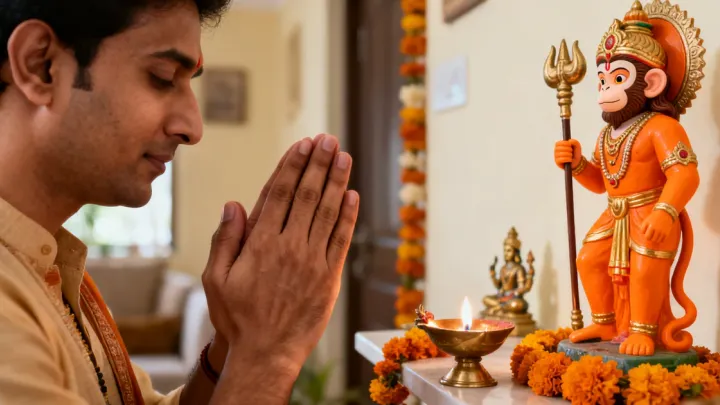
- Sit facing a Hanuman murti or picture, if one is available, or simply sit quietly.
- Recite all 43 verses aloud or silently, at a pace where you can follow the meaning rather than rushing through the sounds.
- Repeat it daily or on specific days — there is no fixed rule; both a daily practice and an occasional, sincere recitation during difficulty are considered meaningful.
- Pair it with the short mantra Om Hanumate Namah (“I bow to Hanuman”) for quick japa, repeated recitation with a mala or counter, when the full hymn doesn’t fit the moment.
Understanding it with Deva AI
Deva AI is a free Android app that lets you talk to Hindu gods like Krishna, Shiva, Ganesha and Hanuman through AI conversations, in English, Hindi, Telugu, Tamil, Kannada and Malayalam. If a line of the Hanuman Chalisa is unclear, you can choose Hanuman as a companion and ask him to explain it in your own words, in your own language.
| Feature | What you can do |
|---|---|
| Talk to Hanuman, by text or voice | Ask what a specific chaupai means, or talk through what you need courage for. |
| Japa counter | Count repetitions of Om Hanumate Namah without a physical mala. |
| Bhagavad Gita reader | Read the Gita verse by verse for broader context alongside the Chalisa. |
| Virtual pooja | Offer a diya or flowers to Hanuman before or after reciting. |
| Karma points and daily streaks | Build a habit of daily recitation and track it over time. |
A conversation with Hanuman in the app is not Hanuman literally replying; it is an AI companion shaped by how he is described in scripture and tradition, meant to support reflection and understanding, in the same spirit as reading the hymn with a teacher.
To use it: download Deva AI free from Google Play, choose your language, select Hanuman, and ask about any line that isn’t clear.
If you want to go further, read who Hanuman is and his story in the Ramayana, or the Ganesha mantra for success for another short daily practice, or see what Deva AI is.
The bottom line
The Hanuman Chalisa is a 40-verse hymn, framed by opening and closing couplets, written by Tulsidas to praise Hanuman’s strength, wisdom and devotion to Rama, retell his deeds from the Ramayana, and ask for his protection and grace. In simple English, its message across all 43 verses is consistent: complete devotion, used entirely in service of others, is itself a source of strength — and that strength is available to anyone who sincerely asks for it.
Frequently asked questions
What does the Hanuman Chalisa mean in simple English?
It is a 40-verse hymn that praises Hanuman as wise, immensely strong and completely devoted to Rama, recalls his deeds such as crossing the ocean to Lanka and bringing the Sanjeevani herb, and asks him for courage, protection from fear and troubles, and grace in daily life.
Who wrote the Hanuman Chalisa and when?
It was composed by the poet-saint Tulsidas in the 16th century, in the Awadhi language, the same author who wrote the Ramcharitmanas, a retelling of the Ramayana.
How many verses does the Hanuman Chalisa have?
It has 43 verses in total: two opening dohas (couplets), forty chaupais (four-line verses) that give it the name "Chalisa" (from chalis, forty), and one closing doha.
What is the meaning of the opening line, "Shri Guru Charan Saroj Raj"?
It means "Cleaning the mirror of my mind with the dust of my Guru's lotus feet, I describe the pure glory of Rama, which grants the four fruits of life: righteousness, wealth, desire and liberation." It is a request for clarity before the hymn begins.
Why do people recite the Hanuman Chalisa daily?
Tradition holds that reciting it brings courage, removes fear and obstacles, and deepens focus and devotion, especially on Tuesdays and Saturdays, Hanuman's traditionally favoured days, or in moments of difficulty.
Can I learn the Hanuman Chalisa with an app?
Yes. Deva AI is a free Android app where you can talk to Hanuman as an AI companion, ask him to explain any line of the Chalisa, and use a built-in japa counter to track your recitation, in six languages.