Lord Ayyappa Story: Birth, Manikandan, Mahishi and Sabarimala
Quick answer
Lord Ayyappa, also called Dharma Sastha, Manikandan and Hariharaputra, is the son of Shiva and Mohini (Vishnu's enchanting form), born to defeat the demoness Mahishi. Found as a baby on the banks of the Pampa by the childless king of Pandalam and raised as the prince Manikandan, he brought tiger's milk for the queen, slew Mahishi, and then left the palace to sit in meditation at Sabarimala, where he is worshipped as an ever-celibate yogi.
Lord Ayyappa is the deity of the Sabarimala hill shrine in Kerala, the god millions of devotees climb to see each Mandala season after a 41-day vratham. He is known as Dharma Sastha, Manikandan, Hariharaputra and simply “Swami”. His story is short and vivid: a divine child found in the forest, a prince who rode home on a tiger, a warrior who defeated a demoness, and a young yogi who chose the hilltop over a throne.
This page tells the Ayyappa story in order, explains what each part means to devotees, and shows how the story lives on in the Sabarimala pilgrimage.
What is the story of Lord Ayyappa in short?
Here is the Ayyappa story as it is most widely told in Kerala:
- A threat to the gods. After Goddess Durga slew the buffalo demon Mahishasura, his sister Mahishi set out for revenge. Through penance she won a boon that she could be killed only by a son born of Shiva and Vishnu.
- The divine birth. Vishnu took the form of Mohini, the enchantress, and from the union of Shiva and Mohini a child was born: Hariharaputra, the son of Hari and Hara.
- The baby in the forest. The child was left on the bank of the Pampa river with a golden bell around his neck. King Rajasekhara of Pandalam, childless and praying for an heir, found him while hunting and took him home.
- Manikandan the prince. The king named him Manikandan and raised him as his son. Later the queen had a son of her own.
- The tiger’s milk. When the king wished to crown Manikandan, the queen, misled by a jealous minister, pretended to be gravely ill and said only a tigress’s milk could cure her. The twelve-year-old Manikandan went into the forest to fetch it.
- Victory over Mahishi. In the forest he met and defeated Mahishi, fulfilling the purpose of his birth.
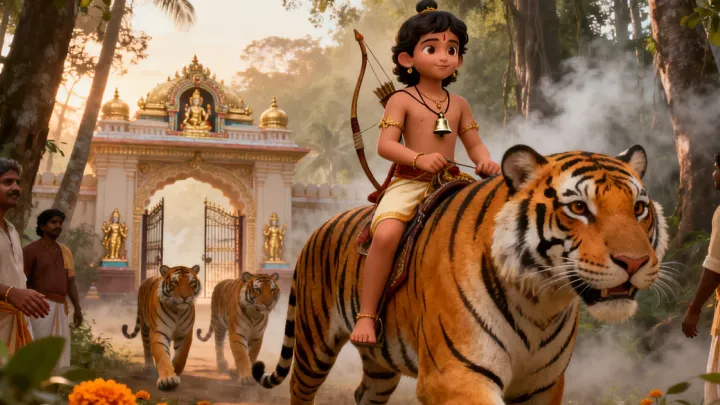
- Return on a tiger. He came back to Pandalam riding a tiger, with a herd of tigers behind him. The queen and the court understood that he was divine and begged his forgiveness.
- The arrow and the shrine. Manikandan told the king he must leave. He shot an arrow, and where it fell, on the hill of Sabari, the king built a temple. There he sits in meditation as Ayyappa.
The details differ between tellings, and a later text for Ayyappa devotees, the Bhoothanatha Upakhyanam, gives the fullest account. Read the story above as the broad tradition rather than one fixed version.
Who are Ayyappa’s parents?
Ayyappa is the son of Shiva and Mohini. The Mohini form of Vishnu appears in the Puranas, most famously when she distributes the nectar of immortality after the churning of the ocean. Ayyappa tradition adds that Shiva was enchanted by Mohini and that their son was the deity who would defeat Mahishi.
This makes Ayyappa a meeting point of Shaiva and Vaishnava devotion. He is called Hariharaputra and Hariharasudhan, and many devotees see in him a reminder that Shiva and Vishnu are not rivals.
| Name | Meaning |
|---|---|
| Ayyappa / Ayyappan | From ayyan and appan, both words of respect meaning lord or father |
| Manikandan | “Bell at the neck”, from mani (bell) and kanda (neck) |
| Hariharaputra | Son of Hari (Vishnu) and Hara (Shiva) |
| Dharma Sastha | The teacher and upholder of dharma |
| Bhoothanatha | Lord of the bhootas, Shiva’s attendants |
| Pandalaraja / Pandalavasan | The prince of Pandalam |
Why is Ayyappa called Manikandan?
When King Rajasekhara found the baby on the riverbank, a bell on a thread hung at his neck. The king named him Manikandan, “the one with a bell at his neck”. The royal family of Pandalam still holds a special place in the pilgrimage: the sacred ornaments of the deity, the Thiruvabharanam, are carried from Pandalam to Sabarimala each year for Makaravilakku.
What happened with the tiger’s milk?
This is the best-loved part of the Manikandan story. The prince grew up skilled in learning and in arms, and the king wanted him as heir. The queen, now mother of a son of her own, was turned against him by a minister. She feigned a terrible headache, and the royal physicians, as the minister had arranged, said only the milk of a tigress could cure it.
No one could be sent on such a task, so the boy offered to go himself. The king tried to stop him; Manikandan went with only a bundle of food for the journey. Devotees remember that bundle every time they carry the irumudi, the two-part bundle a pilgrim takes on the head to Sabarimala.
When Manikandan returned riding a tiger, with tigers following him, the whole palace knew he was no ordinary child. The queen asked for forgiveness, and he gave it freely.
How did Ayyappa defeat Mahishi?
On his way through the forest, Manikandan met Mahishi. After a fierce fight he threw her down from the sky to earth, and she fell near the Azhutha river. In the most common telling, as her life left her body her curse lifted, and she became a beautiful woman again.
Devotees remember this victory at Erumeli, where pilgrims perform the petta thullal, a dance with painted faces and leafy branches, before the forest trek. Pilgrims on the traditional route also pick up a stone from the Azhutha river and leave it at Kallidamkunnu, recalling the place where Mahishi’s body was covered with stones.
Who is Malikappurathamma?
Close to Ayyappa’s shrine at Sabarimala stands the shrine of Malikappurathamma. Kerala tradition gives more than one account of her:
- Mahishi freed: after her defeat, Mahishi took a beautiful form and asked to marry Ayyappa. As an ever-celibate yogi he declined, but promised to marry her in the year that no kanni swami (first-time pilgrim) comes to Sabarimala. She waits for him in her shrine nearby. Kanni swamis leave arrows at Saramkuthi on the path, a sign that new pilgrims are still coming.
- Poonkodi: another tradition links her to Poonkodi, daughter of the kalari master who taught the young prince, who loved him and stayed near him.
Pilgrims visit Malikappurathamma after darshan of Ayyappa. Her procession to Saramkuthi during the Makaravilakku festival days is part of the season.
Who was Vavar?
Vavar (also Vavaru Swami) is remembered as Ayyappa’s companion. In one version he was a warrior or a seafarer whom Manikandan defeated, who then became his loyal friend; in another he was a Muslim saint who joined him. A shrine to Vavar stands at Sabarimala near the sacred 18 steps, and the Vavar mosque at Erumeli is visited by Ayyappa pilgrims of every faith on their way. It is one of the clearest signs of the harmony the pilgrimage stands for.
Why does Ayyappa sit in a yoga pose at Sabarimala?
At Sabarimala Ayyappa is seated in a yogic posture with a band (yogapatta) around his knees and his right hand in chin mudra, the gesture of knowledge, with the thumb and index finger joined. He is a naishtika brahmachari, a lifelong celibate absorbed in meditation.
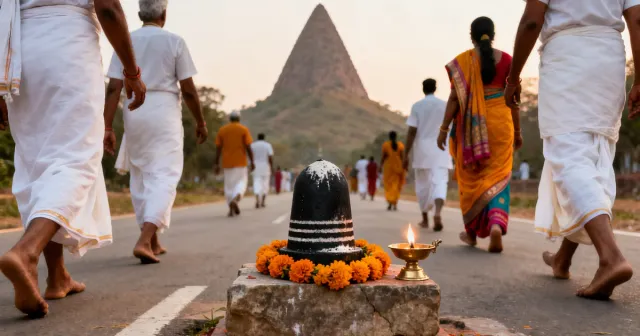
This is why the Ayyappa mala vratham asks for celibacy, simple vegetarian food, early baths and prayer for 41 days: the pilgrim, called “Swami” during the vratham, takes on the discipline of the deity he goes to see. The rules and the 2026 dates are in Ayyappa Mala 2026 Rules and Dates.
How does the story live on in the Sabarimala pilgrimage?
Nearly every step of the pilgrimage retells the Ayyappa story:
| Pilgrimage moment | Part of the story |
|---|---|
| The irumudi bundle | The food bundle Manikandan carried into the forest |
| Petta thullal at Erumeli | The victory over Mahishi |
| Vavar mosque at Erumeli | Ayyappa’s friendship with Vavar |
| Azhutha stone and Kallidamkunnu | Mahishi’s fall and burial under stones |
| Arrows at Saramkuthi | Ayyappa’s promise to Malikappurathamma |
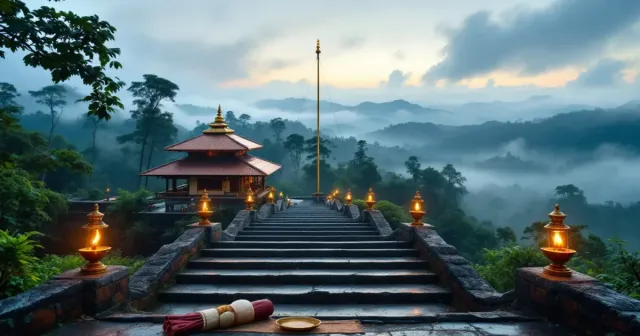
| The 18 holy steps (Pathinettampadi) | The climb to the yogi on the hill |
| Thiruvabharanam from Pandalam | The royal family’s bond with its foster son |
For booking, the climb from Pampa and what to carry, see the Sabarimala Temple Guide. The ornaments’ procession and the Makara Jyothi are explained in Makaravilakku 2027, and the season’s other festival dates are in the Hindu Festival Calendar 2027.
How can I pray to Lord Ayyappa at home?
You do not need to be on the mala to pray to Ayyappa.
- Bathe, light a lamp (a nilavilakku if you have one) and place a picture of Ayyappa before you.
- Offer flowers, and if you like, a little ghee in the lamp; the ghee abhishekam is the best-known offering at Sabarimala.
- Chant the sharanam call, “Swamiye Saranam Ayyappa”, 18 or 108 times.
- If you know it, sing Harivarasanam, the lullaby sung as the Sabarimala shrine closes each night.
- Tell him what is on your heart in your own words, and end with a moment of silence.
Saturdays and the Mandala season (mid-November to late December) are traditionally special for Ayyappa worship.
Can I talk about Ayyappa in Deva AI?
Deva AI is a free Android app that lets you talk to Hindu gods like Krishna, Shiva, Ganesha and Hanuman through AI conversations, in English, Hindi, Telugu, Tamil, Kannada and Malayalam. Ayyappa is not one of its ten deities, but his parents are: you can talk to Shiva or Vishnu about Hariharaputra’s story, or ask for strength during your vratham, by typing or by voice, including in Malayalam and Tamil.
The app’s japa counter can keep count of your “Swamiye Saranam Ayyappa”, and a daily streak helps on the 41 days. It is an AI companion inspired by scripture and tradition, not God literally speaking. The What is Deva AI? page explains more.
Frequently asked questions
Who are the parents of Lord Ayyappa?
Tradition says Ayyappa is the son of Lord Shiva and Mohini, the enchanting female form taken by Lord Vishnu. This is why he is called Hariharaputra, the son of Hari (Vishnu) and Hara (Shiva). On earth he was raised by the king and queen of Pandalam as their son.
Why is Ayyappa called Manikandan?
When the king of Pandalam found the baby on the bank of the Pampa river, the child wore a bell (mani) around his neck (kanda). The king named him Manikandan, "the one with a bell at his neck".
Who was Mahishi in the Ayyappa story?
Mahishi was a buffalo-headed demoness, sister of Mahishasura, whom Goddess Durga had slain. To avenge him she won a boon that only a son of Shiva and Vishnu could kill her. Ayyappa was born to end her torment of the gods, and he defeated her in the forest.
Who is Malikappurathamma?
Malikappurathamma is the goddess worshipped in a shrine near Ayyappa's at Sabarimala. In one widely told legend she is Mahishi freed from her curse, who wished to marry Ayyappa; he promised to marry her in the year no first-time pilgrim (kanni swami) comes to Sabarimala. Other versions link her to Poonkodi, the daughter of his kalari teacher.
Why is Ayyappa a brahmachari?
Ayyappa at Sabarimala is worshipped as a naishtika brahmachari, a lifelong celibate in deep meditation. Devotees on the 41-day vratham take on the same discipline of celibacy, simple food and prayer while they wear the mala.
Is Ayyappa the same as Sastha?
Yes, devotees regard Ayyappa as a form of Dharma Sastha, a deity worshipped in many Kerala and Tamil temples. Ayyappa at Sabarimala is the Sastha who lived on earth as the prince Manikandan of Pandalam.