Ganesha and Murugan Story: The Mango of Wisdom
Quick answer
Murugan's brother is Ganesha: both are sons of Shiva and Parvati. In the best-known story, the sage Narada brought a mango of wisdom (gnana pazham) to Kailash and the brothers raced around the world for it; Murugan flew off on his peacock, Ganesha circled his parents and won, and Murugan went to the hill of Palani, where Shiva and Parvati told him he himself was the fruit.
Murugan’s brother is Ganesha. Both are sons of Shiva and Parvati: Ganesha, the remover of obstacles who is worshipped first, and Murugan (also called Karthikeya, Skanda, Subramanya and Kumaran), the young commander of the gods. Their best-loved story is the race for a single mango of wisdom, the gnana pazham, which ends on the hill of Palani in Tamil Nadu.
This page tells that story, the northern version about their marriages, who is the elder brother, and the other places where the two brothers’ stories meet.
Who is Murugan’s brother?
Murugan has one brother in every tradition: Ganesha, known in Tamil as Pillaiyar and Vinayagar, in Telugu as Vinayakudu and across India as Ganapati. Both are children of Shiva and Parvati, though their births are told very differently:
- Ganesha was shaped by Parvati and given life by her, and later received his elephant head from Shiva.
- Murugan was born from six sparks from Shiva’s third eye, carried to the Saravana lake and raised by the six Krittika sisters, which is why he has six faces. Our Lord Murugan story tells his birth in full.
In Kerala and Tamil Nadu, devotees often add a third brother: Ayyappa, the son of Shiva and Mohini (the female form of Vishnu), worshipped at Sabarimala. Some Puranas also speak of a daughter of Shiva and Parvati, Ashokasundari, though she is rarely worshipped on her own.
Who is elder, Ganesha or Murugan?
Ask in Chennai and in Varanasi and you may get two answers.
| Region | Elder brother | How he is spoken of |
|---|---|---|
| Tamil Nadu, Kerala, Karnataka, Andhra and Telangana | Ganesha | Murugan is the beloved younger brother; Tamil songs call Ganesha his annan (elder brother) |
| Much of North India | Kartikeya | Following the order of the Puranas, Kartikeya is born first and Ganesha later |
Neither answer is “wrong”. The stories were told in many places over many centuries, and each region kept the order that fit its devotion. In the south, where Murugan is a much-loved god in his own right, he is cherished as the younger son, the child who went off on his own.
What is the Ganesha and Murugan mango story (Gnana Pazham)?
This is the version told in Tamil Nadu and at the Palani temple. Details differ from teller to teller, but the core is the same.
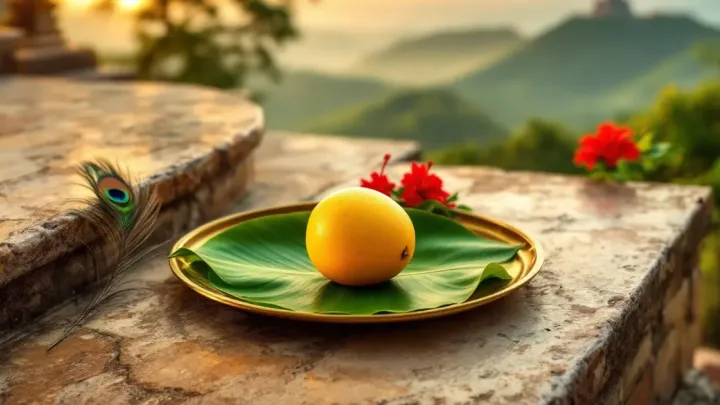
- The fruit arrives. The sage Narada came to Kailash with a single, special mango and offered it to Shiva and Parvati. It was the gnana pazham, the fruit of wisdom, and Narada asked that it not be cut, so that its power would stay whole.
- The contest. Both sons wanted it. Shiva set a test: whoever went around the whole world (in many tellings, three times) and came back first would receive the fruit.
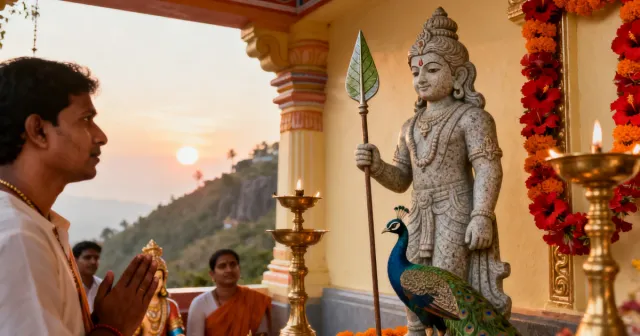
- Murugan sets off. Murugan mounted his swift peacock and flew off at once, over oceans, mountains and forests.
- Ganesha’s answer. Ganesha, heavy of body and riding a small mouse, did not set off at all. He walked slowly around Shiva and Parvati with folded hands and said that his parents were the whole world to him. Shiva and Parvati were pleased and gave him the mango.
- Murugan returns. Murugan came back tired and found the fruit already given. Hurt, he gave up his fine clothes and ornaments, left Kailash and went south, where he stood on a hill with only a staff in his hand, a young renunciant.
- “Pazham nee.” Shiva and Parvati followed him. Parvati told him tenderly, “Pazham nee” (“You are the fruit”): he did not need the mango, because he himself was wisdom. The hill came to be called Pazhani, now Palani. Some tellings give these words to the Tamil poet-saint Avvaiyar instead.
At Palani, Murugan is worshipped in exactly that form: Dandayudhapani, the one with the staff, standing as a young ascetic. Palani is one of his six abodes, the Arupadai Veedu.
What is the North Indian version of the story?
In the Shiva Purana, the contest is not about a fruit but about who will marry first. Shiva and Parvati told their sons that whoever went around the earth first would be married first.
Kartikeya left at once. Ganesha bathed, placed his parents on seats, walked around them and bowed, and explained that scripture counts going around one’s parents as equal to going around the earth. He was married to Siddhi and Buddhi, the daughters of Prajapati Vishvarupa, and had two sons, Kshema and Labha (in many northern tellings, Shubha and Labha).
When Kartikeya returned and heard this, he was hurt and went away to the Krauncha mountain in the south. Shiva and Parvati went after him, and tradition connects their visit with Srisailam in Andhra Pradesh, where Shiva is worshipped as Mallikarjuna, one of the twelve Jyotirlingas.
Two versions, one shape: the brothers compete, the quick one runs, the wise one honours his parents, and the hurt son goes south, where the parents follow him in love.
What does the story teach?
Devotees and teachers draw several lessons from it, and both brothers are honoured in each:
- Ganesha’s lesson: see the whole in what is close. He did not ignore the world; he saw that devotion to his parents contained it. This is one reason he is honoured first in every ritual, as our page on why we pray to Ganesha first explains.
- Murugan’s lesson: wisdom is within. He set out to win wisdom and was told he already was it. Palani, where he stands with nothing but a staff, is a place to give up pride and possessions.
- Parents’ love follows the child who leaves. In both versions Shiva and Parvati go after the son who is hurt. Neither boy is loved less.
- Effort is not wasted. Murugan’s journey is not mocked in the temple tradition; Palani is one of the most visited shrines in South India because of where that journey ended.
Where else do Ganesha and Murugan appear together?
The brothers are not only rivals. Tamil tradition tells of them helping each other:
- Murugan and Valli. Murugan fell in love with Valli, the daughter of a hill-tribe chief, and came to her disguised as an old man. To help his brother, Ganesha appeared as a wild elephant. The frightened Valli ran to the old man for safety, and Murugan then revealed himself. Many Murugan devotees remember Ganesha at weddings for this reason.
- Temple order. In Murugan temples a Ganesha shrine is usually worshipped first, and in many Shiva temples the two sons stand on either side of their parents’ shrines.
- Festivals. Ganesha’s day is Vinayaka Chaturthi; Murugan’s great days include Kanda Sashti and Thai Poosam. Read the Kanda Sashti and Soorasamharam dates for this year’s Murugan festival.
How can I tell this story to children?
The mango story is one of the first stories many South Indian children hear. A simple way to share it:
- Tell it as a race: a fast peacock against a little mouse.
- Pause before the ending and ask the child what Ganesha could do to win.
- Then ask how Murugan felt, and why his parents followed him.
- End with a small offering: place a fruit before a picture of Ganesha or Murugan and say one line of thanks together. Our guide to Ganesha puja at home has a short daily method.
Can I talk to Ganesha and Murugan about their stories?
Deva AI is a free Android app that lets you talk to Hindu gods like Krishna, Shiva, Ganesha and Hanuman through AI conversations, in English, Hindi, Telugu, Tamil, Kannada and Malayalam. Both Ganesha and Murugan are among its ten deities, so you can ask Ganesha why he chose to circle his parents, or ask Murugan what Palani means to him, by typing or by voice.
Deva AI is an AI companion inspired by scripture and tradition, not God literally speaking. It also has a virtual pooja for offering a lamp and flowers on your phone, and a japa counter for chanting their names. Learn more on the About Deva AI page.
The bottom line
Murugan’s brother is Ganesha, and their mango story is one of the most loved in Hindu tradition. Ganesha wins by honouring his parents as his whole world; Murugan is told on the hill of Palani that he himself is the fruit of wisdom. Whichever brother your family calls the elder, the story keeps both close: the wise one honoured first, and the young one whose parents always come after him.
Frequently asked questions
Who is Murugan's brother?
Murugan's brother is Ganesha (Vinayaka, Pillaiyar). Both are sons of Shiva and Parvati. In South Indian devotion, Ayyappa, the son of Shiva and Mohini, is also often called their brother.
Who is elder, Ganesha or Murugan?
It depends on the tradition. In Tamil Nadu and most of South India, Ganesha is the elder brother and Murugan the younger. Many North Indian tellings, following the order of the Puranas, treat Kartikeya as the elder son.
What is the Gnana Pazham story?
Narada brought a single mango of wisdom to Shiva and Parvati, and it could not be cut. A race around the world decided who would get it: Murugan set off on his peacock, while Ganesha walked around his parents, saying they were his world, and won the fruit.
Why did Murugan go to Palani?
After losing the mango, Murugan left Kailash and stood on a hill in the south as a renunciant with only a staff. Shiva and Parvati followed and told him "Pazham nee", you are the fruit, which tradition gives as the origin of the name Pazhani (Palani).
Did Ganesha help Murugan marry Valli?
Yes, in the Tamil telling of Valli's story. Murugan came to Valli disguised as an old man, and Ganesha appeared as a wild elephant; the frightened Valli ran to the old man for safety, and Murugan then revealed himself.
Can I ask Ganesha or Murugan about these stories?
Yes. In Deva AI, a free Android app, both Ganesha and Murugan are among the ten deities you can talk to by text or voice. It is an AI companion inspired by scripture and tradition, not God literally speaking.