Krishna Childhood Stories: Butter Thief, Kaliya, Govardhan
Quick answer
Krishna's childhood stories come mainly from the tenth book of the Bhagavata Purana: his birth in Kamsa's prison and escape to Gokul, the demoness Putana, stealing butter as Makhan Chor, Yashoda seeing the universe in his mouth, being tied to a mortar as Damodara, subduing the serpent Kaliya, and lifting Govardhan hill to shelter Vrindavan from Indra's rain. Each story pairs a child's play with a lesson about love, humility and protection.
Krishna’s childhood stories are the most loved stories in Hinduism: the baby carried across a flooded river at midnight, the toddler who stole butter, the boy who danced on a serpent’s hoods and held up a mountain like an umbrella. Grandparents tell them at bedtime, temples act them out at Janmashtami, and Govardhan Puja is built around one of them.
Here are the main stories in the order they happen, where each one comes from and what devotees take from it.
Where do Krishna’s childhood stories come from?
Almost all of them come from the tenth book (Dashama Skandha) of the Bhagavata Purana, which gives about the first half of that book to Krishna’s early years in Gokul and Vrindavan. The Harivamsa (an appendix to the Mahabharata) and the Vishnu Purana tell many of the same episodes more briefly. Later poets made them part of daily devotion: Surdas sang them in Braj Bhasha, and the Tamil Alvar Periyalvar wrote verses imagining himself as Yashoda caring for the child.
Details change from text to text and region to region. The versions below follow the Bhagavata Purana’s broad outline.
| Story | What happens | Bhagavata Purana (Book 10) |
|---|---|---|
| Birth and escape to Gokul | Born in Kamsa’s prison, carried across the Yamuna to Nanda and Yashoda | Chapter 3 |
| Putana | A demoness tries to kill the baby with poisoned milk | Chapter 6 |
| Shakatasura and Trinavarta | A cart demon and a whirlwind demon are defeated by the infant | Chapter 7 |
| The universe in his mouth | Yashoda sees the whole cosmos inside her son’s mouth | Chapter 8 |
| Makhan Chor and Damodara | The butter thief is tied to a mortar and frees two cursed brothers | Chapters 8 to 10 |
| Bakasura and Aghasura | A crane demon and a python demon are destroyed | Chapters 11 and 12 |
| Brahma and the calves | Brahma hides the cowherd boys and calves; Krishna becomes all of them | Chapters 13 and 14 |
| Kaliya Mardan | Krishna subdues the serpent poisoning the Yamuna | Chapters 16 and 17 |
| Govardhan | Krishna lifts the hill to shield Vrindavan from Indra’s storm | Chapters 24 to 27 |
How was Krishna born, and why was he sent to Gokul?
King Kamsa of Mathura heard a voice from the sky foretell that the eighth child of his sister Devaki would kill him. He imprisoned Devaki and her husband Vasudeva and killed their children one by one as they were born.
Krishna, the eighth child, was born at midnight on the eighth day (Ashtami) of the dark fortnight, which is why Janmashtami is kept at midnight. The chains fell open and the guards slept. Vasudeva carried the newborn in a basket across the Yamuna, which was in flood, while the serpent Shesha spread his hoods over the child against the rain. In Gokul he left Krishna with the cowherd chief Nanda and his wife Yashoda, and brought back their newborn daughter, who was Yogamaya, the Goddess’s power. When Kamsa tried to kill her, she rose into the sky and told him that the one who would end him was already alive.
What it teaches: no prison, flood or tyrant can stop what the divine has decided to protect.
What happened with Putana and the other demons?
Kamsa sent demons to find and kill the baby.
- Putana came to Gokul disguised as a beautiful woman and nursed the baby with poison on her breast. Krishna drew out her life along with the milk. Because she had fed him, even as an enemy, the Bhagavata says she was given the status of a mother and liberated.
- Shakatasura hid in a handcart. The baby kicked the cart and it shattered.
- Trinavarta came as a whirlwind and carried the child into the sky; Krishna grew so heavy that the demon crashed down and died.
Later, as a boy herding calves, he destroyed Bakasura, a giant crane, and Aghasura, a python whose open mouth looked like a mountain cave.
What it teaches: devotees see Putana’s story as the most generous in the Purana. Even a person who comes to the Lord with harm in mind is touched by grace.
What did Yashoda see in Krishna’s mouth?
The other children complained that Krishna had eaten mud. Yashoda made him open his mouth, and inside it she saw the whole universe: the sky, the stars, mountains, oceans, and Gokul itself with herself standing in it. Then the vision faded and she held him again as her little son, with no memory of anything more than a mother’s worry.
What it teaches: the infinite chose to be small enough to be scolded. Many devotees say this is the heart of Krishna bhakti: loving God as a child, not only fearing God as a king.
Why is Krishna called Makhan Chor, the butter thief?
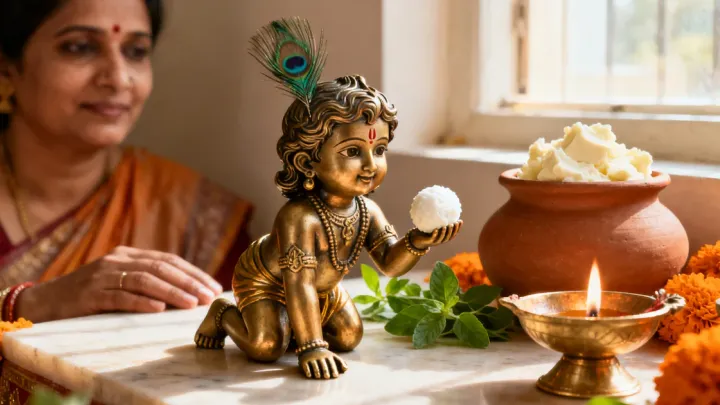
In Gokul every home churned milk into butter and curd, and kept them in pots hung from the ceiling. Krishna and his friends crept into the gopis’ houses, climbed on each other’s shoulders or on a mortar, broke the pots, ate the butter, and fed the rest to the monkeys. The gopis came to Yashoda to complain, while he stood behind her looking innocent.
Hindi devotional poetry is full of this scene, and the line “Maiya mori, main nahin makhan khayo” (“Mother, I did not eat the butter”), associated with Surdas, is sung across North India. In Tamil Nadu, children are dressed as Kannan with a butter pot, and Krishna Jayanthi homes draw small footprints from the doorway to the puja room as if the child had walked in.
What it teaches: the butter is the heart that has been churned by devotion. Krishna steals only what is already his, and only from those who secretly want to be robbed.
What is the Damodara story?
Yashoda was nursing Krishna when the milk on the stove began to boil over. She put him down to save it. Angry, he broke a pot of curd, went to a store of butter and fed it to a monkey. Yashoda came after him with a stick, caught him and decided to tie him to a heavy wooden mortar (ulukhal).
Every rope she brought was two fingers too short. She tied more ropes together and it was still short, until Krishna saw how tired she was and let himself be bound. That is why he is called Damodara, the one with a rope around his belly.
Tied to the mortar, he crawled between two arjuna trees in the courtyard and pulled them down. Out came Nalakuvara and Manigriva, sons of Kubera, who had been cursed by the sage Narada to stand as trees. They praised the child and went home freed.
What it teaches: God cannot be bound by force or effort, only by love, and even then because he allows it. In the month of Kartik, many Vaishnavas sing the Damodarashtakam and offer a lamp to this form of Krishna.
How did Krishna trick Brahma?
Brahma wanted to see this cowherd boy’s power for himself. While Krishna and his friends were eating lunch in the forest, Brahma hid away all the calves and then all the boys. Krishna simply became every calf and every boy, exact to their clothes and habits, and went home as all of them. For a whole year no family noticed anything, except that they loved their children more than before. When Brahma returned and saw every one of them as Vishnu, he bowed and sang a long prayer of apology.
What it teaches: pride in one’s own power, even a creator’s, melts before simple love.
What is the story of Kaliya Mardan?
The serpent Kaliya, with many heads, lived in a pool of the Yamuna near Vrindavan. His poison was so strong that cows and boys who drank there fell dead and birds flying over it dropped from the sky.
Krishna climbed a kadamba tree on the bank and jumped into the pool. Kaliya wrapped him in his coils while Nanda, Yashoda and all of Vrindavan wept on the bank. Then Krishna slipped free, leapt on the serpent’s hoods and danced on them, pressing down each head that rose, until Kaliya was exhausted and vomiting blood. Kaliya’s wives, the Nagapatnis, prayed for their husband’s life. Krishna spared him and sent him with his family to the ocean, promising that Garuda would no longer harm him because he bore the marks of Krishna’s feet on his heads.
The scene of Krishna dancing on Kaliya, called Kaliya Mardan or Kalinga Nartanam, is a favourite of temple sculpture, bronzes and Bharatanatyam.
What it teaches: the serpent is the poison in our own mind. The Lord does not kill it; he dances on it until it gives up, and then sends it away.
Why did Krishna lift Govardhan hill?
Every year the people of Vrindavan offered a grand sacrifice to Indra, king of the gods and giver of rain. Krishna, then a boy, asked his father why. Their life, he said, depended on the cows, the forest and the hill Govardhan that fed them, so they should honour those instead. The villagers agreed, cooked a mountain of food, offered it to the hill and walked around it.
Indra was furious and sent the clouds of destruction to drown Vrindavan in rain and hail. Krishna lifted Govardhan with one hand, the Bhagavata says as easily as a child picks up a mushroom, and held it up like an umbrella. All the people and cattle sheltered under it for seven days, while he did not eat or move. Indra’s pride broke. He came down, bowed to Krishna, and the divine cow Surabhi bathed Krishna and named him Govinda. The Bhagavata describes the boy who did this as seven years old.
This story is the root of Govardhan Puja (Annakut), kept the day after Diwali, when families build a small hill of food and offer it to Krishna. See how it fits the five days in our Diwali 2026 Lakshmi Pooja guide.
What it teaches: honour what actually sustains you, and trust that the one who protects the cows will protect you too.
How can you share these stories with children?
- One story a night. Each episode above is short enough for a bedtime story. Start with the butter thief and Damodara; save Putana and Kaliya for older children.
- End with the lesson. Ask your child what they think the story means before you tell them.
- Use the festivals. Tell the birth story on Janmashtami, Govardhan at Diwali, and Damodara in the month of Kartik.
- Sing. A simple chant such as “Govinda Damodara Madhaveti” or a bhajan about Makhan Chor fixes a story in memory better than reading.
- Ask Krishna. Children love asking “why” questions. Deva AI is a free Android app that lets you talk to Hindu gods like Krishna, Shiva, Ganesha and Hanuman through AI conversations, in English, Hindi, Telugu, Tamil, Kannada and Malayalam. You can ask Krishna about Kaliya or Govardhan by text or voice and hear the story told back in his warm style; read more in Talk to Krishna App.
What comes after Krishna’s childhood?
When Krishna was older, Akrura came from Mathura to take him and Balarama to Kamsa’s wrestling festival. There Krishna killed Kamsa, freed his parents Devaki and Vasudeva, and his life as a prince, a friend of the Pandavas and finally the teacher of the Bhagavad Gita began. Krishna is one of the ten avatars of Vishnu; see where his life sits in Vishnu’s Ten Avatars. For what the grown Krishna taught Arjuna, read Krishna’s Gita Teachings for Stress.
You can also read the Bhagavad Gita verse by verse in Deva AI, and ask Krishna about any story here whenever a child, or you, has a question. Learn more on the About Deva AI page.
Frequently asked questions
Where do the stories of Krishna's childhood come from?
Mainly from the tenth book (Dashama Skandha) of the Bhagavata Purana. The Harivamsa and the Vishnu Purana tell many of the same episodes, and regional poets such as Surdas in Braj Bhasha and Periyalvar in Tamil retold them in devotional songs.
Why is Krishna called Makhan Chor?
Makhan Chor means butter thief. As a small boy in Gokul, Krishna stole butter and curd from the gopis' homes with his friends and fed it to them and to the monkeys. Devotees read the story as God stealing what is offered with love.
How old was Krishna when he lifted Govardhan hill?
The Bhagavata Purana describes the boy who lifted Govardhan as seven years old. He held the hill up on one hand for seven days while the people and cattle of Vrindavan sheltered beneath it.
What is the story of Kaliya?
Kaliya was a many-headed serpent who poisoned a pool of the Yamuna near Vrindavan. Krishna jumped into the water, danced on his hoods until the serpent gave up, and then sent him away to the ocean, so the river became safe again.
Why is Krishna called Damodara?
Dama means rope and udara means belly. When Yashoda tied the child Krishna to a grinding mortar as punishment for his mischief, the rope kept coming up two fingers short until he let himself be bound. The name celebrates God allowing himself to be held by a mother's love.
Can I ask Krishna about these stories?
Yes. In Deva AI you can choose Krishna as a companion and ask him about any episode of his childhood by text or voice. It is an AI companion inspired by scripture and tradition, not God literally speaking.