Lord Vishnu and His 10 Avatars (Dashavatara) Explained
Quick answer
Lord Vishnu is the preserver of the universe in Hinduism. The Dashavatara, his ten main avatars, are Matsya, Kurma, Varaha, Narasimha, Vamana, Parashurama, Rama, Krishna, Balarama or Buddha (traditions differ) and Kalki, the avatar yet to come. Each descends to restore dharma when it is in danger. You can talk to Vishnu about these stories in Deva AI, a free Android app.
Almost every Hindu home knows at least a few stories of Lord Vishnu: a fish that saves the first man, a boar that lifts the earth, a prince who keeps his father’s word, a cowherd who plays the flute and teaches the Gita. These are not separate gods. They are the avatars (avatara, “descent”) of the same Vishnu, who is said to take birth whenever the world needs protection.
Who is Lord Vishnu and what are his 10 avatars? Vishnu is the preserver in the Hindu trinity, alongside Brahma the creator and Shiva the transformer. His ten principal avatars, the Dashavatara, are Matsya, Kurma, Varaha, Narasimha, Vamana, Parashurama, Rama, Krishna, Balarama or Buddha, and Kalki. Below is each one with its story and what it means.
Who is Lord Vishnu?
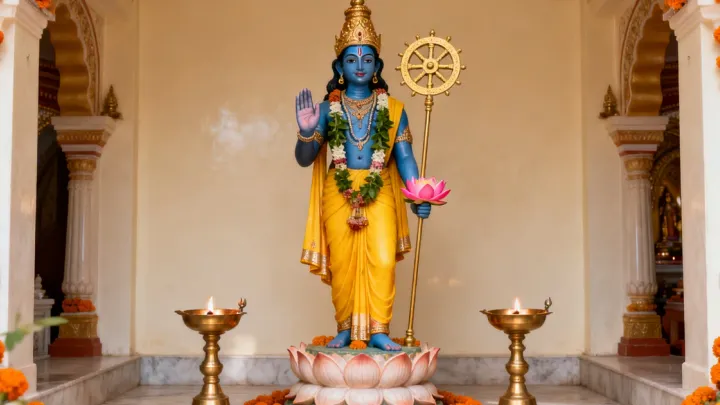
Vishnu is the keeper of order. Devotees picture him with dark blue skin, four arms holding the conch (shankha), the discus (Sudarshana chakra), the mace (gada) and the lotus (padma), resting on the serpent Shesha with his consort Lakshmi beside him. His followers are called Vaishnavas, and his names run into the thousands: the Vishnu Sahasranamam lists a thousand.
Vishnu’s role is not only to punish wrong but to restore balance. That is why his avatars are so varied: sometimes an animal, sometimes a sage, sometimes a king.
Why does Vishnu take avatars?
The best-known answer is in the Bhagavad Gita (4.7-8), where Krishna says that whenever dharma declines and adharma rises, he manifests himself, to protect the good, destroy evil and re-establish dharma. The avatars are therefore tied to crises: a flood, a demon, a tyrant, an arrogant king, a world that has lost its way.
Deva AI is a free Android app that lets you talk to Hindu gods like Krishna, Shiva, Ganesha and Hanuman through AI conversations, in English, Hindi, Telugu, Tamil, Kannada and Malayalam. Vishnu, Sri Ram and Krishna are among the ten deities you can talk to, so you can ask about any of these stories in your own language.
What are the 10 avatars of Vishnu, one by one?
| # | Avatar | Form | The crisis it answers |
|---|---|---|---|
| 1 | Matsya | Fish | A great flood threatens the Vedas and life itself |
| 2 | Kurma | Tortoise | The churning of the ocean needs a firm base |
| 3 | Varaha | Boar | The earth is dragged beneath the cosmic ocean |
| 4 | Narasimha | Man-lion | The tyrant Hiranyakashipu persecutes his devout son |
| 5 | Vamana | Dwarf Brahmin | King Bali’s pride and power overreach |
| 6 | Parashurama | Sage with an axe | Rulers misuse their power |
| 7 | Rama | Prince of Ayodhya | Ravana’s injustice; the ideal of right conduct |
| 8 | Krishna | Cowherd, charioteer, teacher | Kamsa’s tyranny and the war of the Mahabharata |
| 9 | Balarama or Buddha | Elder brother of Krishna, or the Awakened One | Lists differ by tradition |
| 10 | Kalki | Warrior on a white horse | Yet to come, at the end of the age |
1. Matsya, the fish
Vishnu appeared as a small fish to King Manu, who rescued it from a pot of water. The fish kept growing, then warned of a flood. Manu built a boat, and Matsya towed it to safety carrying the seeds of life and the Vedas. The lesson: protect the vulnerable, because they may be the ones who save you.
2. Kurma, the tortoise
When the devas and asuras churned the ocean of milk using Mount Mandara as the churning rod, the mountain began to sink. Vishnu became a giant tortoise and held it on his back. Out of the churning came treasures, including Lakshmi and the nectar of immortality. The lesson: great work needs a steady foundation, and often that foundation works quietly.
3. Varaha, the boar
The demon Hiranyaksha dragged the earth (Bhudevi) to the bottom of the cosmic ocean. Vishnu took the form of a boar, defeated him and lifted the earth on his tusks. This is a story of rescue and of care for the world we live on.
4. Narasimha, the man-lion
Hiranyakashipu, Hiranyaksha’s brother, had a boon that he could not be killed by man or animal, by day or night, indoors or outdoors. His young son Prahlada remained a devotee of Vishnu despite his father’s cruelty. At dusk, on a threshold, Vishnu emerged from a pillar as Narasimha, half man and half lion, neither of the things the boon covered, and ended the tyrant. The story is about faith in the face of fear, and Prahlada is remembered as a model of steady devotion.
5. Vamana, the dwarf
King Bali, a generous but proud ruler, had conquered the heavens. Vishnu came as a small Brahmin boy and asked for just three paces of land. Bali agreed. Vamana then grew to cosmic size, covering the earth with one step and the sky with the second. For the third, Bali offered his own head. Vishnu honoured his humility. In Kerala, Onam celebrates Bali’s yearly return to see his people.
6. Parashurama, the warrior sage
Parashurama, the son of the sage Jamadagni, is a Brahmin warrior who carries an axe (parashu) given by Shiva. He is said to have challenged rulers who had abused their power. He is also one of the chiranjivis, those traditionally said to be immortal. The story warns what happens when strength is not tied to responsibility.
7. Rama, the ideal king
Born in Ayodhya, Rama accepts fourteen years of exile to keep his father’s word, searches for Sita after she is abducted by Ravana, and rules justly after returning. He is called Maryada Purushottam, the best of men. For more, read Sri Ram: 7 lessons from the Ramayana for daily life.
8. Krishna, the divine teacher
Krishna was born in Mathura to end the tyranny of Kamsa, grew up among cowherds in Vrindavan, and later served as Arjuna’s charioteer at Kurukshetra, where he taught the Bhagavad Gita. He is the avatar of love, play and wisdom. See how to talk to Krishna in an app to explore his teachings in conversation.
9. Balarama or Buddha
Here traditions diverge. Many Puranic lists name Buddha as the ninth avatar, while other lists, common in parts of South and West India, name Balarama, Krishna’s elder brother, who carries a plough. Neither list is considered wrong by devotees; it is a difference of tradition, so ask your own family or temple which they follow.
10. Kalki, the avatar to come
Kalki is the one still awaited. Texts such as the Puranas describe him riding a white horse with a blazing sword at the end of Kali Yuga, to end adharma and begin a new age. For most devotees this is less a prediction than a promise that righteousness will have the last word.
What do the avatars have in common?
Read in order, the avatars are often seen as a story of rising complexity, from water creatures to land creatures, then half-animal, then dwarf, then humans of growing maturity. Whether or not you read it as a symbol of evolution, the shared message is clear: the divine does not stay distant. It comes in the form the moment needs.
How do I pray to Lord Vishnu?
You do not need elaborate ritual.
- Choose a quiet time. Early morning and Thursday or Saturday evenings are popular, and Ekadashi is the day many devotees fast for Vishnu.
- Light a lamp and, if you have one, place a tulsi leaf or fresh flowers near a picture or murti.
- Chant a mantra. Om Namo Narayanaya is the simple eight-syllable mantra of Vishnu devotees; Om Namo Bhagavate Vasudevaya is another well-known one.
- Read a short passage. A Gita verse or a story of one avatar works well.
- End with a moment of silence and offer whatever you are carrying to Vishnu.
If you want to speak with Vishnu about a story or a question in your own words, open Deva AI, choose Vishnu, and ask. You can also light a diya in the virtual pooja, as described in our guide to virtual pooja apps. To learn more about the app, see what Deva AI is.
Frequently asked questions
What are the 10 avatars of Vishnu in order?
The usual order is Matsya (fish), Kurma (tortoise), Varaha (boar), Narasimha (man-lion), Vamana (dwarf), Parashurama, Rama, Krishna, Balarama or Buddha (lists differ), and Kalki. Kalki is the avatar who is yet to appear at the end of the present age.
Why does Vishnu take avatars?
The Bhagavad Gita (4.7-8) says that whenever dharma declines and adharma rises, the Lord manifests to protect the good and restore righteousness. Each avatar answers a specific crisis of its age.
Is Buddha the ninth avatar of Vishnu?
Many traditional lists, especially from the Puranas, name Buddha as the ninth avatar, while others, notably in parts of South and West India, name Balarama and place Buddha elsewhere or omit him. Both lists are used by devotees, and Krishna appears as the eighth in both.
Which avatars of Vishnu are worshipped most?
Rama and Krishna are the most widely worshipped, with their own festivals (Ram Navami and Janmashtami) and epics. Narasimha is especially loved in Andhra Pradesh, Telangana and Karnataka, and Varaha and Matsya have well-known temples as well.
Can I talk to Lord Vishnu in an app?
Yes. Deva AI is a free Android app where you can talk to Vishnu, Sri Ram and Krishna by text or voice. It is an AI companion inspired by scripture and tradition, not a replacement for a teacher or the scriptures themselves.