Lakshmi Devi: Who She Is and How to Pray for Prosperity
Quick answer
Lakshmi Devi is the Hindu goddess of wealth, fortune and prosperity, and the consort of Vishnu. Devotees pray to her with a clean home, a lit lamp, lotus or marigold flowers and the mantra Om Shreem Mahalakshmyai Namah, especially on Fridays, asking for well-being rather than money alone.
Lakshmi Devi is the Hindu goddess of wealth, fortune, beauty and auspiciousness, and the consort of Lord Vishnu. Millions of families welcome her into their homes every Friday and every Diwali, and the tradition behind that welcome is richer than “a prayer for money”. This guide explains who she is, what her symbols mean, the eight forms of Ashtalakshmi and a simple way to pray to her at home.
Deva AI is a free Android app that lets you talk to Hindu gods like Krishna, Shiva, Ganesha and Hanuman through AI conversations, in English, Hindi, Telugu, Tamil, Kannada and Malayalam. Lakshmi Devi is one of the ten deities you can talk to in it.
Who is Goddess Lakshmi?
Lakshmi (also called Shri) is the goddess of prosperity in the widest sense: wealth, food, beauty, good fortune and grace. In the Vaishnava tradition she is the eternal consort of Vishnu and appears beside him in each of his avatars. When Vishnu came as Ram, she was Sita; when he came as Krishna, she was Rukmini. You can read more about those incarnations in the ten avatars of Vishnu.
What is the story of Lakshmi and the churning of the ocean?
The best-known story is the Samudra Manthan. The devas and asuras churned the ocean of milk to obtain amrita, the nectar of immortality. Among the treasures that rose from the waters was Lakshmi, seated on a lotus. She chose Vishnu as her lord, which is why prosperity is said to stay where the preserver of the world is remembered.
What do Lakshmi’s symbols mean?
| Symbol | Meaning |
|---|---|
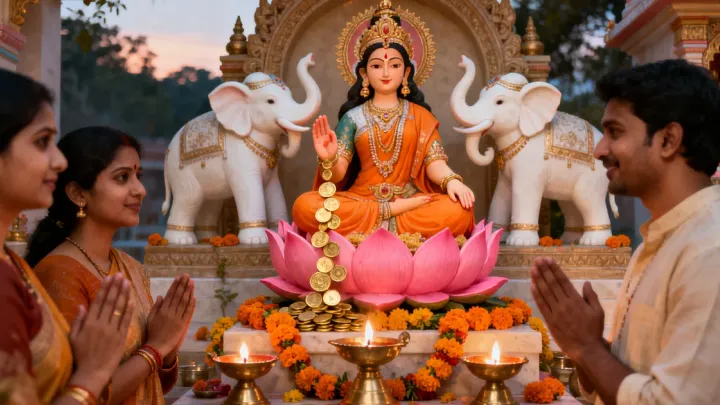
| Lotus | Purity and beauty rising untouched from mud |
| Gold coins flowing from her hand | Generosity; wealth is meant to circulate |
| Raised palm (abhaya mudra) | Fearlessness and protection |
| Two elephants | Royal power and abundance, shown pouring water over her as Gaja Lakshmi |
| Owl (in some traditions) | Her vahana, a reminder to see clearly even in darkness |
What are the eight forms of Lakshmi (Ashtalakshmi)?
Ashtalakshmi shows that prosperity has many faces:
- Adi Lakshmi, the primal form, linked to the source of all abundance.
- Dhana Lakshmi, wealth and money.
- Dhanya Lakshmi, grain and food.
- Gaja Lakshmi, strength and royal prosperity.
- Santana Lakshmi, children and family.
- Veera or Dhairya Lakshmi, courage and perseverance.
- Vijaya Lakshmi, victory and success.
- Vidya Lakshmi, knowledge and learning.
Notice that only one of the eight is about money. This is why many teachers say a prayer to Lakshmi is a prayer for a full life.
Who is Alakshmi?
Alakshmi, also called Jyeshtha (“the elder”), is the goddess of misfortune, poverty and quarrels, and she is traditionally described as Lakshmi’s elder sister. In the version of the Samudra Manthan told in the Padma Purana, she rose from the churning ocean before Lakshmi did, which is why she is called the elder. Other tellings differ: some say she came up with the halahala poison, and texts disagree on whom she married (the Linga Purana names the sage Dussaha; other accounts name the sage Uddalaka).
What all the traditions agree on is where she stays: in homes that are dirty, quarrelsome, lazy or unkind, and where dharma is not followed. Lakshmi is drawn to the opposite. That is the thinking behind several familiar customs:
- Cleaning the house before Diwali. Sweeping, washing and throwing out what is broken is a way of making the home a place Alakshmi will not stay and Lakshmi will enter.
- Sending Alakshmi out first. In parts of Bengal, Alakshmi is ritually sent out of the house on the night Lakshmi is worshipped at Diwali, before Lakshmi is welcomed in.
- Lemon and green chillies at the door. A popular belief holds that Alakshmi likes sour and pungent things, so the string hung at the door lets her “eat” at the threshold and leave.
Jyeshtha was once widely worshipped in South India in her own right, and old images of her survive in many Tamil Nadu temples. The lesson Hindu teachers draw from the two sisters is simple: you cannot invite Lakshmi while living in a way that keeps Alakshmi at home.
How do I pray to Lakshmi Devi at home?
A simple Friday routine takes about fifteen minutes:
- Clean the space. Tidy the prayer corner and the entrance of the home; Lakshmi is associated with cleanliness.
- Bathe and dress simply, then sit facing the image or murti.
- Light a lamp with ghee or oil, and incense if you wish.
- Offer flowers. Lotus is traditional; marigold or any fresh flower is accepted.
- Chant a mantra, such as Om Shreem Mahalakshmyai Namah, 11 or 108 times.
- Offer a sweet such as kheer or sugar candy, and end with an aarti.
- Pray with a clear intention. Ask for steady livelihood, a peaceful home and the wisdom to use wealth well.
For the full festival version of this ritual, see the Diwali Lakshmi pooja guide.
What mantras and hymns are chanted for Lakshmi?
- Om Shreem Mahalakshmyai Namah, a short bija mantra used for daily japa.
- Sri Suktam, a Vedic hymn in praise of Shri, recited on Fridays and at pujas.
- Lakshmi Ashtottara Shatanamavali, the 108 names of Lakshmi (full list below).
- Mahalakshmi Ashtakam, eight verses attributed to Indra (full text below).
- Kanakadhara Stotram, a devotional hymn traditionally attributed to Adi Shankaracharya.
Learn the meaning of what you chant; even a single mantra repeated with understanding lands differently from one repeated by rote.
Mahalakshmi Ashtakam with meaning
The Mahalakshmi Ashtakam is an eight-verse hymn to Lakshmi, traditionally said to come from the Padma Purana and to have been sung by Indra. Each verse ends with the refrain mahalakshmi namo’stu te, “O Mahalakshmi, salutations to you”. The text below follows the standard version (as printed in Prabhata Stotranidhi); the meanings are our own plain-English summaries.
Indra uvacha (Indra said):
1. namaste’stu mahāmāye śrīpīṭhe surapūjite |
śaṅkhacakragadāhaste mahālakṣmi namo’stu te ||
Salutations to you, great Maya, seated on the throne of Shri and worshipped by the gods, holding conch, discus and mace.
2. namaste garuḍārūḍhe kolāsurabhayaṅkari |
sarvapāpahare devi mahālakṣmi namo’stu te ||
Salutations to you who ride Garuda, who struck fear into the demon Kola, and who take away every sin.
3. sarvajñe sarvavarade sarvaduṣṭabhayaṅkari |
sarvaduḥkhahare devi mahālakṣmi namo’stu te ||
All-knowing, giver of every boon, terror of all who do evil, remover of every sorrow: salutations to you.
4. siddhibuddhiprade devi bhuktimuktipradāyini |
mantramūrte sadā devi mahālakṣmi namo’stu te ||
You give success and wisdom, worldly joy and liberation; you are the mantra in living form.
5. ādyantarahite devi ādyaśakti maheśvari |
yogaje yogasambhūte mahālakṣmi namo’stu te ||
Without beginning or end, the first power, the great Goddess, born of yoga and revealed through yoga. (Some texts read yogajñe, “knower of yoga”.)
6. sthūlasūkṣmamahāraudre mahāśakte mahodare |
mahāpāpahare devi mahālakṣmi namo’stu te ||
You are both the visible and the subtle, fierce when needed, the great power who holds the universe within you and destroys great sins.
7. padmāsanasthite devi parabrahmasvarūpiṇi |
parameśi jaganmātar mahālakṣmi namo’stu te ||
Seated on the lotus, you are the Supreme Brahman in form, supreme Goddess, mother of the world.
8. śvetāmbaradhare devi nānālaṅkārabhūṣite |
jagatsthite jaganmātar mahālakṣmi namo’stu te ||
Dressed in white and adorned with many ornaments, you pervade the world, mother of the world.
Phala shruti (the fruit of reciting it):
mahālakṣmyaṣṭakaṁ stotraṁ yaḥ paṭhed bhaktimān naraḥ |
sarvasiddhim avāpnoti rājyaṁ prāpnoti sarvadā ||
ekakālaṁ paṭhen nityaṁ mahāpāpavināśanam |
dvikālaṁ yaḥ paṭhen nityaṁ dhanadhānyasamanvitaḥ ||
trikālaṁ yaḥ paṭhen nityaṁ mahāśatruvināśanam |
mahālakṣmīr bhaven nityaṁ prasannā varadā śubhā ||
Whoever recites this hymn with devotion gains every accomplishment and prosperity. Read once a day, it destroys great sins; twice a day, it brings wealth and grain; three times a day, it overcomes great enemies, and Mahalakshmi stays ever pleased, generous and auspicious.
Many families recite the Ashtakam on Fridays and during Diwali Lakshmi puja, after lighting the lamp.
Lakshmi Ashtottara: the 108 names of Lakshmi
The Lakshmi Ashtottara Shatanamavali is the list of 108 names chanted in puja, each as Om [name] Namah: for example, Om Prakrityai Namah. Offer a flower, a pinch of kumkum or a grain of rice with each name. The names below follow the standard namavali (as printed in Prabhata Stotranidhi); where printed texts differ, the variant is noted.
| # | Name (Om … Namah) | Meaning |
|---|---|---|
| 1 | Prakrityai | Prakriti, primordial nature from which all things come |
| 2 | Vikrityai | The many forms that nature takes |
| 3 | Vidyayai | Knowledge itself |
| 4 | Sarvabhutahitapradayai | Giver of welfare to all beings |
| 5 | Shraddhayai | Faith |
| 6 | Vibhutyai | Splendour and plenty |
| 7 | Surabhyai | Surabhi, the wish-fulfilling cow |
| 8 | Paramatmikayai | The Supreme Self |
| 9 | Vache | Speech |
| 10 | Padmalayayai | She who dwells in the lotus |
| 11 | Padmayai | Padma, the lotus |
| 12 | Shuchaye | The pure one |
| 13 | Svahayai | Svaha, the offering made to the gods |
| 14 | Svadhayai | Svadha, the offering made to the ancestors |
| 15 | Sudhayai | Nectar |
| 16 | Dhanyayai | The blessed one |
| 17 | Hiranmayyai | The golden one |
| 18 | Lakshmyai | Lakshmi, the auspicious one |
| 19 | Nityapushtayai | Ever-nourishing, ever-full |
| 20 | Vibhavaryai | Radiant like the starlit night |
| 21 | Adityai | Aditi, mother of the gods |
| 22 | Dityai | Diti |
| 23 | Diptayai | The shining one |
| 24 | Vasudhayai | The earth, giver of wealth |
| 25 | Vasudharinyai | Bearer of wealth |
| 26 | Kamalayai | Kamala, the lotus-born |
| 27 | Kantayai | The beloved, the lovely |
| 28 | Kshamayai | Patience and forgiveness (some texts: Kamakshyai, with eyes of love) |
| 29 | Kshirodasambhavayai | Born from the ocean of milk (some texts: Krodhasambhavayai) |
| 30 | Anugrahaparayai | Intent on showing grace |
| 31 | Buddhaye | Intelligence |
| 32 | Anaghayai | The sinless one |
| 33 | Harivallabhayai | Beloved of Hari (Vishnu) |
| 34 | Ashokayai | Free of sorrow |
| 35 | Amritayai | Immortal, like nectar |
| 36 | Diptayai | Blazing with light |
| 37 | Lokashokavinashinyai | Destroyer of the world’s sorrow |
| 38 | Dharmanilayayai | Abode of dharma |
| 39 | Karunayai | Compassion |
| 40 | Lokamatre | Mother of the worlds |
| 41 | Padmapriyayai | Lover of the lotus |
| 42 | Padmahastayai | Lotus in hand |
| 43 | Padmakshyai | Lotus-eyed |
| 44 | Padmasundaryai | Beautiful as a lotus |
| 45 | Padmodbhavayai | Risen from the lotus |
| 46 | Padmamukhyai | Lotus-faced |
| 47 | Padmanabhapriyayai | Beloved of Padmanabha (Vishnu) |
| 48 | Ramayai | Rama, the one who delights |
| 49 | Padmamaladharayai | Wearing a garland of lotuses |
| 50 | Devyai | The Goddess |
| 51 | Padminyai | Padmini, of the lotus |
| 52 | Padmagandhinyai | Fragrant as a lotus |
| 53 | Punyagandhayai | Of sacred fragrance |
| 54 | Suprasannayai | Ever gracious and pleased |
| 55 | Prasadabhimukhyai | Turned towards granting favour |
| 56 | Prabhayai | Radiance |
| 57 | Chandravadanayai | Moon-faced |
| 58 | Chandrayai | Cool and bright as the moon |
| 59 | Chandrasahodaryai | Sister of the moon (both rose from the ocean) |
| 60 | Chaturbhujayai | Four-armed |
| 61 | Chandrarupayai | Moon-like in form |
| 62 | Indirayai | Indira, the powerful and radiant |
| 63 | Indushitalayai | Cool like the moon |
| 64 | Ahladajananyai | Source of joy |
| 65 | Pushtyai | Nourishment |
| 66 | Shivayai | The auspicious one |
| 67 | Shivakaryai | Bringer of auspiciousness |
| 68 | Satyai | Truth, the virtuous one |
| 69 | Vimalayai | Spotless |
| 70 | Vishvajananyai | Mother of the universe |
| 71 | Tushtyai | Contentment |
| 72 | Daridryanashinyai | Destroyer of poverty |
| 73 | Pritipushkarinyai | A lotus pond of love |
| 74 | Shantayai | Peace |
| 75 | Shuklamalyambarayai | Wearing white garlands and garments |
| 76 | Shriyai | Shri, fortune and grace |
| 77 | Bhaskaryai | Radiant like the sun |
| 78 | Bilvanilayayai | Dwelling in the bilva tree |
| 79 | Vararohayai | The graceful one |
| 80 | Yashasvinyai | Glorious, famed |
| 81 | Vasundharayai | The earth |
| 82 | Udarangayai | Of noble form |
| 83 | Harinyai | Graceful as a deer |
| 84 | Hemamalinyai | Wearing a golden garland |
| 85 | Dhanadhanyakaryai | Giver of wealth and grain |
| 86 | Siddhaye | Accomplishment |
| 87 | Strainasaumyayai | Gentle and gracious |
| 88 | Shubhapradayai | Giver of good |
| 89 | Nripaveshmagatanandayai | Joy that dwells in palaces |
| 90 | Varalakshmyai | Varalakshmi, giver of boons |
| 91 | Vasupradayai | Giver of wealth |
| 92 | Shubhayai | The auspicious |
| 93 | Hiranyaprakarayai | Within golden ramparts |
| 94 | Samudratanayayai | Daughter of the ocean |
| 95 | Jayayai | Victory |
| 96 | Mangaladevyai | Goddess of all that is auspicious |
| 97 | Vishnuvakshahsthalasthitayai | Dwelling on Vishnu’s chest |
| 98 | Vishnupatnyai | Consort of Vishnu |
| 99 | Prasannakshyai | With gracious eyes |
| 100 | Narayanasamashritayai | Who has taken refuge in Narayana |
| 101 | Daridryadhvamsinyai | Who crushes poverty |
| 102 | Devyai | The Goddess |
| 103 | Sarvopadravavarinyai | Who wards off every calamity |
| 104 | Navadurgayai | The nine Durgas |
| 105 | Mahakalyai | Mahakali |
| 106 | Brahmavishnushivatmikayai | One with Brahma, Vishnu and Shiva |
| 107 | Trikalajnanasampannayai | Knower of past, present and future |
| 108 | Bhuvaneshvaryai | Queen of the worlds |
To chant them, sit before the lamp, say each line slowly as Om … Namah, and offer something small with each. The whole list takes about ten minutes.
When is Lakshmi worshipped?
- Fridays, the weekly day of Lakshmi worship in many homes.
- Diwali, when Lakshmi pooja is done on the evening of Amavasya.
- Sharad Purnima, the full-moon night in autumn, linked to Lakshmi in several regions.
- Varalakshmi Vratam, observed in South India in the month of Shravana, mostly by married women.
Festival dates change every year, so check a trusted panchang for the current one.
What does prosperity really mean in Hindu tradition?
Hindu thought lists four aims of life: dharma, artha (wealth), kama (desire) and moksha (liberation). Artha is honoured, but it sits between dharma and liberation. Lakshmi is said to leave where wealth is earned unfairly or hoarded, and to stay where it is earned honestly, shared and used for good. Praying to her is as much a commitment to that kind of life as it is a request.
Can I talk to Lakshmi Devi in Deva AI?
If you want to reflect on a question about money, work or gratitude, Deva AI lets you chat with an AI companion of Lakshmi Devi by text or voice in your own language. It is inspired by scripture and tradition and is a companion for reflection, not God speaking. You can also light a diya in the app’s virtual pooja when you cannot be at home; see our guide to virtual pooja apps, or the broader overview in the app to talk to God.
Frequently asked questions
Who is Lakshmi Devi in Hinduism?
Lakshmi is the goddess of wealth, fortune, beauty and prosperity, and the divine consort of Vishnu. In the Puranas she rises from the churning of the ocean of milk, seated on a lotus.
Which day is best to pray to Goddess Lakshmi?
Friday is the day most commonly associated with Lakshmi worship in many households. Diwali, Sharad Purnima and Varalakshmi Vratam are the best-known special occasions.
What is the Lakshmi mantra for wealth?
A widely chanted mantra is Om Shreem Mahalakshmyai Namah. Many devotees also recite the Sri Suktam or the Lakshmi Ashtottara, the 108 names of Lakshmi.
What are the eight forms of Lakshmi?
Ashtalakshmi are Adi Lakshmi, Dhana Lakshmi, Dhanya Lakshmi, Gaja Lakshmi, Santana Lakshmi, Veera (or Dhairya) Lakshmi, Vijaya Lakshmi and Vidya Lakshmi. Each stands for a different kind of abundance, such as grain, children, courage, victory and knowledge.
Who is Alakshmi?
Alakshmi, also called Jyeshtha, is the goddess of misfortune and poverty, described as Lakshmi's elder sister who rose from the churning of the ocean before her. She is said to stay in dirty, quarrelsome homes, which is why houses are cleaned before Lakshmi is welcomed at Diwali.
What are the 108 names of Lakshmi?
They are the Lakshmi Ashtottara Shatanamavali, chanted as Om ... Namah, starting with Om Prakrityai Namah and ending with Om Bhuvaneshvaryai Namah. The full list with the meaning of each name is on this page.
Can I talk to Lakshmi Devi in an app?
Yes. Deva AI is a free Android app where you can chat with an AI companion of Lakshmi Devi by text or voice, inspired by scripture and tradition. It is a companion for reflection, not a substitute for your own worship.