Lohri 2027: Date (13 or 14 Jan), Bonfire Time, Dulla Bhatti Story
Quick answer
Lohri 2027 falls on Thursday, 14 January according to Drik Panchang for Delhi and Amritsar, because the Sun enters Makar at 9:14 PM IST that night and Makar Sankranti is on 15 January. Many printed calendars and holiday lists give Wednesday, 13 January, so follow your gurdwara, mandir or family. The bonfire is lit after sunset (about 5:45 PM in Delhi and Amritsar) with offerings of til, gur, rewari, gajak, peanuts and popcorn.
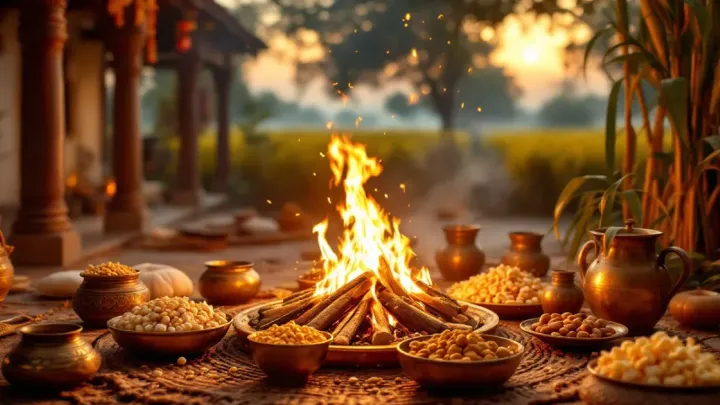
Lohri is the bonfire night of Punjab: the last night of the month of Poh, when families gather around a fire in the courtyard or the street, offer til, gur, peanuts and popcorn to Agni, sing the song of Dulla Bhatti and dance until late. Lohri 2027 falls on Thursday, 14 January 2027 according to Drik Panchang for New Delhi and Amritsar, with Maghi and Makar Sankranti on Friday, 15 January.
Many printed calendars, school holiday lists and websites give Wednesday, 13 January 2027 instead, because Lohri is usually on 13 January. The next section explains the difference. If your gurdwara, mandir or Lohri committee has announced a date, follow that.
Lohri 2027 date and timings
| Event | Date and time | Source |
|---|---|---|
| Lohri (Drik Panchang, Delhi and Amritsar) | Thursday 14 January 2027 | Drik Panchang |
| Lohri (many printed calendars and holiday lists) | Wednesday 13 January 2027 | Varies |
| Sunset, Delhi | 5:44 PM on 13 Jan, 5:45 PM on 14 Jan | Drik Panchang |
| Sunset, Amritsar | 5:47 PM on 13 Jan, 5:48 PM on 14 Jan | Drik Panchang |
| Sankranti moment (Sun enters Makar) | 9:14 PM IST, Thursday 14 January 2027 | Drik Panchang |
| Maghi and Makar Sankranti | Friday 15 January 2027 | Drik Panchang |
The bonfire has no fixed muhurat. It is lit after sunset, once the family and neighbours have gathered, usually between about 6 and 8 PM.
Why do some calendars say 13 January and others 14 January?
Lohri is kept on the night before Maghi, the first day of the solar month of Magh, which is also Makar Sankranti. Most years the Sun enters Makar (Capricorn) on 14 January, so Lohri is on 13 January, and that is the date most people remember.
In 2027 the Sun enters Makar at 9:14 PM IST on 14 January. Because that moment comes after sunset, Drik Panchang counts Makar Sankranti on 15 January and puts Lohri on the evening of 14 January, the night the Sun actually moves into Makar. Calendars that keep Lohri on 13 January every year list it a day earlier. This is the same reason Makar Sankranti 2027 is on 15 January rather than the usual 14th. Both dates are kept in good faith; what matters is that you light the fire with your family and community.
What is Lohri?
Lohri is a winter and harvest festival of Punjab, Haryana, Himachal Pradesh, Jammu and Delhi, kept by Hindu and Sikh families alike. It marks the end of the coldest part of winter: after the longest nights of Poh, the Sun begins its northward journey (Uttarayana) and the days grow longer. In the fields the sugarcane is being cut and the wheat sown in autumn is growing, so the fire is also a thanksgiving for the harvest and a prayer for the next one.
There are a few explanations of the name. One is that it comes from til (sesame) and rorhi (jaggery), the two things thrown into the fire, which became tilohri and then Lohri. Another links it to loh, the warmth and light of the fire. Whatever its origin, the word means one thing to a Punjabi family: the fire, the sweets and the songs.
How to do the Lohri puja, step by step
Lohri has no priest and no complicated vidhi. It is a family offering to Agni, the fire, done together. This is how most families keep it.
- Collect the wood in the afternoon. Children traditionally go from house to house during the day singing Lohri songs and collecting wood, dung cakes, money and sweets. Today most families buy the wood or pool it with the neighbours.
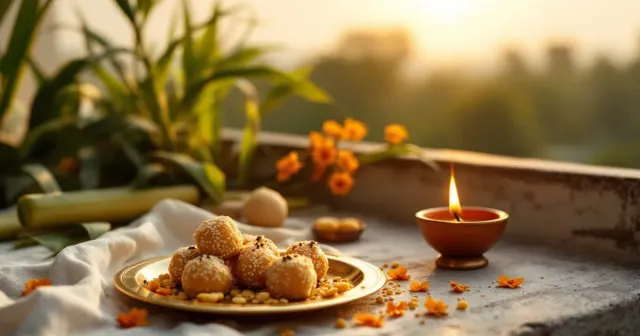
- Prepare the offering. Fill a plate or a basket with til, gur, rewari, gajak, roasted peanuts, popcorn (and in some homes phulliyan, puffed rice, and pieces of sugarcane). Keep some aside to share afterwards as prasad.
- Light the fire after sunset. The eldest member of the family or the head of the house usually lights it. Many families fold their hands and say a short prayer to Agni for health, a good harvest and prosperity for the year.
- Walk around the fire (parikrama). Everyone walks around the bonfire, usually clockwise, throwing handfuls of til, gur, popcorn and peanuts into it. A line often said with the offering is “Eesar aaye, daliddar jaaye”: may prosperity come and poverty go.
- Share the prasad. The rest of the til, gur, rewari, gajak, peanuts and popcorn is shared with everyone around the fire.
- Sing and dance. The songs begin with “Sundar mundriye”, then bhangra for the men and gidda for the women, often around the fire until late at night.
- Eat the Lohri meal. Sarson da saag with makki di roti is the classic dinner. Many homes cook rau di kheer, rice cooked slowly in sugarcane juice, on Lohri night and eat it cold the next morning on Maghi.
What to prepare for Lohri
| Item | Why |
|---|---|
| Dry wood and cow-dung cakes | For the bonfire |
| Til (sesame) and gur (jaggery) | The main offerings to Agni |
| Rewari and gajak | Sesame and jaggery sweets, offered and shared |
| Roasted peanuts and popcorn | Offered in the fire and eaten around it |
| Sugarcane | Harvest offering; some put pieces in the fire |
| Sarson da saag, makki di roti, rau di kheer | The Lohri night meal |
| Warm clothes and blankets | It is a cold January night outdoors |
The story of Dulla Bhatti and Sundar Mundriye
The best known Lohri song is a call-and-response sung by children as they go from house to house. It begins:
Sundar mundriye, ho! Tera kaun vichara, ho! Dulla Bhatti wala, ho! Dulle di dhee viyahi, ho!
“Sundar mundriye, who will look after you? Dulla Bhatti will. Dulla’s daughter was married.”
The song remembers Dulla Bhatti, Rai Abdullah Khan Bhatti, a rebel of the Punjab during the reign of the Mughal emperor Akbar in the late 16th century. In Punjabi folk memory he was a Robin Hood figure who robbed the rich and protected the poor. The story that Lohri keeps is this: girls from poor families were being taken by force and sold, and Dulla Bhatti rescued them. One version names two of them, Sundri and Mundri. He found them grooms, and since they had no one to give them away, he stood as their father at the wedding. With no money for a dowry, he gave them a ser of shakkar (raw sugar) as his gift.
That is why the song calls Dulla’s daughter married, and why the sweets of Lohri are shared with everyone. Dulla Bhatti was later captured and executed at Lahore, but the song of the man who stood as father to girls who had none is sung at every Lohri fire.
First Lohri of a bride or a baby
The first Lohri after a wedding, or after the birth of a child, is one of the biggest celebrations in a Punjabi home. Traditionally it was celebrated most for a son; today many families celebrate the first Lohri of a daughter with the same joy, and some call it dhiyan di Lohri.
- The new bride wears new clothes and jewellery and sits near the fire with her husband. Her parents and relatives send sweets, clothes and gifts, and the women sing and dance gidda for her.
- The baby is brought, well wrapped, to the fire with the mother. Relatives bless the child, the family distributes sweets, and some families invite the whole neighbourhood.
- Both couples and new parents walk around the fire together and make the offering of til and gur.
Lohri, Maghi and Makar Sankranti
Lohri is the night; the next morning is a new solar month. In Punjab that day is Maghi, when Sikh families visit the gurdwara and many go to the Maghi Mela at Sri Muktsar Sahib, which remembers the Chali Mukte, the Forty Liberated Ones. Hindu families take a bath early, give daan of til, gur and khichdi, and worship Surya on Makar Sankranti. In Tamil Nadu the same day is Thai Pongal, with Bhogi on the eve, much like Lohri’s bonfire.
For every festival and vrat date of the year, see the Hindu festival calendar 2027.
Lohri outside India
Punjabi families in Canada, the UK, the USA, Australia and the Gulf keep Lohri too. Many gurdwaras, mandirs and community associations hold a bonfire or a Lohri night, often on the weekend nearest the date, since an open fire is not always possible at home. Check with your local gurdwara or association for the time and place.
Keeping Lohri with Deva AI
Deva AI is a free Android app that lets you talk to Hindu gods like Krishna, Shiva, Ganesha and Hanuman through AI conversations, in English, Hindi, Telugu, Tamil, Kannada and Malayalam. If you are far from family this Lohri, you can light a lamp and offer flowers in the app’s virtual pooja, and the next morning count your Surya mantra or Gayatri japa with the japa counter for Makar Sankranti. You can also talk to Krishna or Shiva in Hindi or English, by text or voice, about what the turning of the season means. To learn more, read what Deva AI is.
Frequently asked questions
When is Lohri in 2027?
Drik Panchang gives Thursday, 14 January 2027 for New Delhi and Amritsar, with Makar Sankranti on Friday, 15 January. Several other calendars and holiday lists give Wednesday, 13 January, so check with your local gurdwara, mandir or community.
Why do some calendars say 13 January and others 14 January for Lohri 2027?
Lohri is the night before Maghi and Makar Sankranti. In 2027 the Sun enters Makar at 9:14 PM IST on 14 January, after sunset, so Sankranti is counted on 15 January and Lohri on the evening of 14 January. Calendars that keep the usual 13 January date for Lohri list it a day earlier.
What time is the Lohri bonfire lit?
After sunset, when the family and neighbours have gathered. On 14 January 2027 sunset is about 5:45 PM in Delhi and 5:48 PM in Amritsar (Drik Panchang). There is no single fixed muhurat; most families light it between sunset and about 8 PM.
What is offered in the Lohri fire?
Til (sesame), gur (jaggery), rewari, gajak, peanuts, popcorn and sometimes puffed rice and sugarcane pieces. People walk around the fire and throw a handful in as an offering to Agni, then share the rest as prasad.
What is the first Lohri?
The first Lohri after a wedding or the birth of a child is celebrated on a large scale. The new bride or the baby sits near the fire with the family, relatives bring gifts and sweets, and there is singing, bhangra and gidda late into the night.
Is Lohri the same as Makar Sankranti?
No. Lohri is the bonfire night on the eve; the next day is Maghi in Punjab and Makar Sankranti across India, when people bathe, give daan and worship Surya.