Durga Saptashati: What It Is, Chapters and How to Read It
Quick answer
Durga Saptashati, also called Devi Mahatmyam or Chandi Path, is a 700-verse Sanskrit text from the Markandeya Purana in 13 chapters. It tells three stories of the Goddess defeating Madhu-Kaitabha, Mahishasura and Shumbha-Nishumbha, and is read especially during Navratri. A full path is usually framed by the Kavacham, Argala and Keelakam before and the Kshama Prarthana after, and can be read in one sitting or spread over several days.
Every Navratri, in homes from Kolkata to Chennai, someone sits before a lamp and a kalash and reads the same book aloud, chapter by chapter, for nine nights. That book is the Durga Saptashati. Families call it by many names and read it in many ways, but the text is the same 700 verses, and so is the hope behind it: protection, courage and the Mother’s grace.
What is Durga Saptashati? Durga Saptashati is a 700-verse Sanskrit hymn and story of the Goddess, found in the Markandeya Purana and arranged in 13 chapters. It is also called Devi Mahatmyam (the glory of the Goddess) and Chandi Path. It tells three stories in which the Goddess, as Mahakali, Mahalakshmi and Mahasaraswati, destroys the demons Madhu and Kaitabha, Mahishasura, and Shumbha and Nishumbha. It is read above all during Chaitra and Sharad Navratri, and on Fridays and Ashtami days through the year.
This guide covers what the text contains, how its chapters are grouped, the prayers read before and after it, and a simple way to do the path at home.
Where does Durga Saptashati come from?
The Devi Mahatmyam forms a block of chapters inside the Markandeya Purana, one of the eighteen major Puranas. It is framed as a conversation. A king named Suratha, who has lost his kingdom, and a merchant named Samadhi, thrown out by his own family, meet in the forest hermitage of the sage Medhas. Both ask the same question: why does the mind still cling to those who hurt us? The sage answers by telling them about Mahamaya, the Goddess whose power both binds the world in attachment and frees it, and then narrates her deeds.
The frame matters. The Saptashati is not only a battle story; it is an answer to a very human problem of grief and attachment, and it ends with both men receiving the Goddess’s blessing.
What are the 13 chapters of Durga Saptashati?
The 13 chapters are grouped into three charitras (episodes), each with its own presiding form of the Goddess.
| Charitra | Chapters | Presiding form | Story |
|---|---|---|---|
| Prathama (first) | 1 | Mahakali | Vishnu, woken from yogic sleep by the Goddess’s grace, slays Madhu and Kaitabha |
| Madhyama (middle) | 2-4 | Mahalakshmi | The Goddess is born from the radiance of all the gods and slays Mahishasura |
| Uttama (last) | 5-13 | Mahasaraswati | The Goddess destroys Shumbha, Nishumbha and their generals |
Chapter by chapter:
- Chapter 1: Suratha and Samadhi meet the sage Medhas. The story of Madhu and Kaitabha, and Brahma’s hymn to the Goddess as Yoganidra.
- Chapter 2: The gods, defeated by Mahishasura, pour out their anger as light; it takes the form of the Goddess, and each god gives her a weapon. She destroys Mahishasura’s army.
- Chapter 3: The slaying of Mahishasura.
- Chapter 4: The gods praise her (the Shakradi Stuti), and she promises to come whenever they remember her in distress.
- Chapter 5: The gods, oppressed by Shumbha and Nishumbha, pray on the Himalaya with the famous Ya Devi Sarvabhuteshu verses. The Goddess Ambika appears, and Shumbha sends a proposal of marriage.
- Chapter 6: The demon Dhumralochana is destroyed.
- Chapter 7: Kali springs from the Goddess’s brow and slays Chanda and Munda, and is named Chamunda.
- Chapter 8: The battle with Raktabija, from each drop of whose blood a new demon rose, and the Matrikas who fight beside the Goddess.
- Chapter 9: Nishumbha is slain.
- Chapter 10: Shumbha is slain.
- Chapter 11: The gods praise her as Narayani (the Narayani Stuti), and she foretells her future appearances to protect the world.
- Chapter 12: The Goddess herself describes the blessings of reading and hearing this text.
- Chapter 13: Suratha and Samadhi worship the Goddess; Suratha receives his kingdom and a future as a Manu, and Samadhi receives the knowledge that frees him.
For the deeper meaning of the Goddess’s forms, see our guide to Durga’s nine forms, the Navadurga, which many families worship on the nine days they read the Saptashati.
Which verses of Durga Saptashati are most famous?
Two passages are chanted on their own far more than the rest.
From chapter 5, the refrain of the gods’ hymn, repeated for every quality in which the Goddess dwells (as consciousness, as intelligence, as sleep, as hunger, as forgiveness, as mother and many more):
Ya Devi sarvabhuteshu shakti-rupena samsthita Namastasyai namastasyai namastasyai namo namah
To the Goddess who dwells in all beings in the form of power: salutations to her, salutations to her, salutations to her again and again.
From chapter 11, the Narayani Stuti verse sung at the end of many pujas:
Sarva-mangala-mangalye shive sarvartha-sadhike Sharanye tryambake gauri narayani namostute
O auspiciousness of all that is auspicious, O gracious one who fulfils every aim, refuge of all, three-eyed Gauri, Narayani, salutations to you.
What is read before and after Durga Saptashati?
A full path (parayana) traditionally places the 13 chapters inside a frame of shorter prayers, called the angas (limbs). The order varies a little between editions and families; a common sequence is:
Before the 13 chapters
- Devi Kavacham – a prayer of protection, asking the forms of the Goddess to guard each part of the body.
- Argala Stotram – verses asking the Goddess to remove obstacles, with the refrain rupam dehi jayam dehi yasho dehi dvisho jahi.
- Keelakam – a short hymn traditionally said to “unlock” the fruit of the reading.
- Navarna mantra japa – Om Aim Hreem Kleem Chamundayai Vichche, often 108 times. Many families take this mantra only with a guru’s instruction; if that is your custom, follow it.
- Ratri Suktam – the hymn to the Goddess as Night, often read before chapter 1.
After the 13 chapters
- Devi Suktam – the Vedic hymn in which the Goddess speaks of herself as the power in all things.
- Navarna mantra japa again.
- The three Rahasyas (Pradhanika, Vaikritika and Murti Rahasya), read in some traditions.
- Kshama Prarthana – asking forgiveness for any mistake in the reading.
Some readers also add the Siddha Kunjika Stotram, a short hymn that tradition offers to those who cannot complete the whole text on a given day.
How do I read Durga Saptashati at home?
You do not need an elaborate setup. A simple, sincere path is enough.
What to prepare
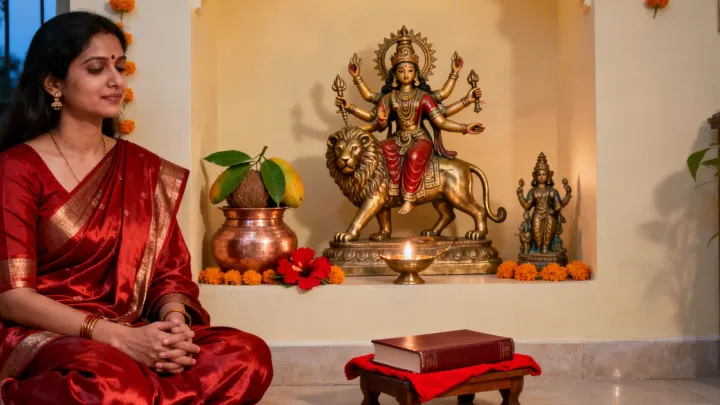
- A clean place facing east or north, a small red cloth and a picture or murti of Durga
- A ghee or oil lamp, incense, red flowers (hibiscus is traditional), kumkum and rice
- A kalash with water and mango leaves if you are doing Navratri ghatasthapana
- A reliable printed edition (Gita Press and Ramakrishna Math editions are widely used), placed on a stand or cloth, never on the floor
Step by step
- Bathe and sit calmly. Light the lamp and offer a flower to Ganesha first, as at the start of any puja.
- Take a sankalpa. Hold water and rice in your right hand, say your name, the day and your intention (for example, “for the peace and protection of my family”), and release it.
- Read the opening angas – Kavacham, Argala, Keelakam – and chant the Navarna mantra if it is part of your practice.
- Read the chapters in order. Read aloud or in a clear low voice, not silently in the mind. Do not stop in the middle of a chapter; if you must break, finish the chapter you are on.
- Read the closing prayers, ending with the Kshama Prarthana.
- Offer aarti and a simple naivedyam (fruit, jaggery, kheer or whatever your family offers), and share it as prasad.
Rules most traditions agree on: pronounce the words as carefully as you can, do not skip chapters, keep the book with respect, and keep the mind on the meaning rather than on speed.
How long does it take, and can I split it over several days?
Read at a steady pace, the 13 chapters take most people two to three hours; experienced readers are faster. If that is too long for one sitting, many households spread it out:
| Plan | How it is commonly divided |
|---|---|
| One day | All angas and all 13 chapters in one sitting, often on Ashtami or Navami |
| Three days | Day 1: chapter 1 (Prathama charitra); Day 2: chapters 2-4 (Madhyama); Day 3: chapters 5-13 (Uttama) |
| Seven or nine days | The chapters spread across Navratri, finishing on Navami; editions and family customs give slightly different splits |
Whatever the plan, read in order and complete the whole text. On days when even that is not possible, many devotees read a single chapter, the Argala Stotram or the Siddha Kunjika Stotram rather than nothing at all.
When is the best time to read Durga Saptashati?
- Navratri: the most common time. Chaitra Navratri 2027 runs from 7 April to 15 April 2027, and Sharad Navratri usually falls in September or October.
- Ashtami and Navami of each lunar month, and Fridays, are traditional days for the Goddess.
- In times of trouble: Chapter 12 itself says that one who hears these deeds with devotion is freed from fear and difficulty, so many families read it during illness, before a journey or at a hard turn in life.
If you count the Navarna mantra or Om Dum Durgayai Namah on a mala, our guide on what japa is and how to count mantras explains the method.
What benefits does Durga Saptashati promise?
The text speaks for itself in chapter 12, where the Goddess says that whoever reads or listens to these stories with devotion, especially on Ashtami, Navami and Chaturdashi, will be protected from enemies, fear and calamity, and will gain prosperity and peace. Devotees read it for:
- Protection of the home and family
- Courage in the face of fear, illness or conflict
- Removing obstacles in work, study and marriage
- Inner strength, which is the real subject of the frame story: Suratha and Samadhi come to the sage broken by attachment and leave free
These are traditional beliefs about a sacred text, offered with faith. They do not replace medical, legal or financial help when you need it; many families pray and act at the same time.
Can I ask about Durga Saptashati in Deva AI?
Deva AI is a free Android app that lets you talk to Hindu gods like Krishna, Shiva, Ganesha and Hanuman through AI conversations, in English, Hindi, Telugu, Tamil, Kannada and Malayalam. Durga Devi is one of its ten deities. You can ask a Durga companion, inspired by scripture and tradition, what a chapter means, why Kali appears in the battle with Chanda and Munda, or how to keep your Navratri reading going when the days get busy. It is a study and prayer companion, not a replacement for the text or for your family’s tradition.
During Navratri you can also count your Navarna or Durga mantra japa with Deva AI’s japa counter and keep a daily streak while you finish the path. For more ways to pray to the Mother of prosperity, read our Lakshmi Devi prayer guide, and see what Deva AI is.
Frequently asked questions
What is Durga Saptashati?
Durga Saptashati is a Sanskrit text of 700 verses in 13 chapters, found in the Markandeya Purana. It praises the Goddess as the power behind the universe and tells how she defeats the demons Madhu-Kaitabha, Mahishasura, and Shumbha and Nishumbha.
Is Durga Saptashati the same as Devi Mahatmyam and Chandi Path?
Yes. Devi Mahatmyam (the glory of the Goddess) is its name in the Purana, Saptashati means "seven hundred" after its verse count, and in Bengal and much of North India it is called Chandi Path.
How many days does it take to read Durga Saptashati?
A practised reader finishes the 13 chapters in about two to three hours. Many families spread it over three, seven or nine days of Navratri, as long as the chapters are read in order and the reading is completed.
Can I read Durga Saptashati at home without a priest?
Yes. Many households read it themselves with a sankalpa, a lamp and a simple puja. Read slowly and clearly; if Sanskrit is difficult, a reliable printed edition with transliteration or a translation in your language helps.
Which chapter of Durga Saptashati has Ya Devi Sarvabhuteshu?
The Ya Devi Sarvabhuteshu verses are in the fifth chapter, where the gods praise the Goddess on the Himalaya before the story of Shumbha and Nishumbha begins.
Can women read Durga Saptashati?
Yes. Women read the Saptashati in homes across India, especially during Navratri. Family and regional customs differ on details such as reading during periods, so follow your own tradition.