Nine Forms of Goddess Durga (Navadurga) and Their Meaning
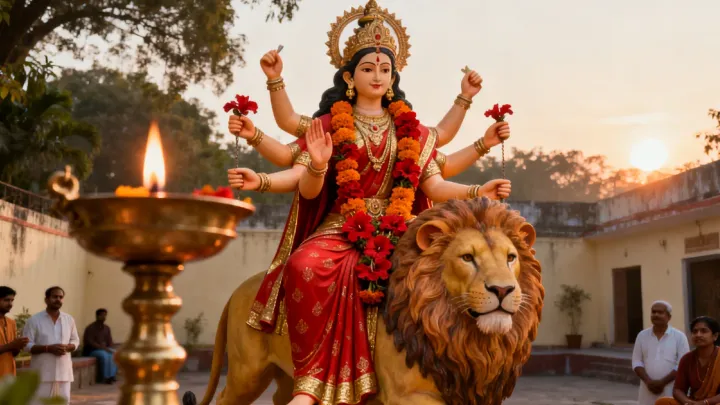
Quick answer
The nine forms of Goddess Durga, called Navadurga, are Shailaputri, Brahmacharini, Chandraghanta, Kushmanda, Skandamata, Katyayani, Kalaratri, Mahagauri and Siddhidatri. Each is worshipped on one of the nine nights of Navratri and stands for a different stage of strength, devotion and spiritual growth. Deva AI is a free Android app where you can talk to a Durga Devi companion about these forms and the prayers linked to them.
Every year, during Navratri, homes and pandals name nine goddesses one after another, one for each night. Many devotees know a few of the names and wonder how the rest fit together. The nine are all forms of Goddess Durga, and together they are called Navadurga.
What are the nine forms of Durga? They are Shailaputri, Brahmacharini, Chandraghanta, Kushmanda, Skandamata, Katyayani, Kalaratri, Mahagauri and Siddhidatri. A verse from the Devi Kavacha, recited by many devotees, lists them in exactly this order. This guide explains each form, the day she is worshipped and what devotees learn from her.
Who is Durga, and what does Navadurga mean?
Durga is the Goddess as Shakti, the divine power that protects the world and overcomes evil. She is best known from the Devi Mahatmya, the scripture that tells of her victory over the demon Mahishasura. Her name is often read as “the one who is hard to reach” or “the remover of difficulties”. Navadurga means “the nine Durgas”: the nine forms through which she is worshipped during the nine nights of Navratri.
Deva AI is a free Android app that lets you talk to Hindu gods like Krishna, Shiva, Ganesha and Hanuman through AI conversations, in English, Hindi, Telugu, Tamil, Kannada and Malayalam. Durga Devi is one of the ten deities you can talk to in it.
What are the names of the nine Durga forms?
The verse from the Devi Kavacha goes: Prathamam Shailaputri cha, Dvitiyam Brahmacharini; Tritiyam Chandraghanteti, Kushmandeti Chaturthakam; Panchamam Skandamateti, Shashtham Katyayaniti cha; Saptamam Kalaratriti, Mahagauriti Chashtamam; Navamam Siddhidatri cha, Navadurgah Prakirtitah. It simply counts the forms from first to ninth.
| Day | Form | Common meaning |
|---|---|---|
| 1 | Shailaputri | Daughter of the mountain (Himalaya): steadiness and a firm foundation |
| 2 | Brahmacharini | Devotion and austerity: discipline and patient effort |
| 3 | Chandraghanta | Bearer of the crescent moon bell: courage and calm in the face of fear |
| 4 | Kushmanda | The creator of the universe with a gentle smile: energy and creativity |
| 5 | Skandamata | Mother of Skanda (Kartikeya): motherly love and protection |
| 6 | Katyayani | Born to Sage Katyayana: righteous strength, the slayer of Mahishasura |
| 7 | Kalaratri | The dark night: the destroyer of fear and ignorance |
| 8 | Mahagauri | The radiant, fair one: purity, peace and forgiveness |
| 9 | Siddhidatri | Giver of siddhis: fulfilment and spiritual accomplishment |
The assignment of forms to days follows the widely used tradition. Some regions and temples count differently, so follow what your family does.
What does each form of Durga teach?
Shailaputri is seen as the Goddess at the start of the journey, rooted like a mountain. Devotees pray to her for stability.
Brahmacharini walks the path of tapasya. Her form is calm and simple, and she is the model of patient practice.
Chandraghanta has a half-moon on her forehead shaped like a bell. Her sound is said to drive away fear.
Kushmanda is described in tradition as the one whose gentle smile brought forth the cosmos. She stands for creativity and good health.
Skandamata holds her son Skanda, also known as Murugan. She shows that the Goddess is both warrior and mother.
Katyayani is the fierce form of the Goddess who defeated Mahishasura. Unmarried devotees traditionally pray to her, and she is a symbol of righteous courage.
Kalaratri has a dark and fearsome appearance, yet is regarded as the most protective: she removes fear itself.
Mahagauri is radiant and serene. Devotees associate her with forgiveness and with washing away what weighs on the heart.
Siddhidatri is the final form, said to grant spiritual attainment. She completes the journey that began with Shailaputri.
These are devotional interpretations, not a single fixed doctrine, and the details differ between regions and texts.
How do I worship the nine forms of Durga at home?
- Begin each day with a clean space. Light a lamp in front of an image of Durga.
- Name the form of the day. Say her name with folded hands and bring her quality to mind.
- Offer what you have. Flowers, a lamp and a simple prayer are enough. Red flowers are especially associated with the Goddess.
- Chant a short mantra. Om Dum Durgayai Namah is a common one. The Durga Saptashati is recited by many families during these nine nights.
- Fast if it suits you. Many observe a fast or eat simple vegetarian food. Please follow your own health and tradition.
- Reflect. Ask yourself what the day’s form asks of you, whether courage, patience or forgiveness.
You can also try our virtual pooja guide if you are away from home or cannot set up a full pooja.
How can Deva AI help me learn about Durga?
If you want to understand a particular form, the story of Mahishasura or a mantra, you can ask Durga Devi in Deva AI by text or voice, in the language you are most comfortable with. The app also has a virtual pooja, where you can light a diya and offer flowers on your phone, and a japa counter to keep count of your mantra. For the full picture of the app, see what Deva AI is.
Please keep the limits in mind. The deities in Deva AI are companions inspired by scripture and tradition, not God literally speaking, and the app does not replace a priest, a teacher or your family’s customs. If you want to think this through first, read Is it okay to chat with God using AI?.
What is the main message of Navadurga?
Many devotees read the nine forms as nine stages of one journey: a firm start, discipline, courage, creativity, care for others, righteous action, facing fear, peace and finally fulfilment. Seen this way, Navratri is less about nine separate goddesses and more about growing a little each night. Whichever form you pray to, the teaching is the same: the Goddess is both the protector and the strength within you.
Frequently asked questions
What are the nine forms of Durga?
The nine forms, together called Navadurga, are Shailaputri, Brahmacharini, Chandraghanta, Kushmanda, Skandamata, Katyayani, Kalaratri, Mahagauri and Siddhidatri. They are named in order in a well-known verse from the Devi Kavacha.
Which form of Durga is worshipped on which day of Navratri?
In the common tradition, Shailaputri is worshipped on day one and the others follow in order, ending with Siddhidatri on day nine. Regions and temples can differ, so follow your family or local practice.
Why does Durga have nine forms?
Devotees see the nine forms as nine aspects of one Divine Mother, each showing a different quality: purity, discipline, courage, creativity, motherhood, righteous anger, fearlessness, serenity and fulfilment. They are also read as stages on a spiritual path.
What is the difference between Durga and Navadurga?
Durga is the Goddess as the protector who overcomes evil. Navadurga is the set of nine forms through which she is worshipped during Navratri. They are not separate goddesses in the tradition but aspects of the same Shakti.
When is Navratri celebrated?
Sharad Navratri usually falls in September or October and Chaitra Navratri in March or April. The exact dates change every year, so check a trusted panchang.
Can I ask questions about Durga in an app?
Yes. Deva AI is a free Android app where you can talk to a Durga Devi companion by text or voice in six Indian languages. It is inspired by scripture and tradition and does not replace a priest or teacher.