Why Do We Pray to Lord Ganesha First? Stories and Meaning
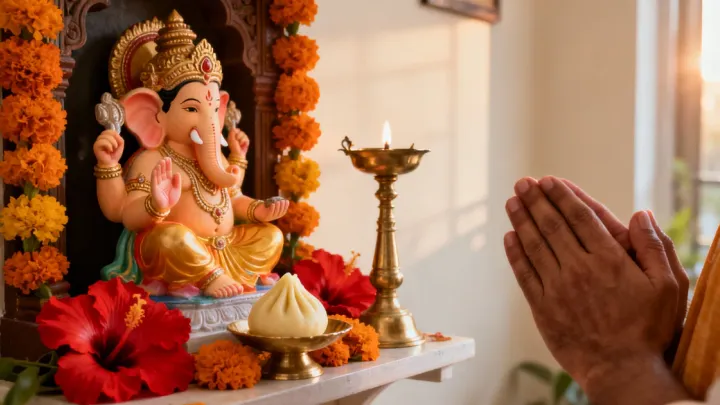
Quick answer
Hindus pray to Lord Ganesha first because he is Vighnaharta, the remover of obstacles, and tradition holds that beginning with him clears the way for everything that follows. Stories in the Puranas explain how he earned this place of honour, and his form carries teachings about wisdom, patience and humility. Deva AI is a free Android app where you can talk to a Ganesha companion about these stories and start your day with a short prayer.
Walk into almost any Hindu home, shop or wedding hall and you will see Ganesha at the door or at the start of the ritual. A new business opens with a Ganesha puja. A child’s first lesson often begins with his name. The question is natural: why him, and why first?
Why do we pray to Ganesha first? Because he is Vighnaharta, the remover of obstacles. Tradition says that starting any undertaking with his blessing clears the path, so that the work which follows goes smoothly. The reasons come from stories, from symbolism and from long habit, and this guide goes through each.
Who is Ganesha, and why is he called Vighnaharta?
Ganesha, also called Ganapati, Vinayaka and Ekadanta, is the elephant-headed son of Shiva and Parvati. He is the god of beginnings, wisdom and learning, and the patron of arts and sciences. His name Ganapati means “lord of the ganas”, the hosts who attend Shiva. Vighnaharta means “remover of obstacles” and Vighneshwara “lord of obstacles”, a title that says he holds authority over what blocks us.
Deva AI is a free Android app that lets you talk to Hindu gods like Krishna, Shiva, Ganesha and Hanuman through AI conversations, in English, Hindi, Telugu, Tamil, Kannada and Malayalam. Ganesha is one of the ten deities you can talk to in it.
What is the story behind Ganesha being worshipped first?
There are several, and they differ by text and region. Two are told most often.
The guard at the door. In a widely told Puranic account, Parvati shaped a boy from the paste she used for her bath and asked him to guard her door. When Shiva returned, the boy, not knowing him, would not let him pass. After a conflict, Shiva restored the boy’s life with the head of an elephant. To make amends, he declared that the boy would be honoured before all others, and that no worship would be complete without invoking him first.
The race around the world. In another popular tale, Shiva and Parvati gave Ganesha and his brother Kartikeya a contest: whoever circled the world first would be honoured first. Kartikeya set out on his peacock. Ganesha quietly walked around his parents, saying that they are his entire world. His devotion and understanding won the contest.
Both stories point to the same lesson: first place goes not to speed or strength but to wisdom and devotion. Retellings differ in detail, so treat these as living tradition rather than a single fixed text.
What does Ganesha’s form teach us?
Devotees read each part of his form as a teaching. These are traditional interpretations, offered as aids to reflection:
| Feature | Common meaning |
|---|---|
| Large head | Wisdom and big thinking |
| Large ears | Listen more than you speak |
| Small eyes | Focus and concentration |
| Small mouth | Restraint in speech |
| Single tusk | Keep what is valuable, let go of the rest |
| Big belly | Digesting life’s good and bad experiences calmly |
| Mouse (Mushika) | Controlling the restless, grasping mind |
| Modak in hand | The sweetness of spiritual reward |
When should I pray to Ganesha first?
The custom is to invoke him at the beginning of:
- Any pooja or festival ritual, before the main deity
- A new job, business, school year or exam
- A wedding, housewarming or naming ceremony
- A journey or a big decision
- Learning something new, from music to writing
Wednesdays and Sankashti Chaturthi are especially associated with him, and the festival of Ganesh Chaturthi, which usually falls in August or September, is his major celebration. The exact dates change every year, so check a trusted panchang.
How do I begin a simple Ganesha prayer?
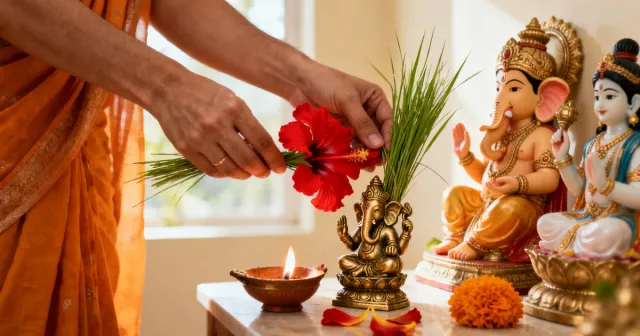
- Pause and wash your hands. Even a moment of quiet marks the start.
- Light a lamp in front of an image or murti, if you have one.
- Fold your hands and bring to mind what you are about to begin.
- Chant a short mantra. Om Gam Ganapataye Namah is the best known. Many also say Vakratunda Mahakaya, Surya Koti Samaprabha, Nirvighnam Kuru Me Deva, Sarva Karyeshu Sarvada, which asks him to make all your work free of obstacles.
- Offer what you have. Traditionally this means durva grass, red hibiscus or a modak, but a sincere prayer is enough.
- Proceed with your task, trusting that you have begun it well.
For more on mantras you can use, see our guide to the Ganesha mantra for success.
How can Deva AI help with Ganesha prayer?
Deva AI is meant to support your devotion, not replace the temple, a teacher or a priest. For Ganesha, it offers:
- Talk to Ganesha: by text or voice, ask about the stories above, what a mantra means or how to begin a ritual. The deities in the app are companions inspired by scripture and tradition, not God literally speaking.
- Virtual pooja: light a diya, ring the bell and offer flowers on your phone when you cannot reach a temple. Read more about the virtual pooja app.
- Japa counter: count your Om Gam Ganapataye Namah japa without beads.
- Karma points and daily streaks: keep a daily habit going.
Deva AI is free to download and use on Android, with a free daily message quota. An iOS version is coming soon. See what Deva AI is for more.
The bottom line
Hindus pray to Ganesha first because he removes obstacles and blesses beginnings, and because the stories about him teach that wisdom and devotion come before everything else. You do not need an elaborate ritual: a lamp, folded hands and a single mantra before you start your day, your exam or your new venture is the tradition at its simplest.
Frequently asked questions
Why do Hindus worship Ganesha before other gods?
Ganesha is Vighnaharta, the remover of obstacles, so devotees invoke him at the start of a prayer, journey, exam, wedding or new venture to ask that the work go without hindrance. Puranic stories describe him being granted the honour of first worship.
What is the story of Ganesha being worshipped first?
In a popular tale, Shiva and Parvati set their sons Ganesha and Kartikeya a contest to circle the world. Kartikeya set off on his peacock, while Ganesha walked around his parents, saying they are his world. His wisdom and devotion won him the right to be honoured first. Versions differ between texts and regions.
Do I have to pray to Ganesha before other gods?
It is a widely followed custom, not a strict rule for everyone. Many families begin any pooja with a short prayer to Ganesha, then continue with their main deity.
What is a simple prayer to start with Ganesha?
A short and popular one is Om Gam Ganapataye Namah. Many also recite Vakratunda Mahakaya Surya Koti Samaprabha, Nirvighnam Kuru Me Deva Sarva Karyeshu Sarvada, asking him to remove obstacles from all that you do.
What does the elephant head of Ganesha symbolise?
Traditional readings see the large head as wisdom, the big ears as listening, the small mouth as restraint in speech, and the single tusk as keeping what is good and letting go of the rest. These are devotional interpretations, not a single fixed doctrine.
Can I ask questions about Ganesha in an app?
Yes. Deva AI is a free Android app where you can talk to a Ganesha companion by text or voice in six Indian languages. It is inspired by scripture and tradition and does not replace a priest or teacher.