Guided Meditation with Krishna for Anxiety: A 10-Minute Script
Quick answer
A guided meditation with Krishna for anxiety has five steps: sit steadily as the Gita describes (6.11-13), slow the breath, picture Krishna's form in detail, repeat a mantra such as Om Namo Bhagavate Vasudevaya, and gently bring the mind back each time it wanders (6.26). Ten minutes a day is enough to start. Deva AI is a free Android app with short deity-led guided meditations and a Krishna companion you can talk to by text or voice.
When anxiety rises, the advice to “just meditate” can feel impossible: the mind is the very thing that will not sit still. A guided meditation with Krishna gives the mind something warm to hold on to, a beloved form, a familiar name and a teaching that was first spoken to a man in panic.
A guided meditation with Krishna for anxiety works in five steps: settle the body, slow the breath, picture Krishna, repeat his name, and keep returning when the mind runs off. The full ten-minute script is below, with the Bhagavad Gita verses each step comes from. This is a devotional practice, not medical treatment; if anxiety is heavy or constant, please use it alongside proper care.
Why meditate on Krishna when you feel anxious?
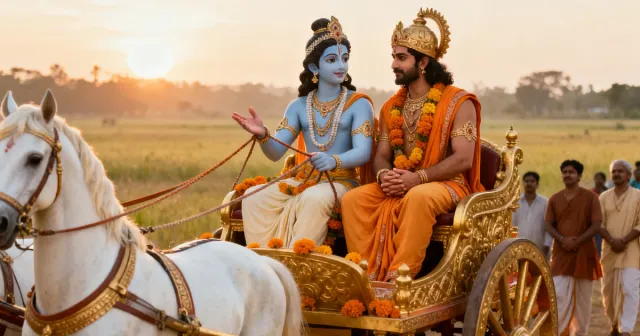
The Bhagavad Gita opens with Arjuna trembling, his mouth dry, his bow slipping from his hand (1.28-30). Krishna does not dismiss that fear. Over the following chapters he teaches Arjuna how to steady the mind, and Chapter 6, Dhyana Yoga, is a practical manual for meditation.
Focusing on a personal form of God, rather than on emptiness, is often easier for beginners. Krishna himself says that for embodied beings, the path of the unmanifest is harder (12.5), and that those who fix their minds on him with faith are dear to him (12.2). For an anxious mind, a face you love is easier to rest on than an abstract idea.
Krishna is also honest about how hard this is. Arjuna complains that the mind is “restless, turbulent, strong and obstinate”, as hard to control as the wind (6.34). Krishna agrees, and answers that it can be trained by abhyasa (steady practice) and vairagya (letting go) (6.35). That is a comforting place to start: the problem is normal, and the solution is repetition.
What do you need before you begin?
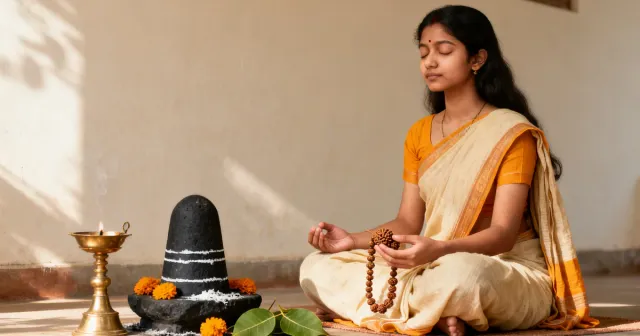
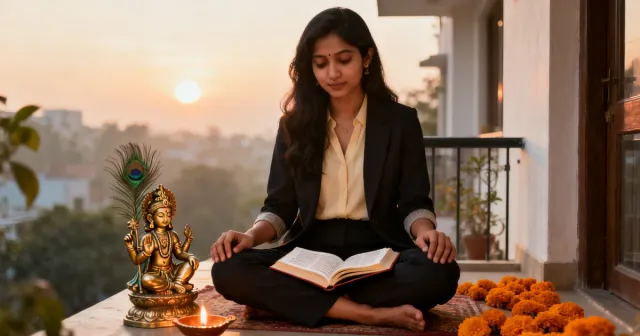
The Gita describes a clean place, a seat that is neither too high nor too low, and a steady posture with body, head and neck in line (6.11-13). In a modern home that means:
- A quiet corner where you will not be disturbed for 10-15 minutes.
- A firm seat: a mat or folded blanket on the floor, or an upright chair with feet flat.
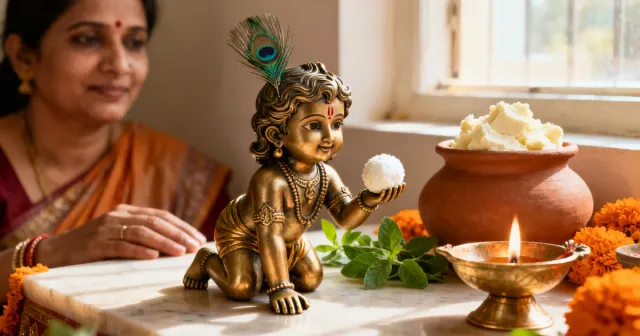
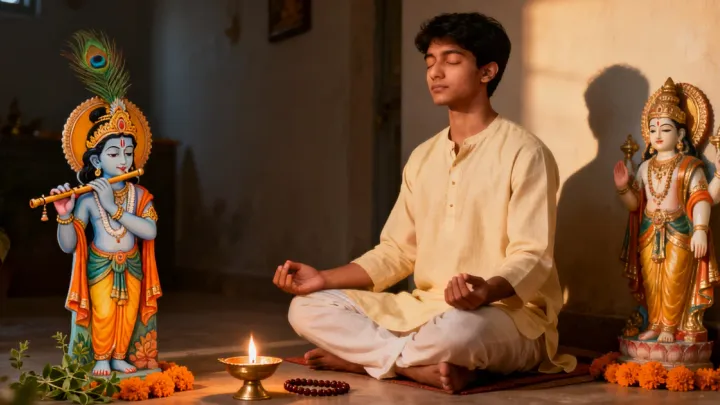
- Optional focus: a small Krishna picture or murti, a lit diya, a tulsi mala if you use one.
- A time you can keep: early morning is traditional, but any regular time works.
- Your phone on silent, or set to a gentle 10-minute timer.
The 10-minute guided meditation with Krishna
Read through the script once, then follow it from memory, or record yourself reading it slowly.
1. Settle the body (1 minute)
Sit down and let your spine rise naturally, head balanced over the shoulders. Rest your hands on your knees or in your lap. Close your eyes, or let them rest half-open on the picture in front of you. Feel the weight of your body on the seat. Say inwardly: “Krishna, I am sitting with you now.”
2. Slow the breath (2 minutes)
Breathe in through the nose for a count of four. Breathe out slowly for a count of six. A longer out-breath tells the body it is safe. Keep this rhythm for about ten breaths. If your thoughts are racing, let them race; your only task is the breath.
3. See Krishna (3 minutes)
Now build his form in your mind, slowly, one detail at a time, as devotees have done for centuries:
- His feet, standing lightly on a lotus or on soft grass by the Yamuna.
- His yellow silk pitambara and the forest-flower garland at his chest.
- His dark blue-grey skin, the colour of a rain cloud.
- His hands holding the flute near his lips.
- His gentle face and smiling eyes, looking straight at you.
- The peacock feather in his crown.
If the image slips, return to the feet and climb up again. You do not need a perfect picture. Even the feeling that he is near is enough.
4. Repeat his name (3 minutes)
With the image in your heart, repeat a mantra silently or in a whisper, letting it ride on the out-breath:
| Mantra | Meaning | How to use it |
|---|---|---|
| Om Namo Bhagavate Vasudevaya | “Om, salutations to the Lord Vasudeva (Krishna)” | One repetition per out-breath |
| Hare Krishna Hare Krishna, Krishna Krishna Hare Hare, Hare Rama Hare Rama, Rama Rama Hare Hare | A call to the divine (Hare) as Krishna and Rama | Softly aloud, at a calm pace |
| Krishna | His name alone | When the mind is too tired for more |
If you use a mala, you can count your repetitions; our guide to japa and counting mantras explains how.
5. Return, and offer the worry (1 minute)
Your mind will wander, probably many times. Each time, notice it and come back to the name. Krishna’s instruction is simply this: whenever the restless mind wanders, draw it back and settle it again (6.26). Every return is the meditation, not a failure of it.
In the final minute, name the thing you are anxious about, in one sentence, and place it at his feet. Remember his promise to those who think of him with undivided devotion: he carries what they lack and preserves what they have (9.22). Then take three slow breaths, bow your head, and open your eyes.
Which Gita verses can you hold on to during the day?
Carry one short line with you after the meditation. These are the verses most often returned to by people with anxious minds:
| Verse | Teaching | When it helps |
|---|---|---|
| 2.47 | You have a right to the action, not to its fruits | Worry about results, exams, interviews |
| 2.14 | Pleasure and pain come and go; bear them patiently | A bad day that feels permanent |
| 6.19 | A lamp in a windless place does not flicker | Picturing a steady mind |
| 6.35 | The mind is trained by practice and detachment | Feeling you are “bad at” meditation |
| 18.66 | Take refuge in me; do not grieve | Moments of overwhelm |
For a fuller look at these lessons, read Krishna’s Gita teachings for stress.
How often should you practise?
- Daily, at the same time, even on good days. The habit is what you lean on when a bad day arrives.
- Start with 10 minutes. Add five minutes once it feels easy.
- Use a short version in the moment: three slow breaths, picture Krishna’s face, say his name three times.
- Keep a one-line note after each sitting, how your mind felt before and after. Over weeks, the pattern is encouraging.
How can Deva AI help with Krishna meditation?
Deva AI is a free Android app that lets you talk to Hindu gods like Krishna, Shiva, Ganesha and Hanuman through AI conversations, in English, Hindi, Telugu, Tamil, Kannada and Malayalam. It includes short deity-led guided meditation sessions for peace and focus, so you can be talked through a sitting instead of remembering the steps.
After meditating, some people like to put their worry into words. In Deva AI you can talk to a Krishna companion by text or voice and ask, for example, what the Gita says about fear of failure, then open the Bhagavad Gita reader to read that verse with its meaning. The japa counter keeps track of your mantra repetitions, and daily streaks help the habit stick. The Krishna companion is an AI inspired by scripture and tradition, not Krishna himself speaking, and not a substitute for a counsellor. You can read more on the Talk to Krishna app page.
When is meditation not enough?
Meditation and prayer can bring real calm, but anxiety that disturbs your sleep, appetite, work or relationships for weeks deserves professional help too. Seeing a doctor or counsellor is not a lack of faith; Arjuna himself needed a guide. In India, the government’s free Tele-MANAS mental health helpline is available on 14416. If you ever feel unsafe, contact local emergency services or someone you trust straight away.
Krishna’s teaching is not that fear will never come. It is that you do not have to face it alone, and that a steady mind can be built, one breath and one name at a time.
Frequently asked questions
Can meditating on Krishna help with anxiety?
Many devotees find that focusing on Krishna's form, name and teaching calms a racing mind, and the Gita's sixth chapter is a guide to exactly this practice. It is a spiritual practice, not a treatment, so if anxiety is severe or constant, please also see a doctor or counsellor.
Which mantra is best for Krishna meditation?
Om Namo Bhagavate Vasudevaya and the Hare Krishna maha-mantra are the two most widely used. Choose the one your family or tradition uses, or the one that feels natural to you, and keep to it.
How long should I meditate on Krishna each day?
Start with 10 minutes once a day, ideally at the same time. Consistency matters more than length; once 10 minutes feels easy, add five more.
What do I do when my mind keeps wandering?
Notice it and bring it back, without scolding yourself. Krishna says in Bhagavad Gita 6.26 that whenever the restless mind wanders, it should be drawn back and settled again; that returning is the practice itself.
Do I need a Krishna murti or picture to meditate?
No, but a picture or small murti in front of you helps beginners hold the image. You can also close your eyes and build the form in your mind step by step.
Is there an app for guided meditation with Krishna?
Yes. Deva AI is a free Android app with short deity-led guided meditation sessions, a Bhagavad Gita reader and a Krishna companion you can talk to by text or voice in six languages.