Mahamrityunjaya Mantra: Meaning, Benefits and How to Chant
Quick answer
The Mahamrityunjaya mantra is a verse from the Rig Veda (7.59.12) addressed to Shiva as the three-eyed lord. It asks to be freed from the bondage of death and fear the way a ripe cucumber is freed from its vine. Devotees chant it for health, protection and courage, usually in multiples of 108. Deva AI is a free Android app where you can ask a Shiva companion about the mantra and count your japa.
The Mahamrityunjaya mantra is one of the oldest and most widely chanted prayers to Shiva. Families chant it at the bedside of someone who is unwell, before surgery, at dawn on Mondays and during Maha Shivaratri. Its power in people’s minds comes from a single idea: that devotion can loosen the grip of fear.
What is the Mahamrityunjaya mantra? It is a verse from the Rig Veda (7.59.12), repeated in the Yajur Veda, addressed to Tryambaka, the three-eyed Shiva. It asks to be released from the bondage of death, and fear of it, as gently as a ripe cucumber falls from its vine, without losing the hold on what is eternal. The name means “the great death-conquering mantra”.
What are the words of the Mahamrityunjaya mantra?
In Devanagari:
ॐ त्र्यम्बकं यजामहे सुगन्धिं पुष्टिवर्धनम् । उर्वारुकमिव बन्धनान् मृत्योर्मुक्षीय माऽमृतात् ॥
In roman letters:
Om Tryambakam yajamahe sugandhim pushtivardhanam Urvarukamiva bandhanan mrityor mukshiya maamritat
Many people add the seed syllables “Om Haum Joom Sah” before it in a longer form used in some traditions. The verse above is the original Vedic text.
What does the Mahamrityunjaya mantra mean, word by word?
| Sanskrit | Meaning |
|---|---|
| Om | The primal sound, the sacred beginning of a mantra |
| Tryambakam | The three-eyed one (Shiva) |
| Yajamahe | We worship, we honour |
| Sugandhim | The fragrant one, whose goodness spreads like perfume |
| Pushti-vardhanam | Who nourishes and increases wellbeing |
| Urvarukam iva | Like a ripe cucumber (or gourd) |
| Bandhanat | From its bond, its stem |
| Mrityor mukshiya | May I be freed from death |
| Ma amritat | Not from immortality |
Put together: “We worship the three-eyed Lord, fragrant and nourishing all beings. As a ripe cucumber is released from its vine, may he free us from death, and not from immortality.”
What is the deeper meaning behind the cucumber image?
A ripe fruit does not tear away from the plant in pain. It lets go when it is ready. The image teaches that the prayer is not for a life without end, and not for denial of death, but for a life where fear of loss no longer rules you. “Not from immortality” points to what tradition says does not die, the Self. Many teachers read the mantra as a prayer for freedom from fear as much as for long life.
The three eyes of Shiva are often explained as the sun, the moon and fire, or as past, present and future. Worshipping Tryambaka is asking the one who sees all three to hold you.
What are the benefits of the Mahamrityunjaya mantra?
Tradition describes these benefits. They are matters of faith and experience, not medical or scientific claims:
- Fearlessness. Repeating the verse steadies the mind in moments of worry about health, loss or the unknown.
- Protection and peace. Families chant it for a sick relative, a journey or a difficult period, as a way of placing the matter in Shiva’s care.
- Calm and focus. The slow rhythm of the verse, chanted aloud or silently, works like any steady japa: it gives the mind something to hold.
- Courage in grief. Many devotees turn to it after a loss, to find strength and acceptance.
It is not a substitute for a doctor. Chant it alongside proper treatment, and treat it as a source of inner steadiness.
How do I chant the Mahamrityunjaya mantra?
- Choose a quiet time. Early morning, or Monday, is traditional, but any time works.
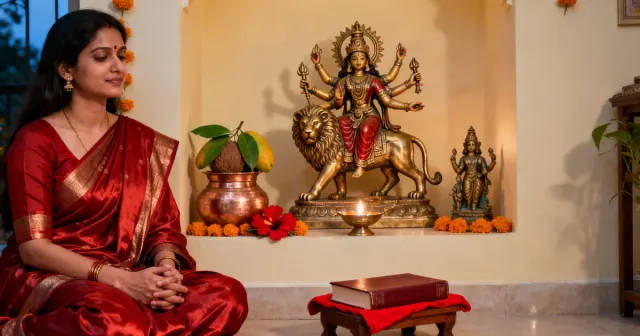
- Sit comfortably facing east or toward a Shiva image or lingam, with a lamp lit if you wish.
- Calm your breath for a minute and set your intention, for example for your own peace or for someone you love.
- Chant slowly and clearly, with attention on each syllable. Silent chanting is also fine.
- Count 108 repetitions on a rudraksha mala, or fewer if you are short on time. Do not rush for the number.
- Close with a moment of silence and a simple thanks.
If you are unsure of the pronunciation, listen to a recording or ask a teacher. Respect matters more than perfection.
How can Deva AI help with this mantra?
Deva AI is a free Android app that lets you talk to Hindu gods like Krishna, Shiva, Ganesha and Hanuman through AI conversations, in English, Hindi, Telugu, Tamil, Kannada and Malayalam.
You can choose Shiva as your companion and ask what a word means, why the cucumber is used or how to sit for chanting. The replies are inspired by scripture and tradition, and they come from an AI, not from Shiva himself. The japa counter helps you keep count of your repetitions without a mala, and a guided meditation can be a calm way to end your practice. See how to talk to Shiva in an app for how the conversations work.
How does this mantra relate to other Shiva practices?
The Mahamrityunjaya mantra sits beside the five-syllable Om Namah Shivaya, which is simpler and often chanted by beginners. If you want a quiet practice around Shiva, how to meditate on Shiva is a good place to start. Some devotees chant Om Namah Shivaya daily and keep the Mahamrityunjaya mantra for moments when they need extra support. Learn more about the app on the What is Deva AI page.
Key takeaways
- The mantra is Rig Veda 7.59.12, addressed to the three-eyed Shiva.
- It asks for freedom from death and fear, “like a cucumber from its vine”, not from immortality.
- A common practice is 108 repetitions, chanted calmly and with attention.
- It is a prayer for strength and peace, to be used alongside medical care, not instead of it.
Frequently asked questions
What is the meaning of the Mahamrityunjaya mantra?
It means: we worship the three-eyed one, who is fragrant and nourishes all beings; may he free us from death like a cucumber is freed from its vine, but not from immortality. It is a prayer for liberation from fear and bondage, addressed to Shiva.
Where does the Mahamrityunjaya mantra come from?
It appears in the Rig Veda (7.59.12) and, with small variations, in the Yajur Veda. Later Puranic tradition links it closely to Shiva and the sage Markandeya.
How many times should I chant the Mahamrityunjaya mantra?
A common practice is 108 times with a rudraksha mala, which is one mala. Some devotees chant 11, 21 or 1,008 times for special occasions. A smaller number chanted with attention is better than a large number rushed.
Can anyone chant the Mahamrityunjaya mantra?
Yes. Traditionally it is chanted by people of any background as a prayer for health and fearlessness. Learn the pronunciation from a teacher or a recording if you can, and chant with respect.
When is the best time to chant the Mahamrityunjaya mantra?
Early morning, sunrise and Mondays are traditionally linked to Shiva, and many devotees also chant during Maha Shivaratri or during illness in the family. You can chant it at any time you feel the need.
Does the mantra guarantee a cure?
No. Tradition treats it as a prayer for strength, peace and protection, not as a replacement for medical care. If someone is ill, see a doctor and chant alongside treatment.