Vishnu Sahasranamam: Full Text, Meaning & How to Recite
Quick answer
The Vishnu Sahasranamam is a hymn of 1,000 names of Vishnu, told by Bhishma to Yudhishthira in the Anushasana Parva of the Mahabharata. The names fill 107 shlokas, usually followed by a 108th closing verse, with opening verses before them and a phala shruti after. This page gives the full stotram in Roman transliteration with a short English meaning for every shloka. Deva AI is a free Android app where you can ask a Vishnu companion what any name means.
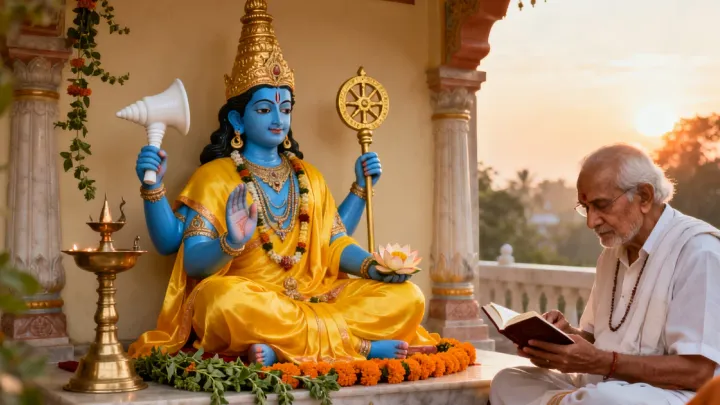
For many families the Vishnu Sahasranamam is the sound of a quiet morning: an elder reciting from a worn book while the lamp burns. It is long, but its idea is simple. Vishnu is called by a thousand names because no single name can hold all that he is.
What is the Vishnu Sahasranamam? It is a stotra, a hymn of praise, made of 1,000 names (sahasranama) of Vishnu. It is found in the Anushasana Parva of the Mahabharata, where the elder Bhishma, lying on his bed of arrows after the war, recites it to Yudhishthira. It is one of the most widely recited Hindu prayers. The complete stotram is below in Roman letters, shloka by shloka, with a short English meaning of the names in each.
Where does the Vishnu Sahasranamam come from?
After the Kurukshetra war, Yudhishthira goes to Bhishma and asks questions about dharma. Among them: who is the one God to be worshipped, and what is the highest path to peace? Bhishma answers by reciting the thousand names of Vishnu, which he says is the way to be freed from sorrow. Krishna is present during this teaching, and tradition sees the hymn as the voice of an old, wise devotee praising the Lord in front of the Lord himself.
The names are arranged in verses of the anushtubh metre. The hymn begins with a short invocation, then the first line of the names themselves, and ends with a phala-shruti, a closing section that lists the traditional fruits of reciting it.
What is the structure of the Vishnu Sahasranamam?
A full recitation has three parts. The names themselves are the middle part; the opening and closing verses frame them.
| Part | What it contains |
|---|---|
| Purva bhaga (opening) | Invocation verses, the dialogue in which Yudhishthira asks his questions and Bhishma begins to answer, then the nyasa (dedication of the hymn: its seer Veda Vyasa, its metre anushtubh, its deity Sri Mahavishnu) and the dhyana verses for meditating on Vishnu’s form |
| Stotram (the 1,000 names) | 107 shlokas of names, from “Om Vishvam Vishnur Vashatkaro” to “Sarva praharanayudhah”, usually followed by a 108th closing verse |
| Uttara bhaga (closing) | The phala shruti, Bhishma’s description of the fruits of reciting the names, followed by closing prayers |
The opening most families know is the first verse of the purva bhaga:
śuklāmbaradharaṃ viṣṇuṃ śaśivarṇaṃ caturbhujam |
prasannavadanaṃ dhyāyet sarvavighnopaśāntaye ||Meditate on Vishnu, clothed in white, bright as the moon, four-armed and of gracious face, so that every obstacle is removed.
Yudhishthira’s questions, which the whole hymn answers, come a few verses later:
kimekaṃ daivataṃ loke kiṃ vāpyekaṃ parāyaṇam |
stuvantaḥ kaṃ kamarcantaḥ prāpnuyurmānavāḥ śubham ||Who is the one God in the world, and what is the one highest refuge? By praising whom, and worshipping whom, do people reach the good?
Among the dhyana verses is the well-known “Shantakaram bhujagashayanam”, which pictures Vishnu calm, lying on the serpent, lotus-naveled and lord of the gods. The names then begin with “Om Vishvam Vishnur Vashatkaro”, where Vishvam means that the whole universe is his form.
Vishnu Sahasranamam full text with meaning
Below are all 108 shlokas of the stotram in Roman transliteration (IAST, the standard scholarly spelling: ś and ṣ are both close to “sh”, ṃ is a nasal “m”, a long bar such as ā means a long vowel). Each shloka is followed by a one-line meaning of the names in it. The text follows the standard recited version and was checked line by line against two published editions, one of them the Sanskrit Wikisource text. Some books differ by a letter here and there (for example vishvadhrik or vishvasrik in shloka 26); those are old variant readings, not mistakes.
The meanings follow the traditional explanations, mostly Adi Shankara’s commentary; other traditions read some names differently. Many names appear more than once, such as Vishnu, Keshava and Padmanabha, and the commentators give each occurrence its own sense. Several names also recall the avatars described in the ten avatars of Vishnu: Narasimha, Vamana, Varaha, Rama and Krishna.
Shlokas 1 to 12
1. viśvaṃ viṣṇurvaṣaṭkāro bhūtabhavyabhavatprabhuḥ |
bhūtakṛdbhūtabhṛdbhāvo bhūtātmā bhūtabhāvanaḥ || 1 ||
Meaning: He is the universe itself and pervades it all; he is invoked in every offering, Lord of past, future and present, maker and sustainer of beings, pure existence, the Self of all and the one who brings beings forth.
2. pūtātmā paramātmā ca muktānāṃ paramā gatiḥ |
avyayaḥ puruṣaḥ sākṣī kṣetrajño’kṣara eva ca || 2 ||
Meaning: The pure Self and the supreme Self, the highest goal of the freed; imperishable, the Purusha, the witness, the knower of the field (the body) and the undecaying.
3. yogo yogavidāṃ netā pradhānapuruṣeśvaraḥ |
nārasiṃhavapuḥ śrīmān keśavaḥ puruṣottamaḥ || 3 ||
Meaning: He is yoga and the leader of those who know it, Lord of nature and spirit; he took the man-lion form, bears Lakshmi, has beautiful locks (Keshava) and is the highest Person.
4. sarvaḥ śarvaḥ śivaḥ sthāṇurbhūtādirnidhiravyayaḥ |
saṃbhavo bhāvano bhartā prabhavaḥ prabhurīśvaraḥ || 4 ||
Meaning: He is all, the remover of sin (Sharva), the auspicious (Shiva), the steady pillar, the origin of beings and their final treasure-house; he is born at will, makes all exist, supports all, and is the source, master and ruler.
5. svayaṃbhūḥ śambhurādityaḥ puṣkarākṣo mahāsvanaḥ |
anādinidhano dhātā vidhātā dhāturuttamaḥ || 5 ||
Meaning: Self-born, bringer of joy, the radiant one among the Adityas, lotus-eyed, of mighty sound; without beginning or end, supporter, ordainer and the finest of elements.
6. aprameyo hṛṣīkeśaḥ padmanābho’maraprabhuḥ |
viśvakarmā manustvaṣṭā sthaviṣṭhaḥ sthaviro dhruvaḥ || 6 ||
Meaning: Beyond measure, master of the senses (Hrishikesha), with a lotus in his navel (Padmanabha), Lord of the gods; maker of the universe, the great thinker, the shaper, the vastest, the ancient and the unchanging.
7. agrāhyaḥ śāśvataḥ kṛṣṇo lohitākṣaḥ pratardanaḥ |
prabhūtastrikakubdhāma pavitraṃ maṅgalaṃ param || 7 ||
Meaning: Beyond grasp, eternal, dark-hued and all-attracting (Krishna), red-eyed, the destroyer at dissolution; full of all riches, the support of the three regions, holy and supremely auspicious.
8. īśānaḥ prāṇadaḥ prāṇo jyeṣṭhaḥ śreṣṭhaḥ prajāpatiḥ |
hiraṇyagarbho bhūgarbho mādhavo madhusūdanaḥ || 8 ||
Meaning: The ruler, the giver of life and life itself, the eldest, the best, Lord of creatures; the golden womb of creation, the one who holds the earth within, Lakshmi’s lord (Madhava) and the slayer of Madhu.
9. īśvaro vikramī dhanvī medhāvī vikramaḥ kramaḥ |
anuttamo durādharṣaḥ kṛtajñaḥ kṛtirātmavān || 9 ||
Meaning: The Lord, full of valour, holder of the bow, the wise one, the stride and the order of things; none is above him, none can overcome him; he knows every deed, is the deed, and is established in himself.
10. sureśaḥ śaraṇaṃ śarma viśvaretāḥ prajābhavaḥ |
ahaḥ saṃvatsaro vyālaḥ pratyayaḥ sarvadarśanaḥ || 10 ||
Meaning: Lord of the gods, the refuge, bliss, seed of the universe, source of all creatures; he is the day and the year, hard to grasp like a serpent, pure knowledge and the all-seeing.
11. ajaḥ sarveśvaraḥ siddhaḥ siddhiḥ sarvādiracyutaḥ |
vṛṣākapirameyātmā sarvayogaviniḥsṛtaḥ || 11 ||
Meaning: Unborn, Lord of all, ever-perfect, the fulfilment of all, the beginning of all, the one who never falls (Achyuta); the dharma that lifts the world (Vrishakapi), of immeasurable Self, known only through every path of yoga.
12. vasurvasumanāḥ satyaḥ samātmā’sammitaḥ samaḥ |
amoghaḥ puṇḍarīkākṣo vṛṣakarmā vṛṣākṛtiḥ || 12 ||
Meaning: The dweller in all, good-hearted, truth itself, the same towards all, beyond measure, impartial; never fruitless, lotus-eyed (Pundarikaksha), whose acts and form are dharma.
Shlokas 13 to 24
13. rudro bahuśirā babhrurviśvayoniḥ śuciśravāḥ |
amṛtaḥ śāśvataḥ sthāṇurvarāroho mahātapāḥ || 13 ||
Meaning: He makes the sorrowful weep away their sorrow (Rudra), many-headed, the bearer of the worlds, source of the universe, of pure fame; immortal, eternal, steady, the highest ascent and great in austerity.
14. sarvagaḥ sarvavidbhānurviṣvakseno janārdanaḥ |
vedo vedavidavyaṅgo vedāṅgo vedavit kaviḥ || 14 ||
Meaning: All-pervading, all-knowing, the radiance, Vishvaksena before whom enemy armies scatter, Janardana who removes the troubles of people; he is the Veda, its knower, flawless, with the Vedas as his limbs, the knowing seer.
15. lokādhyakṣaḥ surādhyakṣo dharmādhyakṣaḥ kṛtākṛtaḥ |
caturātmā caturvyūhaścaturdaṃṣṭraścaturbhujaḥ || 15 ||
Meaning: Overseer of the worlds, of the gods and of dharma, the effect and the cause; of four forms, four emanations (vyuhas), four tusks (as the man-lion) and four arms.
16. bhrājiṣṇurbhojanaṃ bhoktā sahiṣṇurjagadādijaḥ |
anagho vijayo jetā viśvayoniḥ punarvasuḥ || 16 ||
Meaning: Shining, he is both the food and the one who enjoys it, the patient, the first-born of the world; sinless, victory, the victor, the womb of the universe and the one who dwells again and again in all.
17. upendro vāmanaḥ prāṃśuramoghaḥ śucirūrjitaḥ |
atīndraḥ saṃgrahaḥ sargo dhṛtātmā niyamo yamaḥ || 17 ||
Meaning: Younger brother of Indra (Upendra), the dwarf Vamana who grew tall, of unfailing purpose, pure and mighty; beyond Indra, the gatherer and the creation, firm in himself, the one who regulates and restrains.
18. vedyo vaidyaḥ sadāyogī vīrahā mādhavo madhuḥ |
atīndriyo mahāmāyo mahotsāho mahābalaḥ || 18 ||
Meaning: To be known, the healer, ever in yoga, slayer of demonic heroes, lord of knowledge, sweetness itself (Madhu); beyond the senses, of great power of illusion, great zeal and great strength.
19. mahābuddhirmahāvīryo mahāśaktirmahādyutiḥ |
anirdeśyavapuḥ śrīmānameyātmā mahādridhṛk || 19 ||
Meaning: Of great wisdom, valour, power and brilliance; of indescribable form, glorious, of immeasurable Self, the one who held up the great mountain.
20. maheṣvāso mahībhartā śrīnivāsaḥ satāṃ gatiḥ |
aniruddhaḥ surānando govindo govidāṃ patiḥ || 20 ||
Meaning: The great archer, the supporter of the earth, the home of Lakshmi (Shrinivasa), the goal of the good; the unobstructed (Aniruddha), the joy of the gods, Govinda, lord of those who know.
21. marīcirdamano haṃsaḥ suparṇo bhujagottamaḥ |
hiraṇyanābhaḥ sutapāḥ padmanābhaḥ prajāpatiḥ || 21 ||
Meaning: The ray of light, the subduer, the swan, the fair-winged Garuda, the best of serpents; with a golden navel, of noble austerity, lotus-naveled, lord of creatures.
22. amṛtyuḥ sarvadṛk siṃhaḥ sandhātā sandhimān sthiraḥ |
ajo durmarṣaṇaḥ śāstā viśrutātmā surārihā || 22 ||
Meaning: Deathless, all-seeing, the lion, the one who unites beings with the fruit of their acts and holds that bond, the steady; unborn, unbearable to the wicked, the teacher, of renowned Self, the slayer of the enemies of the gods.
23. gururgurutamo dhāma satyaḥ satyaparākramaḥ |
nimiṣo’nimiṣaḥ sragvī vācaspatirudāradhīḥ || 23 ||
Meaning: The guru, the greatest guru, the abode, truth itself, of true valour; he closes and opens his eyes (in sleep and waking), wears a garland, Lord of speech, of noble intellect.
24. agraṇīrgrāmaṇīḥ śrīmān nyāyo netā samīraṇaḥ |
sahasramūrdhā viśvātmā sahasrākṣaḥ sahasrapāt || 24 ||
Meaning: The leader who takes all forward, the guide of beings, glorious, justice itself, the guide, the moving breath; thousand-headed, the Self of the universe, thousand-eyed and thousand-footed.
Shlokas 25 to 36
25. āvartano nivṛttātmā saṃvṛtaḥ saṃpramardanaḥ |
ahaḥ saṃvartako vahniranilo dharaṇīdharaḥ || 25 ||
Meaning: He turns the wheel of samsara yet his Self is withdrawn from it, he is hidden and he crushes all at the end; he is the day, the one who rolls up the worlds, the fire, the wind and the bearer of the earth.
26. suprasādaḥ prasannātmā viśvadhṛgviśvabhugvibhuḥ |
satkartā satkṛtaḥ sādhurjahnurnārāyaṇo naraḥ || 26 ||
Meaning: Of great grace and serene Self, bearer, enjoyer and pervader of the universe; honouring the good and honoured by them, gentle, Jahnu who takes all into himself at the end, Narayana and Nara.
27. asaṃkhyeyo’prameyātmā viśiṣṭaḥ śiṣṭakṛcchuciḥ |
siddhārthaḥ siddhasaṃkalpaḥ siddhidaḥ siddhisādhanaḥ || 27 ||
Meaning: Countless, of unfathomable Self, the most excellent, the maker of the good, pure; his aims are fulfilled and his will is never in vain, he gives fulfilment and is the means to it.
28. vṛṣāhī vṛṣabho viṣṇurvṛṣaparvā vṛṣodaraḥ |
vardhano vardhamānaśca viviktaḥ śrutisāgaraḥ || 28 ||
Meaning: He is the day of dharma, the showerer of blessings, Vishnu, with dharma as his steps and dharma within him; he makes all grow and grows himself, he stands apart, an ocean of scripture.
29. subhujo durdharo vāgmī mahendro vasudo vasuḥ |
naikarūpo bṛhadrūpaḥ śipiviṣṭaḥ prakāśanaḥ || 29 ||
Meaning: Of noble arms, hard to hold back, eloquent, the great Indra, the giver of wealth and wealth itself; of many forms and vast form, present in the rays of light (Shipivishta), the revealer.
30. ojastejodyutidharaḥ prakāśātmā pratāpanaḥ |
ṛddhaḥ spaṣṭākṣaro mantraścandrāṃśurbhāskaradyutiḥ || 30 ||
Meaning: Bearer of vigour, splendour and light, the radiant Self, the scorcher; full of plenty, of clear syllable (Om), the mantra, with the moon’s cool rays and the sun’s brilliance.
31. amṛtāṃśūdbhavo bhānuḥ śaśabinduḥ sureśvaraḥ |
auṣadhaṃ jagataḥ setuḥ satyadharmaparākramaḥ || 31 ||
Meaning: The moon that rose from the ocean of nectar, the sun, the hare-marked moon, the lord of the gods; the medicine of the world, the bridge across samsara, true in dharma and valour.
32. bhūtabhavyabhavannāthaḥ pavanaḥ pāvano’nalaḥ |
kāmahā kāmakṛtkāntaḥ kāmaḥ kāmapradaḥ prabhuḥ || 32 ||
Meaning: Lord of what was, what will be and what is, the wind, the purifier, the fire; he destroys desire and fulfils it, he is lovely, the beloved, the giver of what is desired, the master.
33. yugādikṛdyugāvarto naikamāyo mahāśanaḥ |
adṛśyo vyaktarūpaśca sahasrajidanantajit || 33 ||
Meaning: Maker of the beginning of the ages and turner of their cycle, of many illusions, the great eater at dissolution; unseen, yet of manifest form, conqueror of thousands and of the endless.
34. iṣṭo’viśiṣṭaḥ śiṣṭeṣṭaḥ śikhaṇḍī nahuṣo vṛṣaḥ |
krodhahā krodhakṛtkartā viśvabāhurmahīdharaḥ || 34 ||
Meaning: The beloved, beyond distinction, dear to the wise, wearing a peacock feather (Shikhandi), the binder (Nahusha), dharma itself; he destroys anger and wrath against the wicked, the doer, with arms all over the universe, the upholder of the earth.
35. acyutaḥ prathitaḥ prāṇaḥ prāṇado vāsavānujaḥ |
apāṃnidhiradhiṣṭhānamapramattaḥ pratiṣṭhitaḥ || 35 ||
Meaning: Who never falls from his nature (Achyuta), renowned, the life-breath and its giver, younger brother of Indra (as Vamana); the ocean, the foundation, ever-watchful and firmly established.
36. skandaḥ skandadharo dhuryo varado vāyuvāhanaḥ |
vāsudevo bṛhadbhānurādidevaḥ purandaraḥ || 36 ||
Meaning: Skanda who makes nectar flow, the upholder of the path of dharma, bearer of the load, giver of boons, the mover of the winds; Vasudeva, of great radiance, the first God, destroyer of the cities of the demons.
Shlokas 37 to 48
37. aśokastāraṇastāraḥ śūraḥ śaurirjaneśvaraḥ |
anukūlaḥ śatāvartaḥ padmī padmanibhekṣaṇaḥ || 37 ||
Meaning: Free of sorrow, the saviour who carries beings across, the protector, the hero, Shauri born in the line of Shura, lord of people; the friend of all, of a hundred turns (avatars), holder of the lotus, with eyes like lotuses.
38. padmanābho’ravindākṣaḥ padmagarbhaḥ śarīrabhṛt |
maharddhirṛddho vṛddhātmā mahākṣo garuḍadhvajaḥ || 38 ||
Meaning: Lotus-naveled, with lotus eyes, enthroned in the heart’s lotus, who takes on bodies; of great glory, the prosperous, the ancient Self, of great eyes, with Garuda on his banner.
39. atulaḥ śarabho bhīmaḥ samayajño havirhariḥ |
sarvalakṣaṇalakṣaṇyo lakṣmīvān samitiñjayaḥ || 39 ||
Meaning: The matchless, the Sharabha who dwells in bodies, the awe-inspiring, knower of right time, the offering, Hari who removes sorrow; bearer of every auspicious mark, husband of Lakshmi, the victor in battle.
40. vikṣaro rohito mārgo heturdāmodaraḥ sahaḥ |
mahīdharo mahābhāgo vegavānamitāśanaḥ || 40 ||
Meaning: The undecaying, the red fish (Rohita), the path, the cause, Damodara bound by a cord at the waist, the forbearing; the bearer of the earth, the most blessed, the swift, the eater without measure.
41. udbhavaḥ kṣobhaṇo devaḥ śrīgarbhaḥ parameśvaraḥ |
karaṇaṃ kāraṇaṃ kartā vikartā gahano guhaḥ || 41 ||
Meaning: The origin, the one who stirs nature into creation, the shining God, holding Lakshmi within, the supreme Lord; the instrument, the cause, the doer, the varied creator, the deep one, hidden in the heart.
42. vyavasāyo vyavasthānaḥ saṃsthānaḥ sthānado dhruvaḥ |
pararddhiḥ paramaspaṣṭastuṣṭaḥ puṣṭaḥ śubhekṣaṇaḥ || 42 ||
Meaning: Pure resolve, the ground of order, the final resting place, the giver of places (as to Dhruva), the unmoving; of supreme glory, most clearly manifest, ever content, ever full, of auspicious glance.
43. rāmo virāmo virajo mārgo neyo nayo’nayaḥ |
vīraḥ śaktimatāṃ śreṣṭho dharmo dharmaviduttamaḥ || 43 ||
Meaning: He in whom the yogis rejoice (Rama), the place of rest, free of passion, the path, the one to be reached, the leader and the leaderless; the hero, the best of the strong, dharma itself and the best of its knowers.
44. vaikuṇṭhaḥ puruṣaḥ prāṇaḥ prāṇadaḥ praṇavaḥ pṛthuḥ |
hiraṇyagarbhaḥ śatrughno vyāpto vāyuradhokṣajaḥ || 44 ||
Meaning: Vaikuntha, the Purusha, life-breath and its giver, the sacred syllable Om, the vast; the golden womb, the slayer of foes, the all-pervading, the wind, and the one beyond the reach of the senses (Adhokshaja).
45. ṛtuḥ sudarśanaḥ kālaḥ parameṣṭhī parigrahaḥ |
ugraḥ saṃvatsaro dakṣo viśrāmo viśvadakṣiṇaḥ || 45 ||
Meaning: The season, the one of auspicious vision (Sudarshana), time, the one who dwells in the highest place, the one who embraces all; the fierce, the year, the able, the place of rest, the most generous.
46. vistāraḥ sthāvarasthāṇuḥ pramāṇaṃ bījamavyayam |
artho’nartho mahākośo mahābhogo mahādhanaḥ || 46 ||
Meaning: In whom all spreads out, the steady pillar of the steady, the measure of truth, the imperishable seed; the goal and beyond all goals, the great treasury, of great enjoyment and great wealth.
47. anirviṇṇaḥ sthaviṣṭho’bhūrdharmayūpo mahāmakhaḥ |
nakṣatranemirnakṣatrī kṣamaḥ kṣāmaḥ samīhanaḥ || 47 ||
Meaning: Never weary, the vastest, unborn, the sacrificial post of dharma, the great sacrifice; the centre of the stars and their lord, the patient one, the one who remains at dissolution, the one who wills creation.
48. yajña ijyo mahejyaśca kratuḥ satraṃ satāṃ gatiḥ |
sarvadarśī vimuktātmā sarvajño jñānamuttamam || 48 ||
Meaning: He is the sacrifice, the one worshipped, the greatly worshipped, the rite and the long rite, the goal of the good; all-seeing, of free Self, all-knowing, the highest knowledge.
Shlokas 49 to 60
49. suvrataḥ sumukhaḥ sūkṣmaḥ sughoṣaḥ sukhadaḥ suhṛt |
manoharo jitakrodho vīrabāhurvidāraṇaḥ || 49 ||
Meaning: Of holy vows, of beautiful face, subtle, of sweet sound, the giver of joy, the friend; the stealer of hearts, the conqueror of anger, of heroic arms, the one who tears apart the wicked.
50. svāpanaḥ svavaśo vyāpī naikātmā naikakarmakṛt |
vatsaro vatsalo vatsī ratnagarbho dhaneśvaraḥ || 50 ||
Meaning: He lulls beings to sleep, he is self-ruled and all-pervading, of many forms and many deeds; the year, loving to his devotees, cherishing them like a calf, holder of gems and lord of wealth.
51. dharmagubdharmakṛddharmī sadasatkṣaramakṣaram |
avijñātā sahasrāṃśurvidhātā kṛtalakṣaṇaḥ || 51 ||
Meaning: Protector and maker of dharma and its upholder, the real and the unreal, the perishable and the imperishable; the unknowing (of limits), the thousand-rayed sun, the ordainer, the bearer of the auspicious marks.
52. gabhastinemiḥ sattvasthaḥ siṃho bhūtamaheśvaraḥ |
ādidevo mahādevo deveśo devabhṛdguruḥ || 52 ||
Meaning: The hub of the wheel of rays, abiding in purity, the lion, the great Lord of beings; the first God, the great God, Lord of gods, the support of the gods and their guru.
53. uttaro gopatirgoptā jñānagamyaḥ purātanaḥ |
śarīrabhūtabhṛdbhoktā kapīndro bhūridakṣiṇaḥ || 53 ||
Meaning: The one who lifts beings out of samsara, lord and protector of cows and of the earth, known by knowledge, the ancient; bearer of the elements that make the body, the enjoyer, lord of the monkeys (as Rama), the one of bountiful gifts.
54. somapo’mṛtapaḥ somaḥ purujitpurusattamaḥ |
vinayo jayaḥ satyasaṃdho dāśārhaḥ sāttvatāṃpatiḥ || 54 ||
Meaning: Drinker of soma and of nectar, the soma itself, conqueror of many, best of the many; the one who disciplines, victory, true to his word, of the Dasharha clan, lord of the Satvatas (Yadavas).
55. jīvo vinayitā sākṣī mukundo’mitavikramaḥ |
ambhonidhiranantātmā mahodadhiśayo’ntakaḥ || 55 ||
Meaning: The living soul, the teacher of discipline, the witness, Mukunda who gives liberation, of measureless stride; the ocean, of endless Self, reclining on the great ocean, the ender of all.
56. ajo mahārhaḥ svābhāvyo jitāmitraḥ pramodanaḥ |
ānando nandano nandaḥ satyadharmā trivikramaḥ || 56 ||
Meaning: Unborn, most worthy of worship, ever in his own nature, conqueror of foes, the giver of delight; bliss, the delighter, joy itself, true in dharma, the one who took three strides (Trivikrama).
57. maharṣiḥ kapilācāryaḥ kṛtajño medinīpatiḥ |
tripadastridaśādhyakṣo mahāśṛṅgaḥ kṛtāntakṛt || 57 ||
Meaning: The great seer, Kapila the teacher, knower of deeds, lord of the earth; three-stepped, lord of the gods, the great-horned (fish who drew the boat), the destroyer of death.
58. mahāvarāho govindaḥ suṣeṇaḥ kanakāṅgadī |
guhyo gabhīro gahano guptaścakragadādharaḥ || 58 ||
Meaning: The great boar (Varaha), Govinda who found the earth, with a fine army, wearing golden armlets; secret, profound, deep and hidden, the bearer of discus and mace.
59. vedhāḥ svāṅgo’jitaḥ kṛṣṇo dṛḍhaḥ saṃkarṣaṇo’cyutaḥ |
varuṇo vāruṇo vṛkṣaḥ puṣkarākṣo mahāmanāḥ || 59 ||
Meaning: The creator, of beautiful limbs, unconquered, Krishna, firm, Sankarshana, the unfailing; Varuna, son of Varuna, the tree, lotus-eyed and great-minded.
60. bhagavān bhagahā’’nandī vanamālī halāyudhaḥ |
ādityo jyotirādityaḥ sahiṣṇurgatisattamaḥ || 60 ||
Meaning: The Bhagavan, the one who withdraws all at the end, the blissful, wearing the forest garland, armed with the plough (as Balarama); the Aditya (as Vamana), the light in the sun, the patient, the best of refuges.
Shlokas 61 to 72
61. sudhanvā khaṇḍaparaśurdāruṇo draviṇapradaḥ |
divaḥspṛk sarvadṛgvyāso vācaspatirayonijaḥ || 61 ||
Meaning: With a fine bow, with the axe that cuts enemies (as Parashurama), fierce to the wicked, the giver of wealth; touching the heavens, all-seeing, Vyasa who divided the Vedas, lord of speech, not born of a womb.
62. trisāmā sāmagaḥ sāma nirvāṇaṃ bheṣajaṃ bhiṣak |
saṃnyāsakṛcchamaḥ śānto niṣṭhā śāntiḥ parāyaṇam || 62 ||
Meaning: Praised with the three Sama chants, the singer of the Sama, the Sama itself, liberation, the medicine and the healer; the founder of renunciation, calm, peaceful, the final resting place, peace itself, the highest refuge.
63. śubhāṅgaḥ śāntidaḥ sraṣṭā kumudaḥ kuvaleśayaḥ |
gohito gopatirgoptā vṛṣabhākṣo vṛṣapriyaḥ || 63 ||
Meaning: Of auspicious limbs, the giver of peace, the creator, the delighter of the earth, reclining on the waters; the friend of cows, lord and protector of the earth, with eyes that rain dharma, who loves dharma.
64. anivartī nivṛttātmā saṃkṣeptā kṣemakṛcchivaḥ |
śrīvatsavakṣāḥ śrīvāsaḥ śrīpatiḥ śrīmatāṃvaraḥ || 64 ||
Meaning: Who never turns back, whose Self is withdrawn from the senses, the one who draws in the world, the giver of welfare, the auspicious; with the Shrivatsa mark on his chest, the abode, lord and best of Lakshmi and the blessed.
65. śrīdaḥ śrīśaḥ śrīnivāsaḥ śrīnidhiḥ śrīvibhāvanaḥ |
śrīdharaḥ śrīkaraḥ śreyaḥ śrīmām̐llokatrayāśrayaḥ || 65 ||
Meaning: The giver of prosperity, the lord of Lakshmi, the home and treasure of prosperity, who shares it out by merit; who holds Lakshmi, who brings prosperity, the highest good, the glorious refuge of the three worlds.
66. svakṣaḥ svaṅgaḥ śatānando nandirjyotirgaṇeśvaraḥ |
vijitātmā’vidheyātmā satkīrtiśchinnasaṃśayaḥ || 66 ||
Meaning: Of beautiful eyes and beautiful limbs, of a hundred joys, joy itself, lord of the shining hosts; who has conquered himself, whom none can command, of true fame, the one who cuts all doubt.
67. udīrṇaḥ sarvataścakṣuranīśaḥ śāśvatasthiraḥ |
bhūśayo bhūṣaṇo bhūtirviśokaḥ śokanāśanaḥ || 67 ||
Meaning: Exalted, with eyes on every side, with none above him, eternal and steady; who lies on the ground (on the way to Lanka), the ornament of the earth, its glory, free from sorrow, the destroyer of sorrow.
68. arciṣmānarcitaḥ kumbho viśuddhātmā viśodhanaḥ |
aniruddho’pratirathaḥ pradyumno’mitavikramaḥ || 68 ||
Meaning: Radiant, worshipped, the vessel who holds all, of pure Self, the purifier; Aniruddha the unobstructed, unrivalled, Pradyumna of great wealth, of measureless stride.
69. kālaneminihā vīraḥ śauriḥ śūrajaneśvaraḥ |
trilokātmā trilokeśaḥ keśavaḥ keśihā hariḥ || 69 ||
Meaning: Slayer of Kalanemi, the hero, Shauri of the Shura line, lord of heroes; Self of the three worlds and their lord, Keshava, slayer of the demon Keshi, Hari.
70. kāmadevaḥ kāmapālaḥ kāmī kāntaḥ kṛtāgamaḥ |
anirdeśyavapurviṣṇurvīro’nanto dhanaṃjayaḥ || 70 ||
Meaning: The god of desire, protector of the desired, the one whose desires are fulfilled, the lovely, the giver of the scriptures; of form beyond description, Vishnu, the hero, the endless, the winner of wealth (Dhananjaya).
71. brahmaṇyo brahmakṛd brahmā brahma brahmavivardhanaḥ |
brahmavid brāhmaṇo brahmī brahmajño brāhmaṇapriyaḥ || 71 ||
Meaning: Friend of Brahman (dharma, the Vedas and the wise), maker and growth of Brahman, Brahma and Brahman itself; knower of Brahman, the Brahmana, holder of Brahman, the knower of the Vedas, the one dear to the Brahmanas.
72. mahākramo mahākarmā mahātejā mahoragaḥ |
mahākraturmahāyajvā mahāyajño mahāhaviḥ || 72 ||
Meaning: Of great strides, great deeds, great splendour, the great serpent; the great rite, the great sacrificer, the great sacrifice and the great offering.
Shlokas 73 to 84
73. stavyaḥ stavapriyaḥ stotraṃ stutiḥ stotā raṇapriyaḥ |
pūrṇaḥ pūrayitā puṇyaḥ puṇyakīrtiranāmayaḥ || 73 ||
Meaning: The one to be praised, who loves praise, who is the hymn, the praise and the praiser, who delights in battle; full, the one who fills all, holy, of holy fame, free of disease.
74. manojavastīrthakaro vasuretā vasupradaḥ |
vasuprado vāsudevo vasurvasumanā haviḥ || 74 ||
Meaning: Swift as the mind, maker of sacred fords (teachings), with golden seed, giver of wealth; giver of wealth and of liberation, Vasudeva, the dweller in all, the good-minded and the offering itself.
75. sadgatiḥ satkṛtiḥ sattā sadbhūtiḥ satparāyaṇaḥ |
śūraseno yaduśreṣṭhaḥ sannivāsaḥ suyāmunaḥ || 75 ||
Meaning: The good goal, the good deed, pure existence, the true glory, the highest refuge of the good; leader of the Shura army, best of the Yadus, the abode of the good, who sported on the Yamuna’s banks.
76. bhūtāvāso vāsudevaḥ sarvāsunilayo’nalaḥ |
darpahā darpado dṛpto durdharo’thāparājitaḥ || 76 ||
Meaning: The dwelling of beings, Vasudeva, in whom all life-breaths rest, the unlimited; who humbles pride and gives pride in dharma, ever-content, hard to hold, the unconquered.
77. viśvamūrtirmahāmūrtirdīptamūrtiramūrtimān |
anekamūrtiravyaktaḥ śatamūrtiḥ śatānanaḥ || 77 ||
Meaning: Of universal form, great form, radiant form and also formless; of many forms, unmanifest, of a hundred forms and a hundred faces.
78. eko naikaḥ savaḥ kaḥ kiṃ yat tatpadamanuttamam |
lokabandhurlokanātho mādhavo bhaktavatsalaḥ || 78 ||
Meaning: The one, yet many, the sacrifice that brings forth soma (Sava), bliss (Ka), the one inquired about (Kim), what is (Yat), that (Tat), the unsurpassed state; friend and lord of the world, Madhava, loving to his devotees.
79. suvarṇavarṇo hemāṅgo varāṅgaścandanāṅgadī |
vīrahā viṣamaḥ śūnyo ghṛtāśīracalaścalaḥ || 79 ||
Meaning: Golden in colour and limb, of beautiful body, with sandal paste and armlets; slayer of demonic heroes, unequalled, beyond all qualities (the void), who lives on ghee, the unmoving and the moving.
80. amānī mānado mānyo lokasvāmī trilokadhṛk |
sumedhā medhajo dhanyaḥ satyamedhā dharādharaḥ || 80 ||
Meaning: Free of pride, the giver of honour, the honoured, lord of the world, bearer of the three worlds; of fine intellect, born of sacrifice, the blessed, of true intellect, the bearer of the earth.
81. tejovṛṣo dyutidharaḥ sarvaśastrabhṛtāṃ varaḥ |
pragraho nigraho vyagro naikaśṛṅgo gadāgrajaḥ || 81 ||
Meaning: Showering splendour, bearer of brilliance, best of all who bear weapons; who receives his devotees’ offerings, who restrains, who is never lost, the many-horned (as the boar), the elder brother of Gada.
82. caturmūrtiścaturbāhuścaturvyūhaścaturgatiḥ |
caturātmā caturbhāvaścaturvedavidekapāt || 82 ||
Meaning: Of four forms, four arms, four emanations and the goal of the four stages of life; of fourfold Self and fourfold nature, knower of the four Vedas, the one whose single quarter is the world.
83. samāvarto’nivṛttātmā durjayo duratikramaḥ |
durlabho durgamo durgo durāvāso durārihā || 83 ||
Meaning: Who turns the cycle again and again, whose Self never turns back, hard to defeat and hard to go beyond; hard to attain and to reach, hard to enter like a fort, hard to dwell in, the slayer of evil ones.
84. śubhāṅgo lokasāraṅgaḥ sutantustantuvardhanaḥ |
indrakarmā mahākarmā kṛtakarmā kṛtāgamaḥ || 84 ||
Meaning: Of auspicious limbs, the essence of the world, the fine thread that holds it, who extends that thread; whose acts are like Indra’s, of great deeds, whose work is done, the giver of the scriptures.
Shlokas 85 to 96
85. udbhavaḥ sundaraḥ sundo ratnanābhaḥ sulocanaḥ |
arko vājasanaḥ śṛṅgī jayantaḥ sarvavijjayī || 85 ||
Meaning: The origin, the beautiful, the tender, with a jewel in his navel, of beautiful eyes; the sun, the giver of food, the horned (as the fish), the victorious, the knower of all and the conqueror.
86. suvarṇabindurakṣobhyaḥ sarvavāgīśvareśvaraḥ |
mahāhrado mahāgarto mahābhūto mahānidhiḥ || 86 ||
Meaning: Golden in form and syllable, unshakable, lord of the lords of speech; the great lake, the great depth, the great being and the great treasure.
87. kumudaḥ kundaraḥ kundaḥ parjanyaḥ pāvano’nilaḥ |
amṛtāṃśo’mṛtavapuḥ sarvajñaḥ sarvatomukhaḥ || 87 ||
Meaning: Giver of joy to the earth, giver of the fruit of good deeds, pure like the kunda flower, the rain cloud, the purifier and the wind; of nectar-like rays and nectar body, all-knowing and facing every side.
88. sulabhaḥ suvrataḥ siddhaḥ śatrujicchatrutāpanaḥ |
nyagrodho’dumbaro’śvatthaścāṇūrāndhraniṣūdanaḥ || 88 ||
Meaning: Easily reached, of holy vows, ever-perfect, conqueror and scorcher of foes; the banyan, the fig and the sacred ashvattha tree, the slayer of Chanura of the Andhra clan.
89. sahasrārciḥ saptajihvaḥ saptaidhāḥ saptavāhanaḥ |
amūrtiranagho’cintyo bhayakṛdbhayanāśanaḥ || 89 ||
Meaning: Of a thousand rays, the fire with seven tongues, seven flames and seven horses (the sun); formless, sinless, beyond thought, who brings fear to the wicked and removes the fear of the good.
90. aṇurbṛhatkṛśaḥ sthūlo guṇabhṛnnirguṇo mahān |
adhṛtaḥ svadhṛtaḥ svāsyaḥ prāgvaṃśo vaṃśavardhanaḥ || 90 ||
Meaning: The subtlest atom and the vast, thin and stout, bearer of qualities and beyond all qualities, the great; unsupported, self-supported, of beautiful face, of the ancient lineage, who makes the lineage grow.
91. bhārabhṛt kathito yogī yogīśaḥ sarvakāmadaḥ |
āśramaḥ śramaṇaḥ kṣāmaḥ suparṇo vāyuvāhanaḥ || 91 ||
Meaning: Bearer of the burden (of the worlds), of whom the scriptures speak, the yogi and lord of yogis, giver of every wish; the ashrama where beings rest, who pains the unwise, who remains at the end, the fair-winged one, the bearer of the winds.
92. dhanurdharo dhanurvedo daṇḍo damayitā damaḥ |
aparājitaḥ sarvasaho niyantā’niyamo’yamaḥ || 92 ||
Meaning: Bearer of the bow, knower of the science of archery, the rod of justice, the punisher and the restraint itself; unconquered, all-enduring, the controller of all, himself beyond rule and beyond death.
93. sattvavān sāttvikaḥ satyaḥ satyadharmaparāyaṇaḥ |
abhiprāyaḥ priyārho’rhaḥ priyakṛt prītivardhanaḥ || 93 ||
Meaning: Full of strength, pure in nature, true, devoted to truth and dharma; the one sought by all, worthy of love and of worship, who does what is dear and increases love.
94. vihāyasagatirjyotiḥ surucirhutabhugvibhuḥ |
ravirvirocanaḥ sūryaḥ savitā ravilocanaḥ || 94 ||
Meaning: Moving through the sky, the light, of beautiful radiance, the eater of offerings, the all-pervading; the sun, shining in many ways, the sun who sends forth light, the generator, the one whose eye is the sun.
95. ananto hutabhugbhoktā sukhado naikajo’grajaḥ |
anirviṇṇaḥ sadāmarṣī lokādhiṣṭhānamadbhutaḥ || 95 ||
Meaning: The endless, the eater of offerings, the enjoyer, the giver of happiness, born many times, the first-born; never despondent, ever forgiving, the support of the world, the wonder.
96. sanātsanātanatamaḥ kapilaḥ kapiravyayaḥ |
svastidaḥ svastikṛtsvasti svastibhuksvastidakṣiṇaḥ || 96 ||
Meaning: The eternal, the most ancient, the tawny Kapila, the sun, the imperishable; the giver of well-being, its maker, well-being itself, its enjoyer and the one whose gift is well-being.
Shlokas 97 to 108
97. araudraḥ kuṇḍalī cakrī vikramyūrjitaśāsanaḥ |
śabdātigaḥ śabdasahaḥ śiśiraḥ śarvarīkaraḥ || 97 ||
Meaning: Free of fury, wearing earrings, holding the discus, the bold one whose command is mighty; beyond the reach of words, the one whom all words praise, the cool shade for those scorched by sorrow, the maker of night.
98. akrūraḥ peśalo dakṣo dakṣiṇaḥ kṣamiṇāṃvaraḥ |
vidvattamo vītabhayaḥ puṇyaśravaṇakīrtanaḥ || 98 ||
Meaning: Gentle, tender, skilful, gracious, the best of the patient; most learned, free from fear, the one whose hearing and praise are holy.
99. uttāraṇo duṣkṛtihā puṇyo duḥsvapnanāśanaḥ |
vīrahā rakṣaṇaḥ santo jīvanaḥ paryavasthitaḥ || 99 ||
Meaning: The one who carries beings across the ocean of samsara, the destroyer of evil deeds, holy, the dispeller of bad dreams; slayer of evil heroes, the protector, the good, the life of all, present everywhere.
100. anantarūpo’nantaśrīrjitamanyurbhayāpahaḥ |
caturaśro gabhīrātmā vidiśo vyādiśo diśaḥ || 100 ||
Meaning: Of endless form and endless glory, conqueror of anger, the remover of fear; the just, of profound Self, the giver of fruits in all directions, the commander, the directions themselves.
101. anādirbhūrbhuvo lakṣmīḥ suvīro rucirāṅgadaḥ |
janano janajanmādirbhīmo bhīmaparākramaḥ || 101 ||
Meaning: Without beginning, the earth and the ground of the earth, glory itself (Lakshmi), of noble valour, with beautiful armlets; the begetter, the cause of the birth of beings, the awe-inspiring and of awe-inspiring might.
102. ādhāranilayo’dhātā puṣpahāsaḥ prajāgaraḥ |
ūrdhvagaḥ satpathācāraḥ prāṇadaḥ praṇavaḥ paṇaḥ || 102 ||
Meaning: The ground of all supports, the one beyond creation, whose smile is like a blooming flower, ever awake; who stands above all, whose way is the path of the good, the giver of life, the syllable Om, the giver of rewards.
103. pramāṇaṃ prāṇanilayaḥ prāṇabhṛtprāṇajīvanaḥ |
tattvaṃ tattvavidekātmā janmamṛtyujarātigaḥ || 103 ||
Meaning: The measure of truth, the abode of life, the sustainer and life of the breath; the truth itself, its knower, the one Self, beyond birth, death and old age.
104. bhūrbhuvaḥsvastarustāraḥ savitā prapitāmahaḥ |
yajño yajñapatiryajvā yajñāṅgo yajñavāhanaḥ || 104 ||
Meaning: Bhuh, Bhuvah and Svah, the tree of samsara and the one who carries beings across it, the begetter, the great-grandsire; the sacrifice, its lord, the sacrificer, whose limbs are sacrifice, the one who carries it out.
105. yajñabhṛd yajñakṛd yajñī yajñabhuk yajñasādhanaḥ |
yajñāntakṛd yajñaguhyamannamannāda eva ca || 105 ||
Meaning: Sustainer and maker of sacrifice, the one to whom it is offered, its enjoyer and its means; who completes the sacrifice, its secret essence, the food and the eater of food.
106. ātmayoniḥ svayaṃjāto vaikhānaḥ sāmagāyanaḥ |
devakīnandanaḥ sraṣṭā kṣitīśaḥ pāpanāśanaḥ || 106 ||
Meaning: His own source, self-born, the digger who reached the depths, the singer of the Sama; the son of Devaki, the creator, lord of the earth, destroyer of sin.
107. śaṅkhabhṛnnandakī cakrī śārṅgadhanvā gadādharaḥ |
rathāṅgapāṇirakṣobhyaḥ sarvapraharaṇāyudhaḥ || 107 ||
Meaning: Holding the conch (Panchajanya), the sword (Nandaka), the discus, the bow (Sharnga) and the mace; with the wheel in his hand, unshakable, armed with every weapon.
108. vanamālī gadī śārṅgī śaṅkhī cakrī ca nandakī |
śrīmān nārāyaṇo viṣṇurvāsudevo’bhirakṣatu || 108 ||
Meaning: Closing prayer: may Narayana, Vishnu, Vasudeva, the glorious one who wears the forest garland and holds the mace, bow, conch, discus and sword, protect us.
How do I recite the Vishnu Sahasranamam at home?
- Choose a calm time. Early morning is common. Thursday, the day linked to Vishnu, and Ekadashi are traditional choices.
- Bathe or wash your face and hands, and sit on a clean mat or seat. A lamp and a Vishnu image or tulsi plant make the space feel set apart, but they are not required.
- Begin with the opening verses. Many recitations start with “Shuklambaradharam vishnum” and the dhyana verses shown above, to bring the form of Vishnu to mind.
- Recite the names at an even pace. Read from the text above, a book in a script you know, or follow a recording. Do not rush; attention matters more than speed.
- Finish with the closing verses and a moment of silence. Offer a simple thanks.
- Start small if you need to. You can recite part of the hymn each day, or listen once and recite along as you learn. A short sincere recitation is better than a hurried long one.
If a pronunciation is unfamiliar, a teacher or a recording is the best guide. Respect is more important than perfection.
What are the benefits of reciting the Vishnu Sahasranamam?
The closing verses of the hymn list fruits such as freedom from fear, peace of mind and the grace of Vishnu. These are matters of faith and personal experience, not medical or scientific claims, and the stotra is not a substitute for medical or professional help. What devotees commonly describe:
- A steady start to the day. The same sounds every morning become a gentle anchor.
- Calm and focus. The long, even rhythm of the verses works like any steady japa.
- Closeness to the Divine. Each name turns the mind to one quality of Vishnu: protector, sustainer, friend.
- A shared family practice. Elders and children recite together, so the hymn carries memory as well as meaning.
Who explained the Vishnu Sahasranamam?
Adi Shankara wrote the best-known commentary, explaining the names one by one with their Vedantic meaning. Parashara Bhatta, a teacher of the Sri Vaishnava tradition, also wrote a widely studied commentary. Different traditions read some names in slightly different ways, which is one reason people enjoy studying the hymn for years. If you are curious about the meaning of a particular name, a commentary in your own language is a good companion.
How can Deva AI help with the Vishnu Sahasranamam?
Deva AI is a free Android app that lets you talk to Hindu gods like Krishna, Shiva, Ganesha and Hanuman through AI conversations, in English, Hindi, Telugu, Tamil, Kannada and Malayalam.
Vishnu is one of the ten deities you can talk to in the app. You can ask what a name means, how to pronounce a line, or which name to focus on during a hard week, in your own language, by text or voice. The replies are inspired by scripture and tradition, and they come from an AI, not from Vishnu himself. The japa counter helps you keep count if you repeat a favourite name, and a guided meditation can be a calm way to close your practice. See how to talk to Krishna in an app for how the conversations work, or the What is Deva AI page.
How does this hymn relate to other practices?
The Sahasranamam pairs well with learning from the Gita. Krishna’s teachings on stress show the same Vishnu in the voice of a teacher, and karma in Hinduism explains the ideas of duty and surrender that run through the hymn.
Key takeaways
- The Vishnu Sahasranamam is a hymn of 1,000 names of Vishnu from the Anushasana Parva of the Mahabharata, spoken by Bhishma to Yudhishthira.
- The names fill 107 shlokas, with a 108th closing verse, framed by the purva bhaga (opening) and uttara bhaga (phala shruti).
- Each name describes one quality of the Divine; you can learn them gradually.
- Recite at a calm, even pace, from a book or recording, in any script you know.
- Adi Shankara and Parashara Bhatta wrote the best-known commentaries.
- It is a devotional practice for peace and closeness to Vishnu, not a replacement for medical care.
Frequently asked questions
What is the Vishnu Sahasranamam?
It is a hymn of 1,000 names of Vishnu from the Anushasana Parva of the Mahabharata. Bhishma recites it to Yudhishthira on his bed of arrows, after being asked for the one path that gives peace and the greatest good.
How many verses are there in the Vishnu Sahasranamam?
The 1,000 names are arranged in 107 shlokas in the anushtubh metre. Most books add a 108th verse, "Vanamali gadi sharngi", as a closing prayer. With the opening verses (purva bhaga) and the closing phala shruti (uttara bhaga) the full recitation is longer, and different books number those parts differently.
In which parva of the Mahabharata is the Vishnu Sahasranamam?
It is in the Anushasana Parva, the thirteenth book of the Mahabharata. Bhishma recites it to Yudhishthira while lying on his bed of arrows after the Kurukshetra war, with Krishna present.
What does the first name, Vishvam, mean?
The hymn opens with "Om Vishvam Vishnur Vashatkaro", where Vishvam means the universe itself. Traditional commentators read it as saying that the whole world is Vishnu's form and he pervades everything.
Do I need to know Sanskrit to recite it?
No. Many devotees read it in their own script, such as Devanagari, Telugu, Tamil, Kannada or Malayalam, or recite along with a recording. Understanding the meaning of the names helps, and correct pronunciation can be learned gradually.
When is the best time to recite the Vishnu Sahasranamam?
Early morning is a common choice, and Thursdays and Ekadashi days are traditionally linked to Vishnu. It can also be recited at any time of day with a calm mind.
How long does it take to recite?
A full recitation usually takes around 20 to 30 minutes, depending on pace. If you are short on time, you can recite a part, or listen to it, and build up gradually.
Who wrote the Vishnu Sahasranamam commentary?
Adi Shankara wrote the best-known commentary, explaining the names one by one. Parashara Bhatta, a Sri Vaishnava teacher, wrote another widely studied commentary.