Hanumath Jayanthi 2027: Date (7 Jan), Moolam and Amavasai Timings
Quick answer
Tamil Hanumath Jayanthi 2027 is on Thursday, 7 January 2027, on Margazhi Amavasai (the new moon of Margashirsha). In Chennai the Amavasai tithi runs from 11:13 PM on 6 January to 1:53 AM on 8 January IST, and Hanuman's birth star Moolam ends at 6:08 AM on 7 January, so the two overlap only in the hours before dawn. A second Hanumath Jayanthi falls in the same calendar year, on Monday, 27 December 2027.
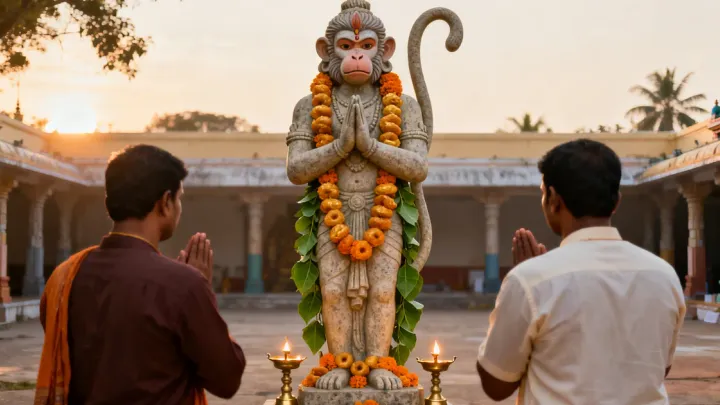
On a cold Margazhi morning, long before sunrise, the 18-foot Anjaneyar at Namakkal stands under the open sky wearing a garland of more than a lakh vadais, and Hanuman temples across Tamil Nadu ring with Rama nama. When is Hanumath Jayanthi in 2027? Tamil Hanumath Jayanthi 2027 is on Thursday, 7 January 2027, on Margazhi Amavasai, the new moon of the month of Margazhi (Margashirsha). In Chennai the Amavasai tithi runs from 11:13 PM on Wednesday 6 January to 1:53 AM on Friday 8 January IST. You will also see the day written as Hanuman Jayanthi, Anjaneyar Jayanthi and Hanumath Jayanti.
Because the festival follows the Tamil solar month, calendar year 2027 has two of them: the second is on Monday, 27 December 2027.
Hanumath Jayanthi 2027 date and timings
| Detail | 2027 (Chennai, IST) |
|---|---|
| Hanumath Jayanthi | Thursday, 7 January 2027 |
| Tamil month and tithi | Margazhi, Amavasai (Margashirsha Amavasya) |
| Amavasai tithi begins | 11:13 PM, Wednesday 6 January |
| Amavasai tithi ends | 1:53 AM, Friday 8 January |
| Moolam (Mula) nakshatra | 3:07 AM, 6 January to 6:08 AM, 7 January |
| Moolam and Amavasai together | 11:13 PM, 6 January to 6:08 AM, 7 January |
| Brahma muhurtam on 7 January | 4:52 AM to 5:43 AM |
| Sunrise / sunset on 7 January | 6:33 AM / 5:57 PM |
| Rahu kalam on 7 January | 1:41 PM to 3:06 PM |
| Yamagandam on 7 January | 6:33 AM to 7:59 AM |
| Next Hanumath Jayanthi | Monday, 27 December 2027 |
All times are from Drik Panchang for Chennai. Your temple’s panchangam may differ by a few minutes, and a few calendars give slightly different tithi times; where they differ, follow your temple or family priest.
What the timings mean for your puja: Moolam ends just before sunrise on 7 January, so the only hours when both Hanuman’s birth star and Amavasai are current are the night of 6 January and the early morning of the 7th. That is why some temples begin the abhishekam and alankaram in the small hours and open for darshan at dawn. At home, the brahma muhurtam (4:52 to 5:43 AM) falls inside that window and is a good time to light the lamp and chant; the main puja can be done any time on the 7th, avoiding Rahu kalam if your family observes it.
Moolam or Amavasai: how is the date fixed?
In the Tamil tradition Hanuman was born in the month of Margazhi, on Amavasai, under the Moolam (Mula) star. In most years Margazhi Amavasai and Moolam fall on the same day. When they do not, the Amavasai day is preferred, which is the rule Drik Panchang follows. In January 2027 the overlap is short and falls before dawn, so the festival day is Thursday, 7 January.
The same rule gives two dates in calendar year 2027. Margazhi runs from mid-December to mid-January, so the festival lands in January in some years and in late December in others. On 27 December 2027 the Amavasai (12:22 AM on 27 December to 1:41 AM on 28 December IST) and Moolam (until 5:06 AM on 28 December) fall together for most of the day. Margazhi Amavasai is also a day for pitru tarpanam, so many families offer tarpanam to their ancestors in the morning before the Hanuman puja.
Hanumath Jayanthi 2027 outside India
The day is kept where Amavasai is current at local sunrise. Converted from the Chennai timings, Amavasai is current at sunrise on Thursday, 7 January in all of these places:
| Country (city) | Date | Amavasai tithi (local time) |
|---|---|---|
| India (Chennai) | Thursday, 7 January | 11:13 PM, 6 Jan to 1:53 AM, 8 Jan |
| Singapore | Thursday, 7 January | 1:43 AM, 7 Jan to 4:23 AM, 8 Jan |
| Malaysia (Kuala Lumpur) | Thursday, 7 January | 1:43 AM, 7 Jan to 4:23 AM, 8 Jan |
| UAE (Dubai) | Thursday, 7 January | 9:43 PM, 6 Jan to 12:23 AM, 8 Jan |
| UK (London) | Thursday, 7 January | 5:43 PM, 6 Jan to 8:23 PM, 7 Jan |
| USA (New York) / Canada (Toronto) | Thursday, 7 January | 12:43 PM, 6 Jan to 3:23 PM, 7 Jan |
| USA (Los Angeles) | Thursday, 7 January | 9:43 AM, 6 Jan to 12:23 PM, 7 Jan |
| Australia (Sydney) | Thursday, 7 January | 4:43 AM, 7 Jan to 7:23 AM, 8 Jan |
In North America, Moolam ends on the evening of 6 January local time, so some temples there may hold the main abhishekam on the 6th or move the celebration to the weekend of 9 and 10 January. Check with your temple before you go.
How is this different from other Hanuman Jayanti dates?
Hanuman’s birthday is kept on different days in different regions, and the dates are close enough around December and January to confuse people.
| Tradition | Date (2026-27) | Tithi or star |
|---|---|---|
| Karnataka: Hanumad Vratam | Tuesday, 22 December 2026 | Margashirsha Shukla Trayodashi |
| Tamil Nadu: Hanumath Jayanthi | Thursday, 7 January 2027 | Margazhi Amavasai, Moolam |
| North India: Hanuman Jayanti | Tuesday, 20 April 2027 | Chaitra Purnima |
| Tamil Nadu: next Hanumath Jayanthi | Monday, 27 December 2027 | Margazhi Amavasai, Moolam |
If you keep the Karnataka observance with its 13-knot thread, read our guide to Hanumad Vratam on 22 December. Every other festival and vrat date of the year is in our Hindu festival calendar 2027. To read this guide in Tamil, see அனுமன் ஜெயந்தி 2027.
The story of Hanuman’s birth
The story is told by Jambavan in the Kishkindha Kanda of the Valmiki Ramayana (sarga 66), when the vanaras sit on the southern shore, unsure who can leap the ocean to Lanka. Jambavan turns to the silent Hanuman and reminds him who he is.
Anjana, a celestial apsara born on earth as a vanara, was the wife of the vanara chief Kesari. One day, as she stood on a mountain, Vayu, the wind god, was drawn to her and blessed her with a son who would be as swift and strong as the wind itself. That son was Hanuman, who is why he is called Maruti, Vayuputra and Anjaneya, the son of Anjana.
As a baby, Hanuman saw the rising sun and, taking it for a ripe fruit, leapt into the sky to catch it. Indra struck him with his vajra, and the child fell, wounded on the jaw (hanu), which gave him the name Hanuman. Vayu, grieving, withdrew the wind from the world until the gods came to him and blessed the child: he would not be harmed by weapons, he would be wise and he could take any form he wished. Jambavan’s words wake Hanuman to his own strength, and the great leap to Lanka follows.
In Tamil homes Hanuman is loved above all as Rama’s perfect devotee: he asks for nothing for himself and finds his strength in Rama’s name. That is why the day is kept with Rama nama, Sundara Kandam and the Hanuman Chalisa as much as with offerings. For more on who he is, read who is Hanuman.
How is Hanumath Jayanthi celebrated in Tamil Nadu?
Vadai malai. The best-known offering is a garland of vadais made of urad dal, strung and placed around Hanuman’s neck. Hanuman is regarded as the lord over Rahu and Sani, to whom urad and sesame are offered, which is one explanation for the custom. At home and in local temples devotees offer smaller vadai malais and then share the vadais as prasadam.
Vennai kappu (butter alankaram). Many Anjaneyar temples cover the murti in butter. A widely told belief is that butter cools Hanuman after the fire set to his tail in Lanka, and the butter is later given to devotees as prasadam.
Vetrilai malai and tulasi. Garlands of betel leaves (vetrilai) and tulasi are offered, along with sindoor and sandal paste.
Chanting. Temples and homes chant the Hanuman Chalisa, Rama nama and Sundara Kandam.
Namakkal Anjaneyar temple
The Anjaneyar of Namakkal, near Salem, is about 18 feet tall, carved from a single stone, and stands in a sanctum with no roof, facing the Narasimha shrine at the foot of Namakkal hill. On Hanumath Jayanthi the murti is adorned with a garland of 1,00,008 vadais, and lakhs of devotees come for darshan, which usually starts in the early morning. Special timings are announced each year, so check the temple’s notice before you travel.
Suchindram Thanumalayan temple
At Suchindram, near Kanyakumari, the Thanumalayan temple has a towering monolithic Hanuman (sources give its height as 18 to 22 feet), and Hanumath Jayanthi draws large crowds there. The butter applied to Hanuman at Suchindram is believed to cool the burning of his tail, and devotees take it home as prasadam.
How to celebrate Hanumath Jayanthi at home: step by step
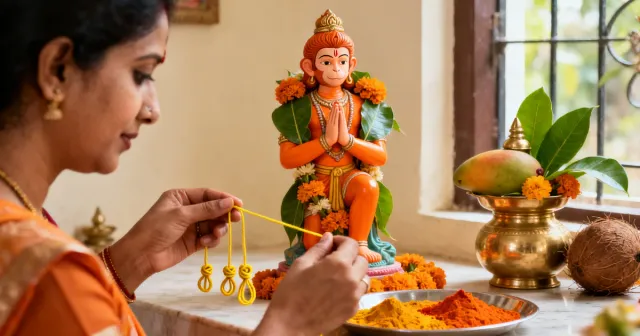
What to keep ready: a picture or murti of Hanuman (with Sri Rama, Sita and Lakshmana if you have one), a lamp with ghee or sesame oil, betel leaves and nuts, tulasi, red or orange flowers, sindoor and sandal paste, a little butter, fruit, and vadais or another naivedya such as panakam or sweet pongal.
- Wake early. Bathe before dawn, during the brahma muhurtam (4:52 to 5:43 AM in Chennai) if you can, and wear clean clothes.
- Clean the puja space and draw a kolam at the doorstep, as on every Margazhi morning.
- Light the lamp and offer a short prayer to Ganesha first.
- Invite Sri Rama, then Hanuman. Hanuman is worshipped with his Lord, so offer flowers to Rama first.
- Offer sindoor, sandal paste, a betel-leaf or tulasi garland and flowers to Hanuman. Touch a little butter to the murti or picture if your family keeps vennai kappu.
- Offer the naivedya: vadais (or a vadai malai), fruit and panakam.
- Chant the Hanuman Chalisa once or more, or 108 repetitions of a Hanuman mantra such as Om Sri Anjaneyaya Namaha, or read a chapter of Sundara Kandam. The meaning of every verse of the Chalisa is in our guide to the Hanuman Chalisa.
- Do aarti with camphor and pray for courage, strength and a mind fixed on what is right.
- Share the prasadam with family and neighbours.
A well-known dhyana shloka to begin with:
मनोजवं मारुततुल्यवेगं जितेन्द्रियं बुद्धिमतां वरिष्ठम् । वातात्मजं वानरयूथमुख्यं श्रीरामदूतं शिरसा नमामि ॥
manojavaṃ mārutatulyavegaṃ jitendriyaṃ buddhimatāṃ variṣṭham vātātmajaṃ vānarayūthamukhyaṃ śrīrāmadūtaṃ śirasā namāmi
Meaning: I bow my head to Sri Rama’s messenger, who is as swift as the mind and as fast as the wind, master of his senses, greatest among the wise, son of Vayu and chief of the vanara army.
Fasting rules for Hanumath Jayanthi
- There is no single rule. Many devotees eat nothing until the puja is over; others take only fruit, milk and water through the day and break the fast in the evening.
- Food on the day is sattvic: no onion, garlic, meat, eggs or alcohol.
- Because it is Amavasai, families who offer tarpanam to their ancestors do it in the morning, then the Hanuman puja.
- Break the fast with the prasadam: vadai, panakam or a simple meal offered first to Hanuman.
- Children, the elderly, pregnant women and anyone unwell or on regular medication should not keep a strict fast. The prayer is the observance; the fast is a custom.
Keeping Hanumath Jayanthi with Deva AI
If you are far from your temple, or keeping the day for the first time, you can ask questions as you go. Deva AI is a free Android app that lets you talk to Hindu gods like Krishna, Shiva, Ganesha and Hanuman through AI conversations, in English, Hindi, Telugu, Tamil, Kannada and Malayalam. You can talk to Hanuman in Tamil or English about the story of his birth or a line of the Chalisa, light a virtual diya with the virtual pooja feature, and keep count of 108 repetitions with the japa counter. It is a companion inspired by scripture and tradition, not a replacement for your temple or family priest. Read more on what Deva AI is.
Frequently asked questions
When is Hanumath Jayanthi in 2027?
Tamil Hanumath Jayanthi is on Thursday, 7 January 2027, on Margazhi Amavasai. Drik Panchang for Chennai gives the Amavasai tithi from 11:13 PM on 6 January to 1:53 AM on 8 January IST. Because the festival follows the Tamil month of Margazhi, 2027 has a second one, on Monday, 27 December 2027.
Is Hanumath Jayanthi on Moolam star or on Amavasai?
Tradition holds that Hanuman was born on Margazhi Amavasai when the Moolam star was rising. Most years the two fall together. When they do not, the Amavasai day is taken. In January 2027 Moolam ends at 6:08 AM on 7 January, so the day is fixed by Amavasai, and some temples start the special abhishekam in the pre-dawn hours while Moolam is still current.
Why is Tamil Hanuman Jayanthi different from the North Indian date?
North India keeps Hanuman Jayanti on Chaitra Purnima (Tuesday, 20 April 2027), Karnataka keeps Hanumad Vratam on Margashirsha Shukla Trayodashi (22 December 2026), and Tamil Nadu keeps it on Margazhi Amavasai with Moolam. Each region follows its own tradition and calendar; none is wrong.
What is the vadai malai offered to Hanuman?
A vadai malai is a garland of fried urad dal vadais strung together and placed on Hanuman. At the Namakkal Anjaneyar temple a garland of 1,00,008 vadais is offered on Hanumath Jayanthi. Devotees also offer smaller vadai malais at home and in local temples.
Should I fast on Hanumath Jayanthi?
Fasting is a family custom, not a rule. Many devotees eat nothing until the morning or evening puja is over, or take only fruit, milk and water, and then eat a simple sattvic meal of the prasadam. The elderly, children, pregnant women and anyone on medication should keep the day through prayer alone.
Can I talk to Hanuman on Hanumath Jayanthi in Deva AI?
Yes. In Deva AI you can talk to Hanuman by text or voice, ask about the meaning of a Hanuman Chalisa verse or the story of his birth, offer a virtual pooja, and count 108 repetitions of a Hanuman mantra with the japa counter.