Hanuman Jayanti Kannada 2026: Hanumad Vratam on 22 December
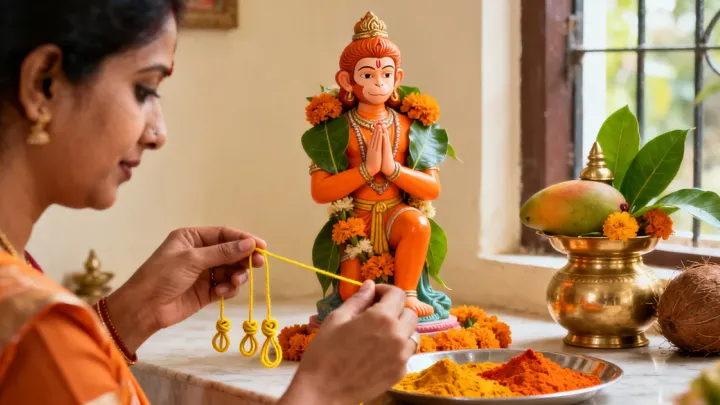
Quick answer
Hanuman Jayanti in Karnataka, also called Hanumad Vratam or Hanumath Vratha, falls on Tuesday, 22 December 2026 in India, on Margashirsha Shukla Trayodashi. The Trayodashi tithi runs from 5:36 PM on 21 December to 2:23 PM on 22 December IST, so the puja and the tying of the 13-knot thread are best done on the morning of the 22nd. In the USA and Canada the day falls on Monday, 21 December.
In many homes across Karnataka, and in parts of Telangana and Andhra Pradesh, Hanuman’s birthday comes not in spring but in the cold of December, with a yellow thread of thirteen knots. When is Hanuman Jayanti in Karnataka in 2026? Kannada Hanuman Jayanti, observed as Hanumad Vratam, is on Tuesday, 22 December 2026, on Shukla Trayodashi (the 13th day of the bright fortnight) of the month Margashirsha. The Trayodashi tithi runs from 5:36 PM on 21 December to 2:23 PM on 22 December IST, so the puja is best done on the morning of the 22nd. You will also see it written as Hanumath Vratha, Hanuman Vratham and Hanumantha Vrata.
Hanumad Vratam 2026 date and timings
| Detail | 2026 (India, IST) |
|---|---|
| Hanumad Vratam / Kannada Hanuman Jayanti | Tuesday, 22 December |
| Month and tithi | Margashirsha Shukla Trayodashi |
| Trayodashi tithi begins | 5:36 PM, Monday 21 December |
| Trayodashi tithi ends | 2:23 PM, Tuesday 22 December |
| Best time for puja and tying the thread | morning of 22 December, before 2:23 PM |
| Vaikuntha Ekadashi, two days earlier | Sunday, 20 December |
The tithi times are from Drik Panchang for Bengaluru and New Delhi, which give the same times. Local panchangas and your family priest may name a slightly different window; follow them where they differ. The next Hanumad Vratam is on Saturday, 11 December 2027.
Hanumad Vratam comes just after Vaikuntha Ekadashi. Some traditions count the days from Vaikuntha Ekadashi to Margashirsha Purnima as a five-day Panchaka observance in which Hanumad Vratam is the third day. Read more about that day in our guide to Vaikuntha Ekadashi 2026.
Hanumad Vratam 2026 outside India
The vrata is kept on the day the Trayodashi tithi is current at sunrise, so it moves by a day in the West.
| Country (city) | Date | Trayodashi tithi (local time) |
|---|---|---|
| India (Bengaluru) | Tuesday, 22 December | 5:36 PM, 21 Dec to 2:23 PM, 22 Dec |
| USA (New York) | Monday, 21 December | 7:06 AM, 21 Dec to 3:53 AM, 22 Dec |
| Canada (Toronto) | Monday, 21 December | 7:06 AM, 21 Dec to 3:53 AM, 22 Dec |
| UK (London) | Monday, 21 December | 12:06 PM, 21 Dec to 8:53 AM, 22 Dec |
| UAE (Dubai) | Tuesday, 22 December | 4:06 PM, 21 Dec to 12:53 PM, 22 Dec |
| Singapore | Tuesday, 22 December | 8:06 PM, 21 Dec to 4:53 PM, 22 Dec |
| Malaysia (Kuala Lumpur) | Tuesday, 22 December | 8:06 PM, 21 Dec to 4:53 PM, 22 Dec |
| Australia (Sydney) | Tuesday, 22 December | 11:06 PM, 21 Dec to 7:53 PM, 22 Dec |
Times are from Drik Panchang for each city. On the US West Coast the tithi starts at 4:06 AM on the 21st, so the date is also Monday, 21 December. Temples abroad sometimes hold the puja on the nearest weekend; check with yours.
Why is Hanuman Jayanti on different dates?
Hanuman’s birthday is kept on four different days in different parts of India. None is wrong; each region follows its own tradition and calendar.
| Tradition | Where | When | Next date |
|---|---|---|---|
| Hanuman Jayanti | North India and most of the country | Chaitra Purnima | Tuesday, 20 April 2027 |
| Hanuman Jayanti (end of the 41-day Deeksha) | Andhra Pradesh, Telangana | Vaishakha Krishna Dashami | Monday, 31 May 2027 |
| Hanumad Vratam | Karnataka, parts of Telangana and Andhra | Margashirsha Shukla Trayodashi | Tuesday, 22 December 2026 |
| Hanumath Jayanthi | Tamil Nadu | Moolam star in Margazhi | Thursday, 7 January 2027 |
Hanumad Vratam is less a birthday party than a vow. It is kept for the health and prosperity of the family and to remove obstacles, and many families keep it every year, passing the method from one generation to the next.
The story of Hanumad Vratam
The vrata story told in Madhva and other South Indian households is placed in the Mahabharata. It is attributed to the Bhavishyottara Purana, and versions differ from family to family.
During the Pandavas’ exile, the brothers asked Vedavyasa how to end their troubles. Vyasa told them that their suffering was linked to Arjuna’s pride: Arjuna had slighted Hanuman, who would later sit on the flag of his chariot. To win Hanuman’s grace, Vyasa taught them the Hanumad Vrata, to be kept on Margashirsha Shukla Trayodashi. Draupadi kept the vrata and wore the yellow thread of thirteen knots on her wrist. In one telling Arjuna mocked the thread, and the family’s troubles deepened until he repented and honoured Hanuman. Many families also believe Sri Rama himself kept the vrata to honour his devotee.
The lesson the story carries is simple: strength without humility fails, and Hanuman, the greatest of devotees, is approached with a bowed head. For more on who Hanuman is and why he is worshipped, see Who is Hanuman?.
What is the 13-knot thread (Hanumad dora)?
The thread is the heart of the vrata.
- Why 13 knots: the vrata falls on Trayodashi, the 13th tithi, so the thread is tied with 13 knots.
- What it is made of: a cotton thread, usually yellow or smeared with turmeric (arishina). Some families use a saffron or red thread.
- How it is used: it is placed before Hanuman and worshipped during the puja, then tied on the right wrist (some families tie it on the upper arm).
- Mantra while tying: many families chant Om Namo Vayunandanaya (“Om, salutations to the son of Vayu”) while tying it.
- How long it is worn: this varies by family. Some wear it until the next year’s vrata, some for a set number of days; ask your elders or priest.
How to do Hanumad Vratam at home: puja vidhi step by step
This is the common outline. Madhva, Smarta and Sri Vaishnava families add their own mantras, and a family priest’s method comes first.
- Prepare the day before. Clean the puja space, draw a rangoli and keep everything in the list below ready.
- Bathe early on 22 December, wear clean clothes and light the lamp.
- Sankalpa. Take a vow naming the day, the vrata and what you pray for.
- Ganapati puja. Begin with a short prayer to Ganesha.
- Kalasha and Pampa puja. Set up a kalasha of water with mango leaves and a coconut. In the traditional method the river Pampa, near Hanuman’s Kishkindha, is invoked in the kalasha; some families also place a cloth soaked in kumkum water on it.
- Worship Hanuman with Sri Rama. Place a picture or murti of Hanuman, ideally with Rama, Sita and Lakshmana, and offer the sixteen upacharas (shodashopachara) as you are able: water, sandal paste, sindoor, flowers, betel leaves, tulsi and incense.
- Worship the 13-knot thread placed before Hanuman with turmeric, kumkum and flowers.
- Chant. Recite the Hanuman Chalisa, a Hanuman mantra or chapters of the Sundara Kanda, and read the vrata story.
- Naivedya and aarti. Offer fruit, jaggery sweets, vada or whatever your family makes, then perform aarti.
- Tie the thread on the wrist with the mantra.
- Give. Many families give vayana (an offering of fruit, betel and sweets) to a married woman or a priest, and donate wheat or food to the poor.
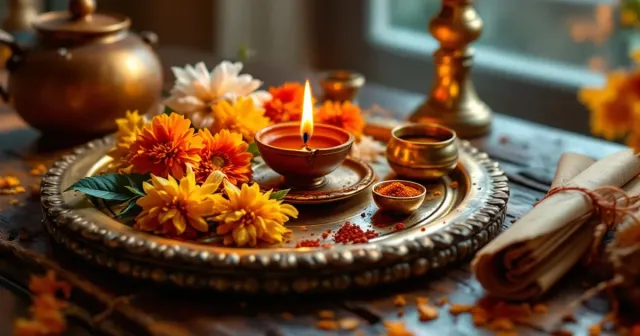
What to keep ready: a picture or murti of Hanuman (with Sri Rama if possible), a kalasha with mango leaves and a coconut, a yellow thread with 13 knots, turmeric, kumkum, sindoor, sandal paste, betel leaves and nuts, tulsi, flowers (marigold and red flowers are traditional for Hanuman), a lamp with ghee or oil, incense, fruit and the naivedya.
A shloka to chant on Hanumad Vratam
This well-known dhyana shloka of Hanuman is chanted before the puja in many homes:
मनोजवं मारुततुल्यवेगं जितेन्द्रियं बुद्धिमतां वरिष्ठम् । वातात्मजं वानरयूथमुख्यं श्रीरामदूतं शिरसा नमामि ॥
manojavaṃ mārutatulyavegaṃ jitendriyaṃ buddhimatāṃ variṣṭham vātātmajaṃ vānarayūthamukhyaṃ śrīrāmadūtaṃ śirasā namāmi
Meaning: I bow my head to Sri Rama’s messenger, who is as swift as the mind and as fast as the wind, master of his senses, greatest among the wise, son of Vayu and chief of the vanara army.
You can count 108 repetitions of this shloka or of Om Namo Vayunandanaya with the japa counter in Deva AI.
Fasting rules for Hanumad Vratam
- There is no single rule. Many devotees eat nothing until the puja is over; others take only fruit and milk, or one sattvic meal.
- Food on the day is simple: no onion, garlic, meat, eggs or alcohol.
- Since Trayodashi ends at 2:23 PM IST on 22 December, most families finish the puja in the morning and eat after offering naivedya.
- Children, elders, pregnant women and anyone who is unwell or on regular medication should not keep a strict fast. The puja and the thread are the vrata; the fast is a custom.
Where is Hanumad Vratam celebrated in Karnataka?
Hanuman temples across Karnataka hold special pujas on the day, and it is widely kept in Madhva homes and mathas. Anjanadri hill near Hampi, in the region traditionally identified with the Ramayana’s Kishkindha, is believed by many to be Hanuman’s birthplace and draws pilgrims through the season. Timings for special pujas change every year, so check with the temple before you travel. You can also read this guide in Kannada: ಹನುಮ ಜಯಂತಿ 2026: ಹನುಮದ್ವ್ರತ ಪೂಜಾ ವಿಧಾನ, and in Telugu: హనుమద్వ్రతం 2026: పూజా విధానం, 13 ముడుల తోరం.
Keeping the vrata with Deva AI
If you are far from home or keeping the vrata for the first time, you can ask questions as you go. Deva AI is a free Android app that lets you talk to Hindu gods like Krishna, Shiva, Ganesha and Hanuman through AI conversations, in English, Hindi, Telugu, Tamil, Kannada and Malayalam. You can talk to Hanuman about the meaning of the vrata or a verse of the Chalisa, light a virtual diya with the virtual pooja feature, and keep count of your japa. It is a companion inspired by scripture and tradition, not a replacement for your family’s priest. Read more on what Deva AI is.
Frequently asked questions
When is Hanuman Jayanti in Karnataka in 2026?
Hanuman Jayanti as observed in Karnataka, called Hanumad Vratam, is on Tuesday, 22 December 2026. It falls on Shukla Trayodashi of the month Margashirsha, which runs from 5:36 PM on 21 December to 2:23 PM on 22 December IST.
Why are there different Hanuman Jayanti dates?
Regions follow different traditions. North India marks Hanuman Jayanti on Chaitra Purnima (2 April in 2026), Telugu states keep a 41-day Deeksha ending on Vaishakha Krishna Dashami (12 May in 2026), Tamil Nadu celebrates Hanumath Jayanthi on Moolam star in Margazhi (7 January 2027), and Karnataka keeps Hanumad Vratam on Margashirsha Shukla Trayodashi (22 December 2026).
Why does the Hanumad Vratam thread have 13 knots?
The vrata falls on Trayodashi, the 13th day of the lunar fortnight, so the thread (dora) has 13 knots. It is usually a yellow thread smeared with turmeric, worshipped during the puja and tied on the right wrist, commonly with the mantra Om Namo Vayunandanaya.
What is Hanumad Vratam in the USA in 2026?
In the USA and Canada Hanumad Vratam falls on Monday, 21 December 2026, because the Trayodashi tithi starts at 7:06 AM Eastern Time that day and ends before sunrise on the 22nd. In the UK it is also Monday, 21 December; in Singapore, Malaysia, the UAE and Australia it is Tuesday, 22 December.
Do I have to fast on Hanumad Vratam?
Fasting is a family custom, not a rule. Many devotees eat nothing until the puja is over, or take only fruit and milk, and eat a simple sattvic meal after offering naivedya. Anyone who is unwell, pregnant, elderly or on medication can keep the vrata through the puja alone.
Can I talk to Hanuman about the vrata in Deva AI?
Yes. In Deva AI you can talk to Hanuman by text or voice about the meaning of the vrata, ask about a line of the Hanuman Chalisa, and count your japa of a Hanuman mantra with the japa counter.