Subramanya Shashti 2026: Date (15 Dec), Timings & Puja Vidhi
Quick answer
Subramanya Shashti 2026, also called Champa Shashti or Kukke Shashti, falls on Tuesday 15 December 2026, the Shukla Shashti of Margashirsha. In New Delhi the Shashti tithi runs from 7:15 PM on 14 December to 9:19 PM on 15 December. Devotees fast, worship Subrahmanya (Murugan, Kartikeya) with milk and flowers, and many offer naga dosha prayers; Kukke Subramanya in Karnataka holds its chariot festival on this day.
Subramanya Shashti 2026 falls on Tuesday, 15 December 2026. It is the Shukla Paksha Shashti (sixth day of the bright fortnight) of Margashirsha, a day for Lord Subrahmanya, the god Tamil devotees call Murugan and North India knows as Kartikeya or Skanda. In New Delhi the Shashti tithi begins at 7:15 PM on Monday 14 December and ends at 9:19 PM on Tuesday 15 December 2026 (Drik Panchang). Because Shashti is present at sunrise on the 15th, that is the festival day across India. Telugu readers can read this guide in their own language: సుబ్రహ్మణ్య షష్ఠి 2026.
The same day is called Champa Shashti (Champa Shashthi), Kukke Shashti and Margashirsha Skanda Shashti. Below are the timings, the meaning of the day, what happens at Kukke Subramanya, how to do the puja and fast at home, and the story behind it.
When is Subramanya Shashti 2026? Date and tithi timings
| Detail | 2026 |
|---|---|
| Festival | Subramanya Shashti / Champa Shashti / Kukke Shashti |
| Date in India | Tuesday, 15 December 2026 |
| Tithi | Margashirsha Shukla Shashti |
| Shashti tithi begins | 7:15 PM, Monday 14 December (IST) |
| Shashti tithi ends | 9:19 PM, Tuesday 15 December (IST) |
| Previous day | Panchami, 14 December (many devotees start the fast here) |
| Date in some US calendars | Monday, 14 December |
Timings are for New Delhi from Drik Panchang. The start and end of a tithi happen at the same instant everywhere, so in any Indian city the IST times are the same; only sunrise and sunset differ. Temples such as Kukke Subramanya announce their own schedule, so check the temple notice if you plan to travel.
Why do some calendars say 14 December?
A festival day is usually the day on which the tithi is present at sunrise. In India, Shashti begins in the evening of the 14th, so the 15th is the sunrise day. In US time zones the tithi begins on the morning of 14 December (local time), which is why some American and Canadian calendars list Monday, 14 December. If you live outside India, follow your local temple.
What is Subramanya Shashti?
Shashti, the sixth lunar day, is sacred to Subrahmanya. Every month’s Shukla Shashti is kept as a small vrat (Skanda Shashti), but two are the great ones:
- Kanda Sashti in the Tamil month of Aippasi (October-November), a six-day festival ending in Soorasamharam, the victory of Murugan over the asura Surapadman. In 2026 that fell on 15 November; see our Kanda Sashti 2026 guide.
- Subramanya Shashti in Margashirsha (November-December), one lunar month later, the subject of this page.
In Karnataka, Andhra Pradesh and Telangana, Subramanya Shashti is the bigger of the two. Families with a Subrahmanya kshetra in their tradition visit the temple, many parents keep the fast for the welfare of their children, and many people pray for relief from naga dosha.
Why is Subrahmanya worshipped for naga dosha?
Subrahmanya is closely linked with serpents in Karnataka and Andhra. At Kukke, the temple’s story says the serpent king Vasuki did penance in the caves there to escape Garuda, the eagle who hunts snakes. Subrahmanya appeared, blessed him and promised to stay in that place to protect him. That is why he is worshipped together with the nagas at Kukke, and why devotees who believe they carry sarpa dosha (often attributed to harm done to snakes in this life or a past one) pray to him.
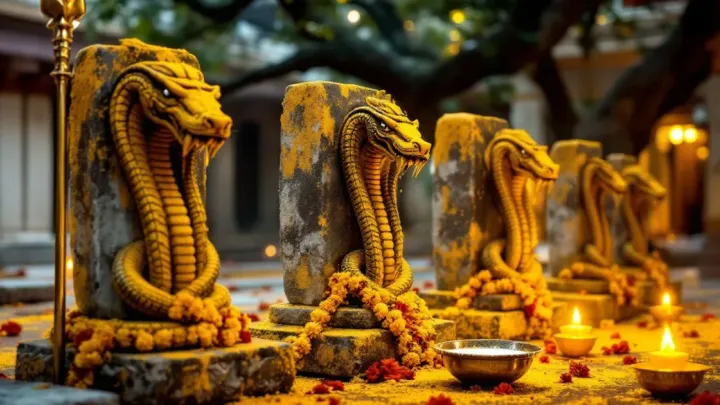
On Subramanya Shashti many families also visit a naga stone (nagakal) under a peepal or banyan tree, pour milk over it and decorate it with turmeric, kumkum and flowers.
What happens at Kukke Subramanya on Champa Shashti?
Kukke Subramanya Temple stands in Subramanya village in Dakshina Kannada district, Karnataka, at the foot of the Western Ghats beside the Kumaradhara river. It is the best-known temple for this festival.
- The annual car festival (rathotsava) is held around Champa Shashti, with special pujas to the deity.
- Naga dosha sevas such as Sarpa Samskara and Ashlesha Bali are performed at Kukke throughout the year and are much in demand around Shashti. Book through the temple’s own office or website, and expect large crowds.
- The Devasena wedding: temple tradition holds that after his victory over Tarakasura, Kumaraswamy (Subrahmanya) married Devasena, Indra’s daughter, on Margashirsha Shukla Shashti at Kumara Parvatha, the peak above Kukke. Tellings differ on the place, but the date is why this Shashti is so festive there.
Champa Shashti in Maharashtra: Khandoba of Jejuri
In Maharashtra the same tithi is Champa Shashti, but the deity is Khandoba (Martanda Bhairava), a form of Shiva worshipped as the family god of many Marathi households. Khandoba’s festival runs for six days from Margashirsha Shukla Pratipada and ends on Champa Shashti, celebrating his victory over the demons Mani and Malla. The temple at Jejuri near Pune is the centre, with turmeric (bhandara) thrown in the air by devotees. Maharashtra’s tourism listing gives 15 December 2026 for the Jejuri festival day. If your family keeps Khandoba’s Champa Shashti, the date is the same as Subramanya Shashti.
How do you do Subramanya Shashti puja at home?
Customs vary by family and region. A simple home puja on 15 December:
- Begin the fast. Many devotees eat a light meal on Panchami (14 December) and fast on Shashti until the puja. Take a bath at sunrise and wear clean clothes.
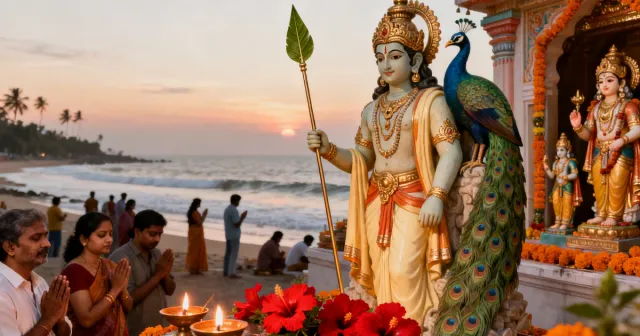
- Set up the altar. Place a picture or murti of Subrahmanya (Murugan with his vel and peacock), or a vel alone. Some families also place a small silver or brass naga.
- Light the lamp. A ghee or sesame oil lamp, with incense.
- Abhishekam. Pour milk over the murti, vel or naga, then water; wipe and apply sandal paste, turmeric and kumkum.
- Offer flowers. Red flowers such as oleander and hibiscus, and jasmine, are common.
- Chant. Repeat the six-syllable mantra Om Saravanabhava (or Om Sharavanabhavaya Namah) 108 times, then any stotra you know, such as the Subrahmanya Ashtakam or Skanda Shashti Kavacham.
- Naivedya. Offer milk, banana, jaggery, panchamritam or a sweet like payasam.
- Aarti and prayer. Wave camphor and pray for your children, health and freedom from naga dosha.
- Break the fast after the evening puja with a satvik meal, or the next morning on Saptami, as your family does.
If you can visit a temple, many devotees go for darshan in the morning and keep the home puja for the evening.
What to prepare
| Item | Use |
|---|---|
| Picture or murti of Subrahmanya, or a vel | Altar |
| Milk, water, panchamritam | Abhishekam |
| Turmeric, kumkum, sandal paste | Decoration |
| Red flowers, jasmine, a small garland | Offering |
| Ghee or sesame oil lamp, camphor, incense | Lamp and aarti |
| Banana, jaggery, payasam | Naivedya |
| A mala of 108 beads (or a japa counter) | Mantra chanting |
What are the fasting rules for Subramanya Shashti?
- Full fast: no food until the evening puja; water, milk and fruit if needed.
- Partial fast (ekabhukta): one satvik meal during the day.
- Avoid: onion, garlic, meat, eggs, fish and alcohol for the day.
- Health first: pregnant women, elders and anyone on medication should keep a light fast or none. Devotion is in the intention, not in going hungry.
Which mantras are chanted on Subramanya Shashti?
| Mantra | Meaning |
|---|---|
| Om Saravanabhava | The six-syllable mantra: “Om, to the one born in the Saravana reed pond” |
| Om Sharavanabhavaya Namah | The same, as a salutation |
| Om Tatpurushaya Vidmahe, Mahasenaya Dhimahi, Tanno Shanmukha Prachodayat | Subrahmanya Gayatri: “May we know the Supreme Being; may we meditate on the great commander; may the six-faced one inspire us” |
| Om Subrahmanyaya Namah | Simple salutation for 108 repetitions |
The story of Subrahmanya Shashti
The asura Tarakasura won a boon that only a son of Shiva could kill him. Shiva was then lost in meditation after the death of Sati, and the devas suffered. Through Parvati’s devotion and penance Shiva married again, and from his energy came six sparks that the river carried to the Saravana pond. There they became six babies, cared for by the six Krittika stars. Parvati embraced them and they became one child with six faces, Shanmukha, also called Kartikeya after the Krittikas.
Made commander of the gods (Devasenapati), the young Skanda received the vel, the divine spear, and defeated Tarakasura. Tradition in Karnataka holds that afterwards he came to Kukke and married Devasena on Margashirsha Shukla Shashti, and that he stayed there as the protector of Vasuki. Read more in the story of Murugan and the meaning of his vel, and for a lighter tale, Ganesha and Murugan’s mango story.
Celebrating with Deva AI
Deva AI is a free Android app that lets you talk to Hindu gods like Krishna, Shiva, Ganesha and Hanuman through AI conversations, in English, Hindi, Telugu, Tamil, Kannada and Malayalam. Murugan is one of its ten deities, so on Subramanya Shashti you can ask the Murugan companion about the story of the vel or how to keep the fast. It is a companion inspired by scripture and tradition, not a priest or a substitute for your temple.
You can count Om Saravanabhava on the app’s japa counter and light a diya in the virtual pooja if you are away from home. Deva AI is free to download and use, with a free daily message quota. Read what Deva AI is to learn more. Kannada readers can also read this guide in Kannada: ಸುಬ್ರಹ್ಮಣ್ಯ ಷಷ್ಠಿ 2026.
Quick checklist for 15 December 2026
- Shashti tithi: 7:15 PM on 14 December to 9:19 PM on 15 December (IST).
- Light meal on Panchami, fast on Shashti until the evening puja.
- Milk abhishekam to Subrahmanya, his vel or a naga stone.
- Chant Om Saravanabhava 108 times.
- Visit Kukke Subramanya or your nearest Subrahmanya temple if you can, and check the temple’s own schedule first.
Frequently asked questions
When is Subramanya Shashti in 2026?
Subramanya Shashti 2026 is on Tuesday, 15 December. The Shashti tithi begins at 7:15 PM on 14 December and ends at 9:19 PM on 15 December (New Delhi times from Drik Panchang), so 15 December, when Shashti is present at sunrise, is the festival day in India.
Is Subramanya Shashti the same as Champa Shashti?
They fall on the same tithi, the Shukla Shashti of Margashirsha. In Karnataka and parts of Andhra Pradesh and Telangana it is Subramanya Shashti, honouring Murugan. In Maharashtra, Champa Shashti closes the six-day festival of Khandoba, a form of Shiva, at Jejuri. In Karnataka the day is also called Champa Shashti.
Is Subramanya Shashti the same as Kanda Sashti?
No. Kanda Sashti is the six-day Tamil festival in Aippasi (October-November) that ends with Soorasamharam; in 2026 Soorasamharam fell on 15 November. Subramanya Shashti comes one lunar month later, in Margashirsha (December).
What is the date of Subramanya Shashti in the USA?
In US time zones the Shashti tithi starts on the morning of 14 December, so some American calendars list Monday, 14 December. Follow your temple, because each one decides by its local panchang.
Why do people do naga dosha puja on Subramanya Shashti?
Subrahmanya is believed to protect the serpent king Vasuki, so he is worshipped for relief from sarpa dosha or naga dosha. Kukke Subramanya in Dakshina Kannada is the best-known temple for these prayers, with sevas such as Sarpa Samskara and Ashlesha Bali.
What do you eat on the Subramanya Shashti fast?
Many devotees fast until the evening puja and then eat a simple satvik meal. Others take fruit, milk and water during the day. Onion, garlic, meat and alcohol are avoided, and anyone with a health condition can keep a lighter fast.